
After a GDPR readiness assessment, check one personal-data flow in the report against the live system. In 2020, the ICO issued a penalty notice to Ticketmaster UK following its 2018 payment-page chatbot breach. The notice describes supplier assurances that did not establish security for that deployment. This is an operational analogy, not evidence that Ticketmaster completed a readiness assessment. It shows why the next decision needs a specific processing scope.
A GDPR readiness assessment reviews an organization's arrangements against applicable data protection requirements and identifies gaps requiring action.
GDPR readiness findings cover different processing decisions
A readiness report can bring scattered work into one place. It can identify missing records and unclear supplier obligations. Assigning owners helps turn findings into work that somebody can complete. A dated action plan also gives management a way to see which gaps remain unresolved.
Ask each action owner what will show that the work is complete. An updated policy might need approval before staff can use it. A changed access setting needs a check in the relevant service. Record that evidence beside the action so the sign-off does not depend on somebody remembering the conversation.
Keep the assessment's legal scope visible. Check whether it addresses EU GDPR or UK GDPR, and which operations it includes. A report for one business unit may not describe another unit's systems. The word “ready” should therefore refer to stated activities, rather than imply that every use of personal data has been approved.
The ICO's accountability guidance explains the responsibility to comply and demonstrate compliance. A readiness plan can help organize that evidence. Completing the plan is useful, but a completion status needs a defined claim: what arrangement was checked, and for which processing?
Read the findings beside the actual data flows. Where an action says “update supplier agreement,” identify the supplier service and the information it handles. Where an action says “review retention,” identify the system holding those records. Close a defined gap in a defined operation.
Readiness action plan
- Assign owners to the report findings.
- Record completion against each action.
- Use a general supplier assurance.
Processing decision
- Name the data flow being permitted.
- Check the deployed supplier access.
- State the conditions for continuing processing.
The comparison shows two connected tasks. The action plan organizes corrective work. The processing decision states what the organization intends to permit after that work. Without the second task, a completed document can be applied to a deployment it was never intended to cover.
This is a problem of governance and compliance as well as documentation. The organisational governance question is who decides whether the particular activity proceeds. Name that activity before asking someone to approve readiness.
The GDPR readiness report lists work to finish. Define the processing decision that those actions are meant to support. Start the Walk →
Which processing would the readiness plan permit?
Choose one flow connected to a proposed launch or supplier change. Follow it from collection to its destination. Identify the personal data involved and the stated purpose. Compare the live service with the report. A discrepancy is a reason to examine that flow before relying on the completion status.
Keep the check small enough to finish. The first task is not to repeat the whole assessment. It is to find whether one important report claim matches the operation about to proceed. If the report states that a supplier cannot access certain information, inspect the deployed access rather than accepting that statement again.
Preserve any mismatch in the record. It may show that the report needs correction or that the service needs to change. Decide which before closing the action. Silently updating the description to match the deployment can remove the finding without addressing the reason that it mattered.
Then separate organizational readiness from a Data Protection Impact Assessment. ICO DPIA guidance describes a process for assessing a project or processing operation. It focuses on risks to people's rights and freedoms. A general readiness checklist cannot replace a required assessment of the proposed processing.
That distinction changes the framing. “Can the readiness report be signed?” asks about a document. “Can this supplier receive these records for this purpose?” asks about an activity affecting people. The second question makes the required evidence more specific. The decision concerns processing, not the report's status.
Which live data flow would this readiness sign-off allow to continue?
A hypothetical change makes the distinction concrete. A supplier previously used for general enquiries is proposed for a page where users enter sensitive information. The existing supplier record may remain accurate about the earlier use. It may provide little evidence about the proposed deployment. This example is a proposed check, not an additional real case.
Identify the affected person's interest as well as the operational benefit. A plan written only around finishing the launch can miss an alternative that collects less data. It can also miss the option of changing the supplier's access. Naming the underlying assumptions helps expose those options before the project has committed to its original design.
Ask the accountable decision maker to review the flow and any discrepancy. Decision rights matter here because a report owner may lack authority to alter the service. Put the processing choice with someone who can change it.
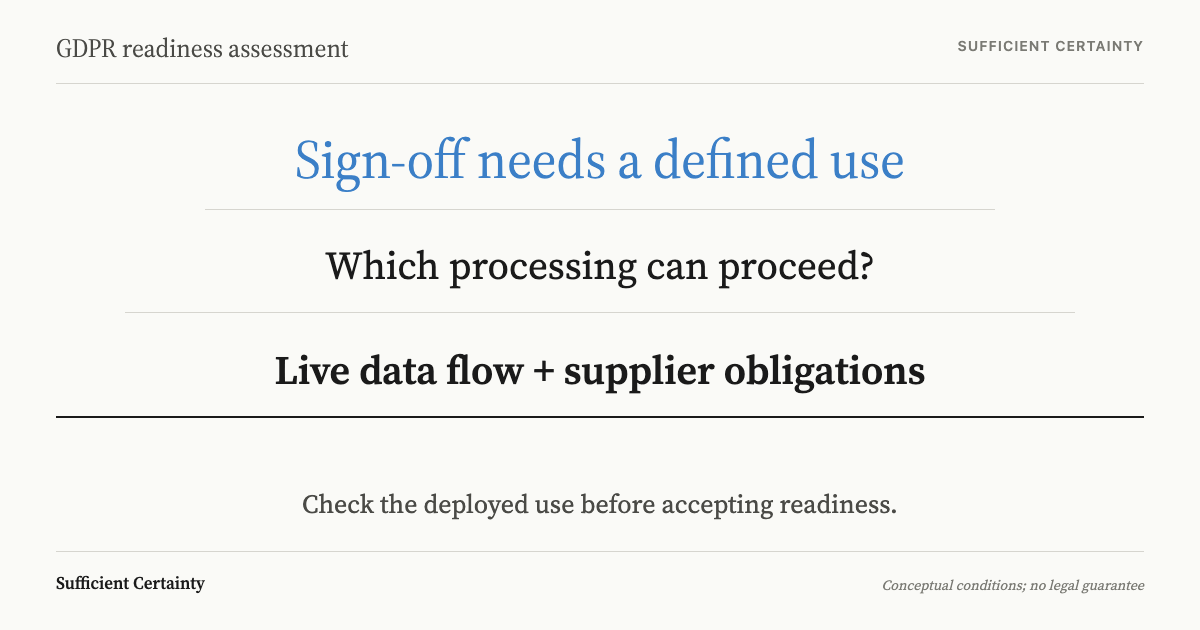
Ticketmaster: supplier assurances and processing responsibility
The ICO's November 2020 penalty notice concerns Ticketmaster UK's Inbenta chatbot deployment. It does not establish completion of a formal GDPR readiness assessment.
Paragraph 3.48.1 says no risk assessment was performed when the chatbot entered the payment environment. Paragraph 3.48.2 records that the Inbenta contract lacked specific provisions concerning payment-card security. The notice also says Ticketmaster lacked the required annual program for monitoring supplier PCI-DSS compliance.
Paragraph 6.22.2 records that the most recent completed periodic supplier security vetting at the breach's start dated from 2013. Paragraph 6.22.3 gives little weight to Inbenta's security certifications as evidence of chatbot security in those circumstances. That finding does not say that all security certifications are worthless.
Paragraph 6.22.4 does not treat a missing business-requirement document as a GDPR breach in every case. That finding concerns this deployment. No claim about a later appeal outcome is made here.
The proposed practice is to trace the service before treating a supplier assurance as evidence for it. This keeps the review tied to the actual use. It gives the decision maker a concrete discrepancy to resolve, rather than a general request for another supplier document.
The operational analogy is specific. A supplier assurance can describe the supplier without establishing whether its software is suitable for a particular page. The proposed readiness check asks whether the live data flow is covered by the evidence being used to permit it. Check suitability for the actual processing.
The ICO's controller and processor contract guidance distinguishes the parties' responsibilities. A supplier relationship belongs in the processing decision, not only the procurement file. The relevant question is whether the obligations and working arrangements address what that supplier will actually do.
Set conditions for the processing before clearing the plan
Bring the checked flow to the person making the processing decision. State what can proceed and what must change first. A general readiness approval should not hide an unresolved condition for a particular service. Make the permitted scope explicit.
The Universal Decision-Making Method can structure that decision. It does not replace applicable legal requirements or a required DPIA. Use its five steps to connect the readiness findings to the proposed operation:
- Frame. State the purpose of the processing and whose interests it affects. Identify the decision maker and the activity being considered.
- Tentative Elements. Identify workable options. These may include changing supplier access or reducing the data collected, rather than continuing the original design.
- Assumptions. Name the conditions on which the selected option depends. Check the live data flow against the supplier's documented obligations.
- Sufficient Certainty. Decide what evidence is sufficient for the operational commitment while meeting applicable requirements. A confidence judgment cannot remove a legal obligation.
- Implement+Monitor. Assign the required changes. State which change in processing or supplier access would require the decision to be reviewed.
Keep the evidence and conditions in a decision record. If a supplier's software changes, check whether the approved flow still describes the service. If the processing purpose changes, return to the decision before using the old readiness status to justify the new activity.
Retain unresolved legal questions beside the relevant operation. Route them to the responsible privacy specialist before clearing that operation. A dated assessment remains evidence of what was reviewed at that time. It does not guarantee continuing compliance after the system or its use changes.
You could close every GDPR readiness action and still leave a supplier deployment outside the scope of the evidence checked.
Work through your decisionNo sign-up. Just pick your decision and start.
Grant Purdy is the co-author, with Roger Estall, of Deciding (2020), and the architect of the Universal Decision-Making Method.