
After a human factors analysis, observe a safe walkthrough of the highest-consequence redesigned task with its operators using the staffing and interface planned for actual work. A recommendation can reach approval with a new procedure attached and no evidence that people can perform it in the time available. Test that fit before accepting the design.
Human factors analysis examines how task design, work conditions, and human capabilities affect performance and the potential for failure.
Human factors findings identify demands within a task
A completed analysis should describe how people carry out the task and which conditions make failure more likely. It can identify demands created by the interface or the working environment. That information gives the design team a basis for changes beyond a general instruction to pay more attention.
The acceptance decision concerns a redesigned task that people can actually perform.
The HSE guidance on human factors in risk assessment calls for understanding tasks where they are carried out and involving the workforce. It also calls for checking that controls work. Preserve that direct connection to the work when converting findings into design changes.
Keep each recommendation beside the task demand it addresses. A changed display should help the operator obtain information needed for an action. A revised allocation of duties should resolve a specific conflict in the work. If the recommendation only says “retrain,” ask which design demand remains after training is complete.
These are illustrative perspectives for an acceptance review. They are not reported comments from the case below. Ask the actual people in those roles to identify the evidence they need. A design can meet a written requirement while leaving a practical conflict between tasks unresolved.
Frame the problem around the work demand before selecting another training action.
The wider risk assessment should retain the consequence of a failed task. Use that consequence to decide which redesign deserves the closest examination. The analysis should help the approving manager ask a specific question about the changed work, rather than approve every recommendation as a single package.
Can the redesigned task work with the actual staffing?
Check the task under the staffing and interface conditions proposed for use. Record what the operator must notice and what action must follow. Identify any competing activity at the same time. Ask whether the plan assumes another person is available when that person is already assigned elsewhere.
Available staff and available time are part of the design being accepted.
The HSE workload guidance says workload should be assessed when tasks, equipment, systems, or responsibilities change. It also emphasizes the whole team and unusual operating conditions. A review of normal work alone can miss the demand created when several actions become necessary together.
Use a safe walkthrough, mock-up, or simulation appropriate to the task. Have a competent person plan the examination. Do not recreate a dangerous condition in live operations. The aim is to learn whether the changed arrangement supports performance, not to expose people to the event the analysis is meant to prevent.
A useful task test observes what the design allows the operator to notice and do.
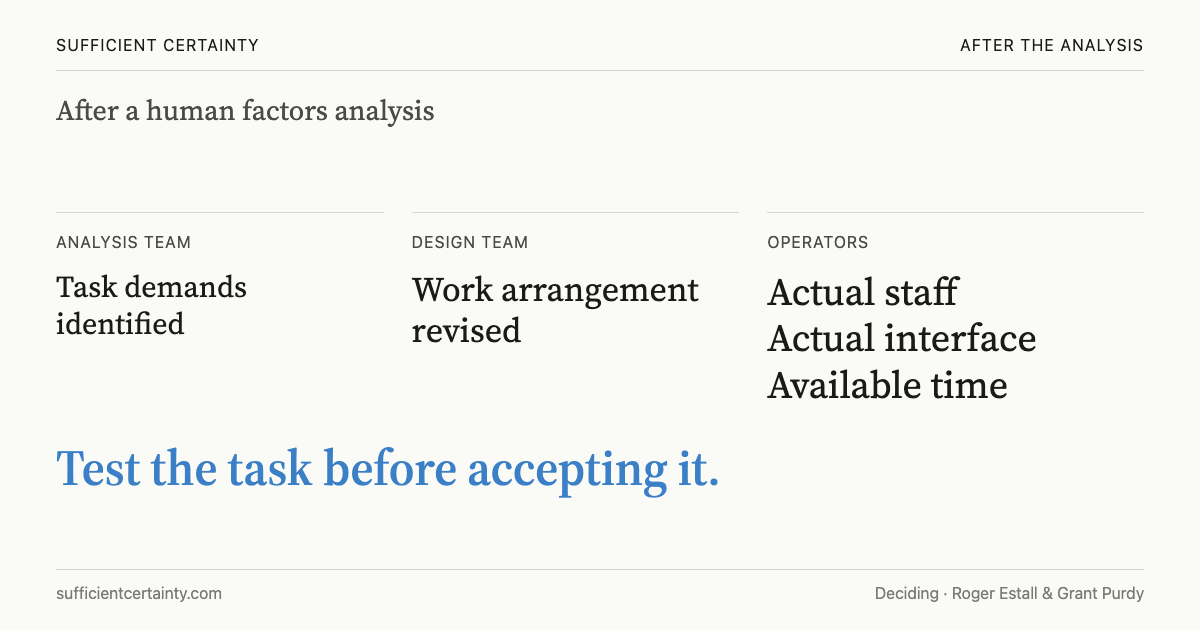
Ask the operator to use the proposed information and controls. Observe whether the required cue can be found while other duties continue. Record where the person must stop another task, ask for help, or supply information from memory. Those observations reveal demands the design review must resolve.
Agree the acceptance basis before the walkthrough. Specify the task conditions and the result that would justify relying on the redesign. Where time matters, the responsible specialist should establish the requirement and a suitable way to examine it. Do not invent a generic completion time or pass rate for unrelated tasks.
This differs from verifying a causal explanation after root cause analysis. The question is whether the proposed work arrangement can be performed, even when no incident has occurred. It also differs from permission to resume after a near miss. The checkpoint here accepts or rejects the redesigned task itself.
State consequential assumptions about the work in the acceptance record. This lets the reviewer check whether staffing and task timing were supported by observation.
Can the revised task be performed with the staff and time actually available? Start the Walk →
Royal Majesty’s bridge concealed important mode information
The passenger ship Royal Majesty grounded on June 10, 1995. The NTSB investigation report found that important navigation mode information was unavailable at the central console and warnings were inadequate. It also found that training did not prepare officers for malfunctions and that the integrated bridge system inadequately incorporated human-factors engineering.
This was a retrospective investigation. It does not establish that a completed human factors analysis had been ignored before the accident. Its relevance here is analogous: an operator can be expected to respond to a condition without receiving a sufficiently clear cue through the installed interface.
Royal Majesty’s findings connect operator performance with the information the system made available.
The report should not be reduced to a lesson about individual vigilance. The official findings include design and training issues together. The proposed acceptance procedure asks a different, forward-looking question: can operators detect the relevant condition and perform the required response using the revised arrangement?
A team applying that question to a redesigned task should examine the whole information path. Identify where a condition is detected, where its meaning appears, and who must respond. A technically accurate status on a remote component may not help the person making the next action at the working position.
If the operator misses the cue during the walkthrough, record the conditions before explaining it as inattention. Determine whether the cue was available and distinguishable while other task demands continued. Then consider whether changing the interface or allocation of work would address the problem more directly.
The boundary matters when drawing lessons from investigations. The work after a near-miss investigation examines a control before authorizing the same activity. Here, the evidence is about whether a proposed task design fits its users and work conditions. Keep that decision clear when accepting the redesign.
Test the revised task before accepting its design
Write one acceptance record for the changed task before approving its use. Identify the task revision, staffing, interface, and operating conditions examined. State who participated and what was observed. Keep unresolved conflicts visible to the person responsible for approving the design.
Approval should describe the task conditions the evidence actually supports.
Include people who understand the intended work, rather than only the people who developed the recommendation. Record any difference between their usual conditions and the test arrangement. If extra assistance made the task possible, that assistance becomes part of the acceptance question. Do not omit it from the proposed staffing basis.
The Universal Decision-Making Method begins by clarifying the decision and its purpose. Here the decision is whether to accept a particular work arrangement. The analysis informs that choice. The test supplies evidence about whether the arrangement can achieve its purpose under the conditions people will encounter.
The question of having enough information to decide should be answered for this task and its consequence. Keep that basis visible when the redesign is approved.
When the test exposes a conflict, assign the design change needed to resolve it. Determine whether the affected task can be restricted while that work proceeds. A statement that the operator will be reminded does not resolve a demonstrated conflict between simultaneous duties. Ask the design owner to explain how the revised arrangement removes it.
An accepted design needs review when the work conditions supporting acceptance change.
Name the relevant change triggers. Reduced staffing, added duties, or another interface change can affect the earlier result. Select the triggers from the accepted task conditions and connect them to existing change management. The work on monitoring decisions explains why each signal needs a responsible person and a response.
Keep the test record accessible to the people planning later changes. They should see which staffing assumption or interface feature supported acceptance. A later modification can then be checked against actual evidence, rather than the memory that the task was “human-factors reviewed.”
The immediate result is a defensible decision about the redesigned task. It identifies the working conditions examined and the evidence accepted. Where performance remains uncertain, the record states what must change before approval. The analysis has then produced a task decision that the organization can explain and revisit.
A human factors recommendation needs operator evidence before its task design is accepted.
Work through your decisionNo sign-up. Just pick your decision and start.
Grant Purdy is the co-author, with Roger Estall, of Deciding (2020), and the architect of the Universal Decision-Making Method.