
After completing a risk register, take one high-risk row to the person who can approve its next action. In March 2023, the National Audit Office reported about £2 billion spent on the Emergency Services Network since 2015, while a functioning replacement remained distant. The funding concern was already recorded.
A risk register records identified risks, their assigned owners and planned responses. It provides a shared record for reviewing those risks.
A completed register makes concerns visible
The register is complete when the workshop ends, but the work it records usually continues. Owners review entries. Teams carry out planned mitigation. Managers receive updates and consider whether any concern needs escalation. The useful next step is to connect this routine to an actual choice that someone must make.
Begin with a row linked to a commitment that is coming up. Read its proposed mitigation alongside the approval that depends on it. Keep the existing description and rating available. The purpose is to use the completed register, rather than repeat the assessment that produced it.
Name the pending decision. A row about insufficient funding should connect to a choice about committing expenditure or changing the work. “Monitor funding” leaves that choice unstated. Write the choice beside the row, then find the person whose approval allows it to proceed.
The Orange Book calls for treatment plans to identify approval responsibilities and resources, with arrangements for monitoring effectiveness. Applying this to a completed register means checking what happens after an owner submits an update. Someone must be able to use the information to change the proposed action.
| Row review | Mitigation evidence missing | Mitigation evidence available |
|---|---|---|
| Approver identified | Ask for evidence before approval | Approver reviews the evidence |
| Approver missing | Find the approver and evidence | Send evidence to the authorized approver |
This is a schematic for reviewing a row, not another risk score. It classifies two observable gaps: missing approval authority and missing evidence. The wider risk assessment process still matters, but neither gap disappears because a rating has been agreed.
Why is an assigned owner useful?
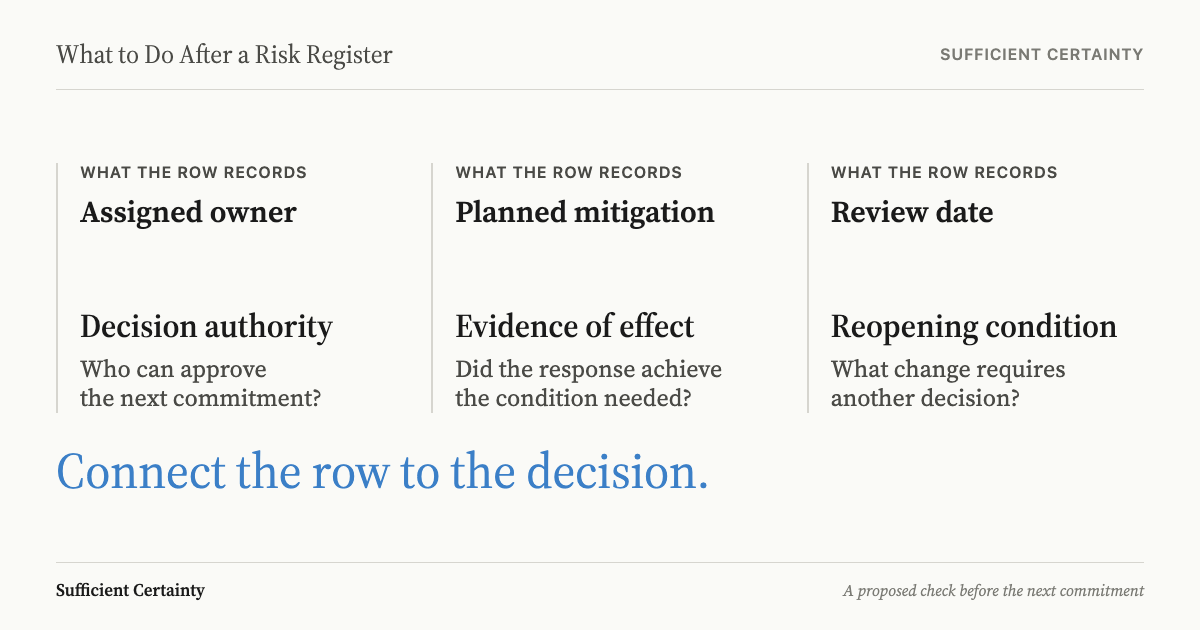
An assigned owner gives colleagues a clear person to contact about the concern. That person can explain the entry, gather evidence and follow up a response. Keeping the same owner through successive reviews also helps preserve the reasons behind a change in status.
Check the owner's authority. A person who maintains the row may have no authority to change the budget it concerns. The distinction is practical. Ask which decision the owner can approve within their delegation, and which decision must go elsewhere.
The Cabinet Office's governance guidance puts authority limits and decision-making roles within the governance framework. For a register review, check the actual delegation document. A role title alone does not establish permission to approve the particular commitment under discussion.
A useful handoff includes the choice awaiting approval and the relevant row. Ask the recipient to confirm whether the choice falls within their authority. If it does not, establish the next recipient before the commitment is made. This makes the distinction between accountability and ownership usable during the review.
Keep the row owner involved after escalation. They can explain the evidence and record what the approver decided. Record the approval boundary. Colleagues should be able to see whether the owner is authorized to proceed or is still waiting for someone else's decision.
The review should also distinguish permission to investigate from permission to commit. An owner may be allowed to request a revised funding plan while approval for expenditure remains elsewhere. Put both decisions in the note if both are needed. Keep each condition attached to the decision it affects.
If the approver withholds approval, record the evidence needed for another review. If approval is conditional, record the condition and who must confirm it. Do not describe either result as unrestricted permission to proceed. The row should let the next person follow the decision without reconstructing it from meeting notes.
Which decision can your risk register owner actually approve, and what evidence supports it? Start the Walk →
A mitigation status still depends on evidence
A mitigation plan contains an assumption about what an action will achieve. Completing that action gives evidence about delivery. It does not automatically establish the promised effect. Before approval, state what must now be true for the proposed commitment to be justified.
Use the wording already in the row to make the claim specific. If a funding response is marked complete, ask what funding is available for the work awaiting approval. Check whether the evidence covers the same period and conditions as the proposed commitment. An earlier agreement may cover a different scope.
Test the claimed effect. Find the document or observation that supports the mitigation claim. Read its limits as well as its conclusion. Record any condition that remains unresolved, instead of treating a completed task as permission to proceed.
The distinction belongs in the review note. “Action completed” describes something the team did. “Funding approved for this commitment” describes a condition the decision needs. The article on surfacing assumptions explains how to make such dependencies explicit before acting.
The required evidence depends on the commitment. A reversible action may justify proceeding while a question remains open. A commitment that creates a lasting obligation may require that question to be resolved first. Keep uncertainty visible. Ask the approver to decide whether the available evidence is sufficient for this choice.
Do not close the row merely because evidence has been requested. Leave its status consistent with what has actually been established. If the planned evidence will arrive after the approval date, bring that timing conflict to the approver now. Waiting for the next reporting cycle does not resolve it.
ESN funding risk escalated despite recorded mitigation
The Home Office's Emergency Services Network project aimed to replace Airwave, the communications network used by emergency services. The NAO's March 2023 report describes detailed monthly risk registers and reports to the program board. This case concerns the findings recorded at that time.
The risk of inadequate funding had been in the second-highest category since at least April 2021. It rose to the highest category in June 2022 and became an issue in September 2022. The NAO interpreted that progression as indicating ineffective mitigation. It also found that reporting did not show how successful actions had been in reducing or managing risks.
Those findings establish a gap between recording a response and demonstrating its effect. They do not establish that every owner lacked authority. Nor do they show that a different register format would have solved the funding problem. Separate the finding from the proposed remedy.
In July 2023, the Public Accounts Committee reported that delays imposed extra costs on emergency services. It said no specific mechanism had been created to help them bear those costs. It recommended exploring how Airwave savings could support transition activities and replacement devices in the new business case.
A program-wide funding response can leave costs with separate organizations. The register review must identify whose commitment the evidence actually supports.
Applied to a completed register, the proposed check is straightforward. Bring the funding row to whoever can authorize the next commitment. Ask for evidence that the response covers that commitment. This is a reader application of the historical findings, not a claim that the Home Office performed these checks or that the same conditions persist today.
Attach the next decision to one register row
At the next approval, put the relevant row alongside a short decision note. Name the person authorized to decide and state the mitigation condition on which the choice depends. Link the evidence directly. Use the Universal Decision-Making Method to work through the choice:
- Frame: State the purpose of the decision and the commitment awaiting approval.
- Tentative Elements: Set out the proposed action and the alternative if approval is withheld.
- Assumptions: Identify what must be true about the mitigation for the action to achieve its purpose.
- Sufficient Certainty: Assess whether the evidence justifies this commitment, given the consequences of being wrong.
- Implement+Monitor: Record the decision and the change that requires another review.
Keep the evidence note short enough to use during approval. Distinguish confirmed conditions from unresolved claims. Where authority is unclear, resolve the handoff before treating the response as approved. This is how authority in management becomes part of the actual choice.
Set a reason to return. Record the condition that would invalidate the mitigation evidence, with a person responsible for noticing it. Link that trigger to decision monitoring. Update the register when the decision changes, so the next reviewer sees what was approved and why.
You could update every mitigation status in the register and still leave its claimed effect untested.
Work through your decisionNo sign-up. Just pick your decision and start.
Grant Purdy is the co-author, with Roger Estall, of Deciding (2020), and the architect of the Universal Decision-Making Method.