
Accountability in management breaks the moment a manager owns the target but not the decision. Finance freezes the headcount, sales sets the deadline, and the plant manager explains the shortfall. That arrangement is not accountability. It is blame with extra steps. Authority must travel with the number.
A plant manager I worked with carried the quarterly margin number while the levers sat elsewhere. Finance had frozen staff. Sales had already promised the shipment date. He could not approve overtime or move the launch date by even 48 hours. Yet he was the one told to explain the shortfall. That is the version of accountability in management I see most often.
The manager owns the number while somebody else owns the real choices.
Accountability in management is the practice of making a manager answerable only for decisions they have authority to shape, including the assumptions and monitoring behind those decisions.
Why accountability in management so often turns false
The cleanest proof I know came from the U.S. Government Accountability Office in 2001. Across 28 large federal agencies, managers in 22 of them said they were being held accountable for results. At only one agency did more than half say they had the decision-making authority they needed. The problem is organisational wiring, not manager motivation.
I do not call that accountability. I call it managed exposure. The organisation keeps the theatre of discipline while withholding the authority that would make the discipline fair. Most of what passes for accountability culture is built on exactly that dodge. The review gets harsher while the target stays put, and finance, the sponsor, or the committee chair stay clear of the blast.
GAO also noted that performance agreements helped when they tied goals and measures to day-to-day management. Write down the decision boundary and the later review has something solid to inspect. Without that, the annual appraisal is just hindsight with a badge on.
Accountability in management got worse when firms flattened the middle
The squeeze is not imaginary, and it is getting worse. Gallup's 2025 work on span of control said the average manager's direct reports rose from 10.9 in 2024 to 12.1 in 2025. It also found that 97 per cent of managers now operate as player-coaches, spending a median 40 per cent of their time on non-managerial work. Then somebody writes an advice piece telling them to hold better one-to-ones and follow up more firmly. On what spare afternoon?
A manager with 12 direct reports and 40 per cent of the week spent doing individual-contributor work is already short of room to judge, coach, and change course. The calendar is consumed before the first review begins. Then the same organisation complains that follow-up is weak, priorities are muddy, and standards slip. That is arithmetic, not a character flaw.
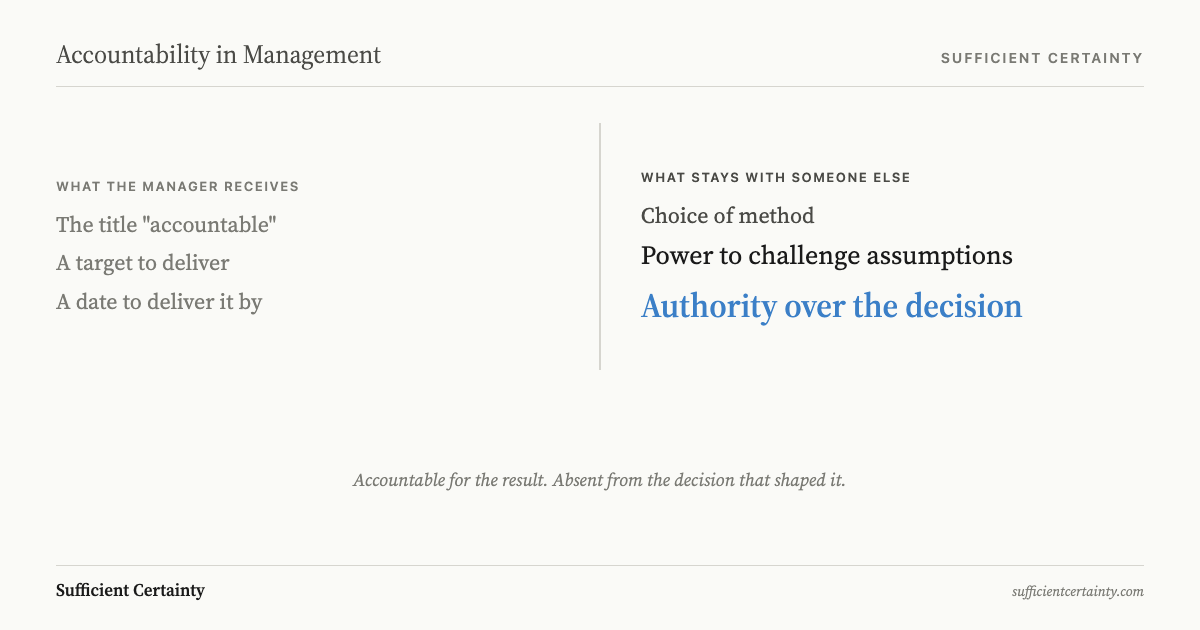
This is where generic management advice loses me. The overloaded manager is not short of exhortation. The problem is room to move. If headcount is frozen and the date is politically fixed, pricing may still belong to another function. The person in the middle may still be responsible for carrying the work. That is different from owning the call.
I have spent much of my working life watching organisations widen this gap and then act surprised when trust evaporates. People are not fools. They can tell when a review is really a ritual for protecting someone higher up the chain.
Once you see the pattern, the paperwork looks different. Monthly packs, committee escalations, and red-amber-green dashboards can describe the strain, but they do not repair it. Most accountability frameworks do the same: they record the gap between the person who must explain the result and the person who can still change the underlying call.
Check the target your manager owns against the lever they control and record the authority gap. Start the Walk →
Power near the work changes the result
The defence world offers a brutal example. GAO reported in 2005 that commercial program managers could redirect funding and replace poor performers, while U.S. Department of Defense program managers generally could not. By 2008, 95 major defence acquisition programs were $295 billion over their first estimates and 21 months late. The assumptions behind scope and money were sitting elsewhere, along with the staffing call. The program manager carried the number without the levers.
That is why I distrust managerial language about ownership when the budget, staffing, and timing levers sit elsewhere. Ownership without control is just a polite way to allocate embarrassment in advance.
The Danish hospital study points the other way. In research published on 17 July 2024 in BMC Health Services Research, wards whose frontline managers had the highest degree of decentralised authority had lower odds of sickness absence. Where managers also had cross-functional authority, the odds were lower again. No mystery there. That is what accountability in management looks like when it is not decorative: the person judged on the ward can actually change how the ward runs.
Authority near the work lets a manager shift people, change the sequence, or stop a commitment that no longer makes sense. Once the Deciders are clear, the room is calmer because everybody knows who can change the call and who can only advise.
What accountability in management should mean
I start with one rude question: can this manager change the thing they will later be judged on? If the answer is no, the accountable person sits somewhere else. Stop pretending otherwise. Put the decision where the authority actually is, or move the authority to where the work and the knowledge sit. That is the only version of accountability in management worth defending.
Roger Estall and I built the Universal Decision-Making Method in Deciding around that point: name the call, name who can change it, write the weak assumption in plain English, and state the signal that puts it back on the table.
If the manager can recommend but not commit, escalate it quickly and name the person who can. If you want the wider version of that argument, accountability in leadership starts before the decision, but at management level the test stays the same: stop calling the manager accountable for a result they were never allowed to shape.
When an organisation gets this right, the post-mortem changes tone. The discussion is about whether the decision sat with the right person, and whether the organisation stayed close enough to the assumption that mattered. That is what a review that judges the decision rather than the person actually looks like. Anything else is blame with stationery.
You could promote them to accountable and still leave the lever with someone else.
Work through your decisionNo sign-up. Just pick your decision and start.
Grant Purdy is the co-author, with Roger Estall, of Deciding (2020), and the architect of the Universal Decision-Making Method.