
After an environmental audit, add an owner, a closure test, and a due date to the finding with the greatest immediate operating consequence. An audit register can show an action as complete while the site still lacks the evidence needed to accept it. Keep the finding open until that evidence has been reviewed.
An environmental audit is a structured examination of environmental activities against defined criteria within a stated scope.
Assign closure evidence to each operating-site finding
Start with findings about the operating site: permits, emissions, discharges, waste handling, and the records supporting them. Identify which condition is still present. Determine whether immediate protection, notification, or operating restrictions are required under the applicable rules. Obtain site-specific environmental and legal advice where the finding raises those questions.
The first corrective priority depends on what the site is doing now.
A finding about missing records may require reconstructing evidence and changing record controls. A finding about an uncontrolled discharge may require immediate work at the discharge point. The audit severity label helps organize attention, but the responsible manager still needs to understand the actual condition before assigning the response.
Keep the permit or other obligation beside the finding. Record the exact location and activity involved. Ask the action owner to describe the correction in observable terms. “Improve waste management” leaves too much unresolved. State which handling step will change and what evidence the reviewer must see before accepting that change.
Use the existing register rather than create another reporting tool. This is part of turning situation analysis into a decision about present operations. It differs from approving a new project stage after an environmental impact assessment. The decision here concerns correction at a site that is already operating.
Check dependencies before setting the action order. One correction may require a planned shutdown or an approved contractor. Another may depend on a permit decision. Record what can be done immediately and what requires that dependency to be resolved. The site manager should be able to explain why a lower-ranked task starts first when it removes a constraint on more urgent work.
Corrective priorities depend on the operating consequence
An environmental audit collects findings against a defined scope and set of criteria. That gives managers a clearer basis for corrective work than an informal list of concerns. Keep that scope visible when preparing the action plan. A completed audit does not establish the condition of every unexamined location or activity.
A useful action plan connects each finding to evidence that can support closure.
The EPA’s new-owner audit policy summary distinguishes correction from preventing recurrence. It also recognizes agreed extensions where correction requires more time. These are conditions of a particular US policy, with eligibility limits. They illustrate why a due date and a closed status are insufficient descriptions of environmental follow-up.
The closure review can separate physical completion from demonstrated performance. An installation record may establish that equipment was fitted. The acceptance evidence must address the finding itself. If the finding concerns discharge conditions during a particular operating mode, a check performed outside that mode may leave the question unresolved.
Closure evidence must describe the environmental condition the correction was meant to change.
That requirement also helps the owner estimate the work. Evidence may need to be collected during production or under a specified sampling arrangement. Arrange access and qualified review before the completion date. A manager should know early when a promised closure date depends on a test that cannot yet take place.
The EPA audit policy also treats discovery and disclosure as distinct from correction. Follow the applicable process for each.
What result must the site show before this environmental finding can close? Start the Walk →
Which change would reopen a closed environmental finding?
Write the reopening condition while the correction is being planned. It should describe something that would undermine the reason for closure. A failed result, changed waste stream, or changed operating mode may matter. Select the trigger from the specific finding and its accepted evidence, rather than copy a standard list into every action.
A closed finding needs an assigned response when its supporting conditions change.
Identify who will receive the signal and who can direct the response. If the owner leaves the site, that duty must transfer. Connect the trigger to an existing inspection, permit review, or operating change process. A note hidden in the audit file will not help the person managing the affected activity.
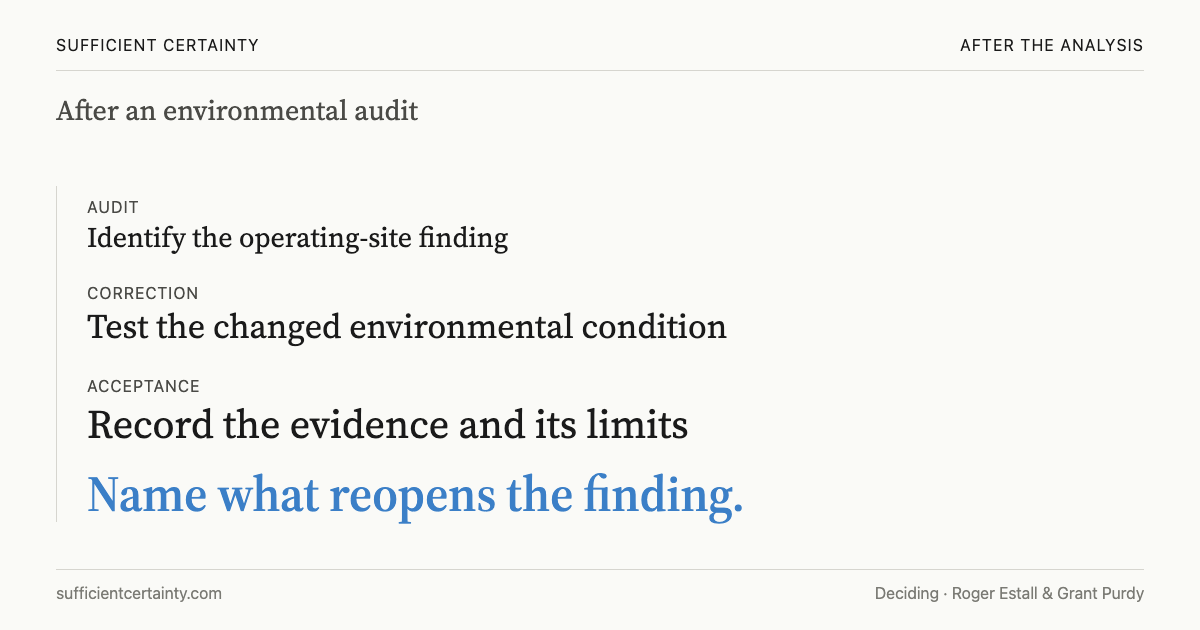
Set the response as well as the trigger. The relevant manager may need to check the correction, restrict the affected activity, or seek specialist advice. Applicable requirements determine any mandatory response. The proposed record does not replace those requirements; it makes the person and the next decision visible.
There is a boundary with system-level review after an ISO 14001 audit. That review can examine changes to significant environmental aspects. This operating-site checkpoint follows a specific finding: whether the correction remains effective at the permit, discharge, or waste location for which closure was accepted.
MountainWest moved from audit findings to documented corrections
Williams audited newly acquired MountainWest facilities under an agreement with EPA. The June 2025 Notice of Determination describes an April 2024 report confirming some corrections and requesting more time for others. EPA granted an extension. Williams supplied further corrective-action information in February 2025.
EPA subsequently waived civil penalties for the disclosed violations based on the company’s certifications and the relevant policy conditions. The determination concerns those disclosures. It is not a finding that every facility activity was compliant, nor proof that no environmental harm existed. Its reservations preserve important limits on what the determination establishes.
MountainWest’s record separates the audit report from later evidence about corrective work.
The dates matter because the audit did not finish every action. The record describes later reporting and an agreed extension. Do not turn that history into a universal deadline or a guarantee of penalty relief. An operator considering a disclosure needs advice about its own jurisdiction, circumstances, and eligibility.
The practical procedure proposed here carries that distinction into a site register. A requested extension should show which condition remains unresolved and who is responsible during the delay. Record any required interim protection and how it will be checked. Do not quietly replace the old due date without retaining the reason and approval.
Ask the closure reviewer to identify the evidence relied on and its limits. If the evidence comes from an owner’s certification, say so. If independent testing was performed, record what it covered. A decision remains easier to review when reported completion and independent verification are described accurately.
Set the trigger before accepting the correction
Before accepting the correction, read the finding and the proposed closure evidence together. Check that they concern the same location and operating condition. Resolve any mismatch with the environmental specialist. The Universal Decision-Making Method places this question before commitment: is the evidence sufficient for the decision being made?
Keep the original finding visible after closure. Retain the evidence reference and the person who accepted it. When a trigger occurs, the new reviewer can then compare current conditions with the accepted basis. Without that record, the team may have to repeat the audit discussion before it can decide whether the correction still works.
Accept the correction only within the conditions its evidence supports.
Give the reviewer a clear outcome: closure supported, more evidence required, or corrective work still incomplete. Where only part of the finding is resolved, identify that part. Avoid closing the whole finding because one convenient action is finished. The record should still direct attention toward the condition that remains.
A proportionate review does not require endless sampling. State what evidence the decision needs and why. Consider the consequence of accepting a failed correction and the opportunity to detect a problem later. The question of having enough information to decide concerns the particular commitment, rather than a demand for complete knowledge.
Keep the reopening trigger with the closure decision where the operator can find it.
Review that trigger when the affected activity changes. Assign a person to obtain the next evidence and a person to decide what follows. The existing approach to monitoring decisions supports this handover. The result is a correction whose acceptance can be explained and whose failure has a defined response.
A completed correction still needs a named signal for reviewing the evidence behind closure.
Work through your decisionNo sign-up. Just pick your decision and start.
Grant Purdy is the co-author, with Roger Estall, of Deciding (2020), and the architect of the Universal Decision-Making Method.