
After an environmental site assessment, the step before demolition or development is to ask the environmental professional what must be done to resolve one finding before work starts. In 2011, Aberdeen bought a former school site for a library; its later assessment found asbestos and petroleum-contaminated soil.
The next decision needs a named activity, a defined work area and evidence that supports releasing that work. A report conclusion can help set those conditions. The project lead must connect them to the proposed demolition or development plan.
An environmental site assessment investigates a property's environmental conditions, including evidence of contamination and information gaps relevant to its proposed use.
Resolve the finding before releasing site work
Start with the report's conclusions and recommendations. Select the finding that affects the next planned activity. Put its location beside the demolition plan, excavation drawing or development layout. Ask the environmental professional whether the report supports that activity, and what additional work is needed.
Record the answer with its report reference. A finding about a former tank area needs a clear connection to the proposed ground work. A building-material finding needs a connection to the planned disturbance. Keep those questions separate so each can reach the appropriate specialist.
In the United States, EPA's All Appropriate Inquiries guidance covers investigation of property conditions, professional conclusions and significant information gaps. Its suggested report content treats asbestos investigations and Phase II sampling as additional services. Check the commissioned scope before treating any issue as assessed.
A Phase I report therefore needs careful reading when demolition is next. Commissioning a site assessment does not establish that every building material was surveyed. The report's scope and exclusions should identify what the project team still needs to arrange.
If the findings call for further investigation, agree the question that investigation must answer. EPA's brownfield assessment guidance describes Phase II work as sampling to investigate potential contamination and its distribution. It also connects assessment results with cleanup planning for the proposed reuse.
The project lead can assemble the resulting work sequence with the environmental professional and relevant authority. Include the investigation or cleanup task, its owner and the evidence needed before the affected activity starts. Attach this sequence to the work package so the report's recommendation reaches the people scheduling the work. Ground behavior needs a separate technical check: the follow-up to a geotechnical investigation matches the investigation coverage to the next excavation or foundation package.
This is a focused part of situation analysis: connecting a known property condition to the next commitment. Broader due diligence may address many transaction questions. Here, the immediate task concerns the release of a specific site activity.
The report gives each finding a location and a limit
The review after an environmental impact assessment addresses predicted project effects and consent conditions, distinct from site contamination findings. An assessment gives the team a documented basis for follow-up. Its references let a specialist trace a conclusion to the material reviewed or the investigation performed. Its limitations identify where that conclusion needs care. Keep both visible when preparing the next work package.
The finding becomes useful when it changes a named part of the work plan. It can inform where investigation is needed, which activity must wait or what information a contractor needs. Those connections let the project lead explain a hold without asking everyone to interpret the entire report.
Use a short checklist to distinguish what the report establishes from what the next decision still needs. The following is a proposed review aid, not a description of Aberdeen's project records.
Mark the remaining items verified only after checking the supporting records. A report reference proves what the report says. A completion record or specialist review answers a different question about readiness for work. The release decision needs evidence about the proposed activity, not only the property's history.
This scope also differs from an environmental management system. ISO describes ISO 14001 as a framework for managing an organization's environmental impacts and improving performance. The follow-up to an ISO 14001 audit concerns that system. A site assessment needs decisions about conditions at this property.
Before releasing demolition or development, decide what evidence resolves the finding in the affected work area. Start the Walk →
Aberdeen's library needed a different sequence of work
The former Bethlehem Lutheran Church school property in Aberdeen, South Dakota, had deteriorated after the parish moved. A private company bought it but did not proceed with planned apartments and offices. Aberdeen acquired the downtown block in 2011 for $700,000 to build a public library.
The city's assessment followed that acquisition. It found asbestos in building materials and petroleum-contaminated soil. The state worked with the city to remove asbestos before demolition and monitored groundwater. EPA also records work on contamination associated with an underground petroleum tank. Following remediation, construction began. The K.O. Lee Aberdeen Public Library opened on September 18, 2017, according to EPA's Aberdeen case report.
The report gives a sequence, but it does not publish the full assessment or detailed technical results. It cannot establish that the assessment determined the purchase price. Nor does it establish that the assessment alone caused redevelopment to proceed. The useful lesson concerns work after acquisition.
Frame the follow-up around the next activity that could disturb the affected material. In this case, asbestos removal preceded demolition. That sequence supports a practical question for another project: what must happen before this work starts? The question directs attention to the affected work package.
Asking whether the whole property is acceptable can leave several different decisions inside one answer. The team may need to decide whether investigation can start, whether demolition can start or whether construction can start. Each decision needs its own scope. Approval for one activity should state what it covers.
A finding can change the sequence of work while the intended use stays the same. Aberdeen's planned library still required environmental work first. For another site, the project lead should ask specialists whether the proposed sequence or layout needs revision. This is a decision-method application, not a reported detail of Aberdeen's internal deliberations.
Compare options for the affected work package before requesting a general project approval. The comparison might concern investigation before design completion or cleanup before a contractor mobilizes. Treat those as proposed choices for specialist review. Clear problem framing helps expose which decision the assessment must support.
The chosen frame also determines which information matters next. A question about demolition needs evidence relevant to demolition. A question about later use needs evidence relevant to that use. Further investigation should answer the unresolved decision question, with the environmental professional defining the appropriate technical work.
What would allow demolition or development to proceed?
Prepare one finding-to-work release note before signing the affected work authorization. This proposed checkpoint applies the Universal Decision-Making Method to the handoff from assessment to site work. Its purpose is to make the immediate decision and its supporting evidence clear.
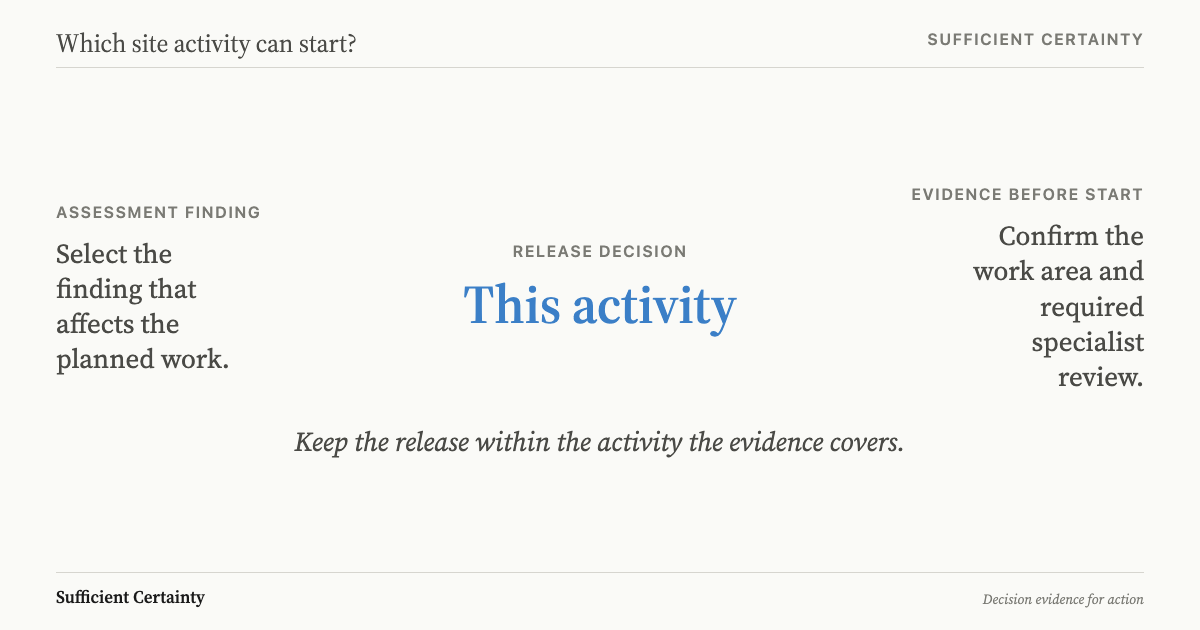
Head the note with the exact activity and work area. Add the assessment finding and report reference. State the unresolved question in terms the environmental professional can answer. Name the person responsible for obtaining the evidence and the person authorized to release the work.
Agree what evidence would answer the question before ordering further work. Reference the required specialist review or completion record. Confirm any authority's requirements through the appropriate professional. A proposed decision note cannot substitute for technical assessment or required approvals.
Keep the hold on the activity affected by the unresolved finding. Ask whether other work can proceed within defined limits. This makes the scope of any release explicit. It also prevents an approval for one area being treated as permission to disturb another.
Put the conditions in the contractor's work package, then check that the current drawing and schedule match the note. This connects the recorded decision to implementation. Attach the evidence references so the person releasing work can check them without reconstructing the report history.
Reopen the release decision when the work area, disturbance or intended use changes. Record that trigger in advance. The environmental professional should review whether the existing evidence still applies. The same check is needed when new site information contradicts the basis of the release.
A defined trigger gives monitoring a practical task: identify a change that needs a new decision. Before work starts, the project lead should be able to name the released activity, show the evidence and explain the conditions that would stop or revise it.
What must be true before the work beside that site finding can start?
Work through your decisionNo sign-up. Just pick your decision and start.
Grant Purdy is the co-author, with Roger Estall, of Deciding (2020), and the architect of the Universal Decision-Making Method.