
After an inventory audit, check the stock status of each item on the proposed reorder list before approving purchases. In March 2014, the U.S. Air Force's excess-stock measure was 4.3% with contractor-managed inventory in the denominator, versus 5.8% without it. That 1.5 percentage point gap came from the calculation's boundary, not a change in the excess stock. GAO's comparison shows why a verified balance needs a separate check before it supports an order or disposal decision.
An inventory audit examines stock quantities, records and controls to assess whether reported inventory information is supported.
Check stock status before placing another order
The normal follow-up starts with reconciliation. Compare the audit evidence with the stock ledger. Investigate differences, correct supported errors and record unresolved exceptions. Keep the adjustment approval separate from the person who prepares it. Preserve the evidence behind each change so another person can check what happened.
Where the audit includes a physical count, identify movements between the count and the decision date. A receipt, dispatch or transfer can change the balance after verification. A late transaction can explain a difference without proving that goods were lost. Check the transaction before choosing a corrective action.
Correct the record before using it. Then prepare the stock decisions that need attention. These may include buying replacements, releasing a hold, moving stock between sites, retaining spare parts or disposing of unusable goods. The audit's exception list helps identify where to start, but each action requires its own reasons.
Record the proposed action beside the item, location, owner and stock status. Separate goods available for use from goods allocated, quarantined, damaged or awaiting inspection. These categories describe different conditions. Combining them in one total can hide the shortage that the purchasing team needs to resolve.
| What the audit produced | What the proposed action assumes | Gap to test |
|---|---|---|
| A verified stock balance | The goods can meet the next requirement | Check ownership, condition and existing allocations |
| A list of slow-moving items | Low recent demand means no future use | Check planned work, substitutes and replacement lead time |
| A reconciled shortage | Buying more is the best response | Check usable stock elsewhere and confirmed incoming supply |
A stock adjustment needs evidence. An action owner also needs authority to approve the purchase, transfer or disposal. Ownership and accountability should be clear before the warehouse receives instructions. An unresolved decision should not become an unapproved stock movement.
Do not resolve an unexplained difference by changing the available balance to the amount needed for an order. Keep the uncertainty visible until the relevant evidence is checked. If work cannot wait, the decision-maker can approve a limited purchase with a clear reason. Record the remaining uncertainty and the check still required.
An accurate balance makes the next check possible
An audit gives the decision-maker a firmer starting point. It can expose missing records, unreliable count procedures and differences that need investigation. Correcting those problems matters. A purchasing decision based on a balance known to be wrong starts with an avoidable weakness.
The PCAOB inventory auditing standard describes observation, tests and inquiries concerning quantities and physical condition. It also explains that accounting records alone are insufficient when the auditor has not obtained adequate evidence about inventory quantities. The relevant audit work should establish what the records can support.
Keep the audit's scope visible. Read its findings alongside its coverage, dates and exceptions. Confirm whether the evidence concerns physical existence, record accuracy, valuation or management controls. A conclusion about one area cannot automatically answer a question about another.
For valuation, IAS 2 requires inventory to be measured at the lower of cost and net realisable value. Its definition of net realisable value uses estimated selling proceeds less completion and selling costs. That financial assessment does not decide which goods can be released for tomorrow's work.
Likewise, a reliable quantity does not by itself establish future demand. The decision-maker still needs to connect the goods to an actual requirement. Read the report as evidence for that decision, with clear limits. This is part of organisational governance, because someone must decide which use of resources serves the organisation's Purpose.
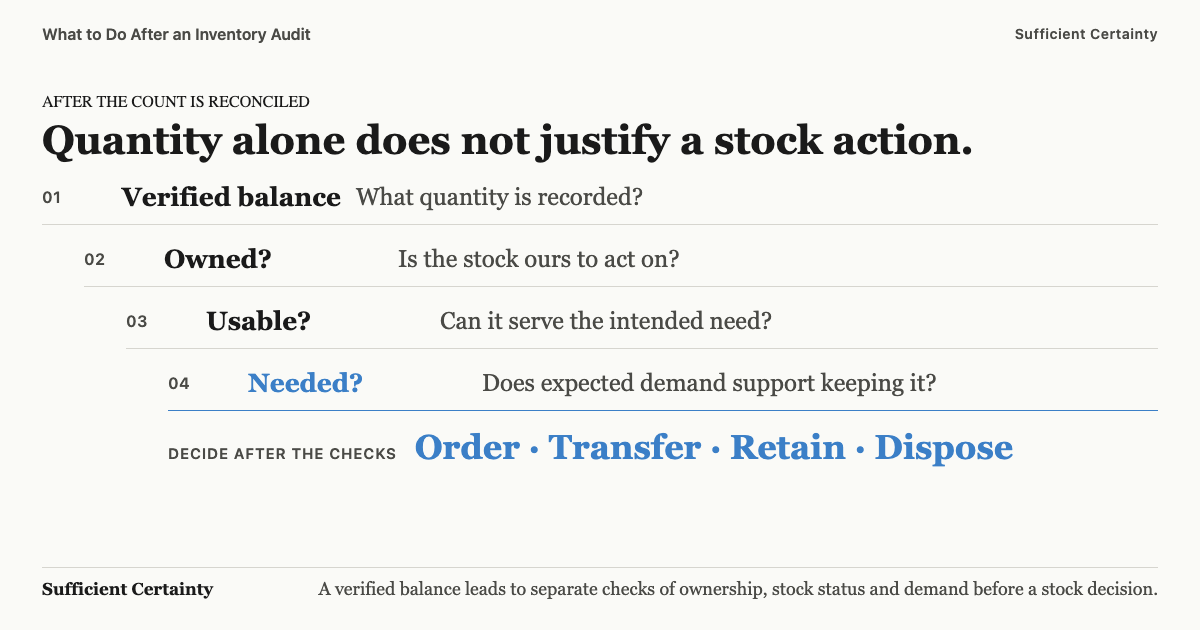
Available stock needs a defined meaning. Put that meaning in the decision notes. Specify which holds, allocations and locations exclude goods from availability. The next person should be able to reproduce the available balance without guessing which categories were included.
Which items on the reorder list are owned, usable and available for the work ahead? Start the Walk →
What counted as excess in the Defense inventory review?
In its April 2015 Defense inventory report, GAO reviewed inventory management and reporting. This was not a physical stocktake. The Navy and Air Force reported meeting a goal of reducing on-hand excess inventory to 10% of total inventory value. However, contractor-managed stock enlarged their denominator while excess values covered service-managed stock.
The Air Force comparison below uses the same date and excess category. Both percentages remained below the goal. The problem was overstated progress, not evidence that the corrected Air Force figure missed the target. GAO also found an Army requirements calculation could underreport excess.
Check what the percentage includes. The case illustrates a reporting boundary problem. It does not show that warehouse staff counted parts incorrectly. Its application after an inventory audit is specific: check whether the definition behind a proposed action matches the question being decided.
A warehouse can have verified goods that belong to another organisation. Goods owned by the organisation can be held elsewhere. Goods in the right location can be reserved for a different job. These are possible conditions to check, not additional findings from the Defense report. Each can change what a stock balance means for a particular order.
The same care applies to demand. A slow-moving item might support equipment that remains essential. A fast-moving item might serve a product being withdrawn. Before disposal or replenishment, name the expected use and the evidence for it. Make the assumption explicit so operations and purchasing can challenge it.
Test the reason for the action. Fixing the metric can improve visibility, but it does not select the best use of stock. As with follow-up after an internal audit, completing the correction and making the management decision are distinct tasks.
From reconciled balances to justified stock decisions
Before approving the next order or disposal, prepare a short decision note for the affected items. Include the verified balance, usable quantity, expected requirement and proposed action. Record exceptions where the evidence remains incomplete. Use the Universal Decision-Making Method to examine the conditions that make the action sensible.
- Frame. State the Purpose and the decision. Identify the work that needs stock, when it needs it and who decides.
- Tentative Elements. Compare buying, retaining, redistributing, cancelling incoming supply and disposing. Include leaving the stock in place while a specific uncertainty is resolved.
- Assumptions. Write what each option relies on. Check ownership, condition, allocation, future demand and the time needed to obtain replacements.
- Sufficient Certainty. Decide which checks justify action. Focus on uncertainties that could change the choice, especially before disposal that cannot readily be reversed.
- Implement+Monitor. Assign the action and record what would reopen it. Specify who checks demand changes, failed inspections or delayed incoming stock.
Separate confirmed facts from expected demand. Label the source and date beside each important statement. A count record, inspection result and demand forecast answer different questions. If the decision relies on a forecast, record why that forecast remains suitable for this item.
Keep the further checks proportionate. Confirm a disputed allocation with its owner. Ask maintenance whether a replacement is compatible. Check whether stock at another site can arrive before the requirement. Use evidence to resolve the choice, rather than collecting detail that cannot change it.
For a proposed disposal, ask what would happen if the item were needed again. Consider replacement availability, compatibility and delivery time alongside storage cost. For a proposed purchase, ask whether the apparent shortage already has incoming supply assigned to it. These checks test the recommendation directly. They also help avoid retaining everything because disposal feels uncertain.
Record the condition that would reopen it. A cancelled job, changed delivery date or failed inspection can invalidate an otherwise sound stock decision. The audit provides a checked starting point. The decision note explains why the proposed use of that stock remains justified.
A reconciled stock balance can still leave the demand assumption behind an order or disposal untested.
Work through your decisionNo sign-up. Just pick your decision and start.
Grant Purdy is the co-author, with Roger Estall, of Deciding (2020), and the architect of the Universal Decision-Making Method.