
After completing a board skills matrix, ask the company secretary for evidence behind the capability needed for the next major board decision. Wesfarmers asked directors to support their highest self-ratings with evidence in its 2024 assessment. That check helps a nomination committee distinguish a demonstrated capability from an unchecked claim before choosing whom to recruit.
The next task is to decide which gap should govern the nomination, then record what would change that choice. A director's departure or a change in strategy can make a completed matrix unsuitable for the appointment being considered.
A board skills matrix records the capabilities of a board's members against the capabilities the organisation needs.
Use the matrix to specify the next nomination
Start with the decisions the board expects to make during the next director's tenure. Put the most consequential pending decision beside the relevant capability in the completed matrix. Ask what directors must understand well enough to challenge the proposal and judge the answers.
A broad label such as technology can cover very different experience. Leading a software business does not establish experience overseeing a major system replacement. Specify the work the board expects the director to perform. The recruitment brief should describe that work clearly enough for a candidate to supply relevant evidence.
The ASX fourth-edition commentary on Recommendation 2.2 connects the matrix to gaps addressed through director development or succession planning. It also calls for regular review as business and governance issues change. A completed matrix therefore supports more than recruitment.
Consider whether the missing expertise must remain inside the board. A recurring need to question management may justify a director with relevant depth. A specialist assessment for one transaction may suit an independent adviser. Development may help existing directors understand a subject, provided it can meet the need before the board commits.
Choose the response by the work required and the time available, rather than by the emptiest matrix cell. In organisational governance, the committee must also consider how the appointment changes the board as a whole. Filling one gap does not settle every requirement for the role.
Record why the selected gap takes priority over the others. Note which pending commitment depends on it and when that commitment will be considered. The nomination brief needs a condition for reconsideration if that decision changes before the search ends.
For each remaining gap, state why it can wait. The reason might be that no relevant commitment is pending, or that existing advice meets the immediate need. If the reason depends on the timing of a project, record that dependence. Moving the project forward should prompt a fresh look at which capability takes priority, even when no director rating has changed.
Which change in board capability would require the nomination committee to revise its search brief? Start the Walk →
A board needs evidence behind each rating
The matrix gives the committee a common set of categories. It can expose reliance on a single director and show where recruitment priorities compete. The Financial Reporting Council guidance on board composition describes it as a way to examine current capabilities and gaps relevant to future appointments.
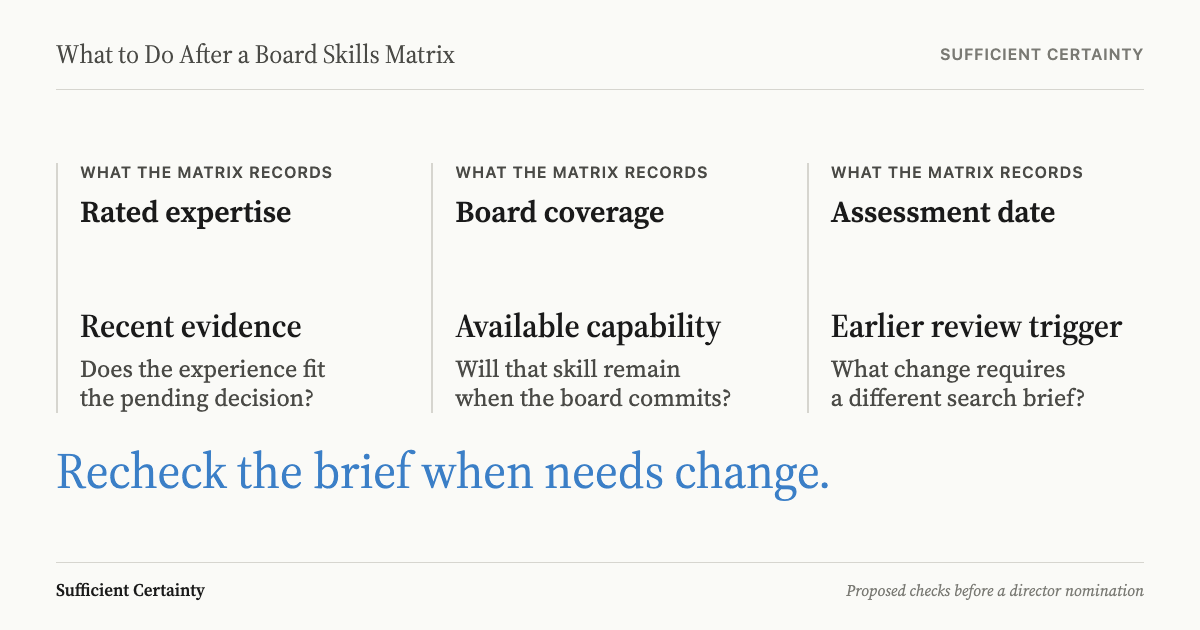
Check how the ratings were reached. Did directors use the same definition of experienced? Does an expert rating describe recent work in a relevant setting? Ask for a short description of the work and the director's part in it. Confidential evidence can be checked without publishing the underlying material.
A capability rating is useful for nomination only when its meaning matches the work the board needs. The following checks are proposed questions for a completed matrix. They do not describe findings about Wesfarmers or another board.
A stated assumption belongs beside the rating, not only in interview notes. The approach to surfacing assumptions before a decision applies here: identify what the committee is relying on, then decide what evidence it needs.
Ask the committee chair to review disputed ratings before using them to rule out a capability gap. If the evidence remains unclear, describe that uncertainty in the brief. A higher rating should not close the question merely because a director has held a senior title. The committee needs to know what the person can contribute to the board work now being considered.
Availability also matters. Expertise held by a departing director may appear in the current matrix but disappear before the relevant vote. Check capability at the expected decision date as well as at the assessment date.
Wesfarmers checked directors’ claimed expertise
Wesfarmers described a structured assessment in its 2024 Corporate Governance Statement. Directors assessed themselves against capability areas using competent, experienced and expert levels. Other directors' feedback was used to adjust those assessments. Directors were also asked for evidence supporting areas rated expert.
The statement published the adjusted matrix. It also explained that management and external advisers supplement board capabilities. These are useful distinctions for a nomination committee: the board's own expertise and access to expertise outside the board are different resources.
The disclosure establishes how Wesfarmers assessed capability. It does not establish how each director applied that capability to a particular decision. It does not prove that a particular appointment was necessary or that the process prevented a failure. Use the case as evidence of an assessment practice, with its limits stated.
The proposed next step for a reader is to attach a review condition to the resulting nomination choice. If a search relies on an existing director supplying a second capability, record what happens if that director leaves. If specialist advice covers the immediate gap, state when that arrangement must be confirmed.
A committee can then distinguish a changed rating from a changed need. A rating might remain accurate while the board moves into a different business. Conversely, the strategy might stay the same while the person supplying the relevant experience becomes unavailable.
Which change would require a different nomination brief?
For a reader applying this practice, the review note should distinguish permanent coverage from temporary support. Advice booked for an early assessment may not extend through negotiation or implementation. Confirm the scope before relying on it to defer recruitment. This is a proposed check on an adviser arrangement, not a claim about the arrangements disclosed by Wesfarmers.
Neither event requires waiting for the next annual matrix exercise. The committee should return to its priority gap when the condition occurs. The broader record of a board decision can preserve why that gap governed the search, without turning the matrix itself into a complete decision record.
Set a review point for the capability gap
Before approving the search brief, add a short note to the committee paper. Name the capability the appointment must provide. State the evidence supporting the current coverage and identify who will report a material change. Keep the note specific to this appointment.
The Universal Decision-Making Method gives the committee a way to connect the completed assessment to the commitment:
- Frame: State the board work the appointment must support and when that capability is needed.
- Tentative Elements: Compare a director appointment with advice or development where those options could meet the need.
- Assumptions: Record whose capability and availability the preferred option depends on.
- Sufficient Certainty: Decide whether the evidence justifies issuing this search brief before the board commits to the appointment.
- Implement+Monitor: Assign the check and specify the change that brings the brief back to the committee.
Use an observable trigger. A relevant director announcing departure is observable. So is the board approving a material change to strategy. A general instruction to keep skills under review gives the secretary much less guidance. Monitoring a decision starts with knowing which condition to watch.
The signal for revisiting a decision should relate to a condition behind the choice. Updating a rating alone does not establish that a different nomination is needed.
Place a further check before the candidate recommendation goes to the board. Confirm that the selected gap still has priority and that interim advice remains available. If a trigger has occurred, revise the brief or explain why the original choice still holds.
Give the secretary a clear route for reporting the trigger. The nomination committee chair should decide whether the brief needs revision, rather than leaving a recruiter to interpret a changed matrix. Keep the original reason and the revised reason together so the board can understand the recommendation.
The completed matrix should lead to an appointment brief with a stated reason for reopening it. That gives the committee a practical response when the board's needs change during a search.
A completed skills matrix can support a nomination while leaving unclear when the appointment brief needs to change.
Work through your decisionNo sign-up. Just pick your decision and start.
Grant Purdy is the co-author, with Roger Estall, of Deciding (2020), and the architect of the Universal Decision-Making Method.