
After a capability maturity assessment, write down the operating result that one proposed improvement must achieve. Reaching a higher level can leave the required performance unchanged. Before funding progression, ask what evidence would show that this particular change can do enough for the work your team needs to perform.
A capability maturity assessment compares an organization's practices with defined levels of capability to identify strengths and priorities for improvement.
Tie the maturity gaps to one operating commitment
Start with the improvement that is about to receive resources. Name the work it should enable and the result required from that work. In road operations, the commitment might concern coordinating an incident response or managing a work zone. These are illustrative purposes. The relevant outcome should come from the operation's own responsibilities and service commitments. If the investment also rests on a claimed competitive advantage, the VRIO analysis follow-up checks the evidence behind that resource label.
The FHWA Organizing for Reliability tools use a capability maturity model to assess transportation operations and develop an action plan. The framework covers organizational dimensions that include business processes, workforce and collaboration. This recognizes that effective operations depend on more than equipment or a written procedure.
The budget needs a connection between the assessed practice and the operating result. Find the evidence behind the selected gap. A workshop conclusion may identify a missing coordination arrangement. The budget paper must then explain which operating difficulty that arrangement would address and how the proposed change would address it.
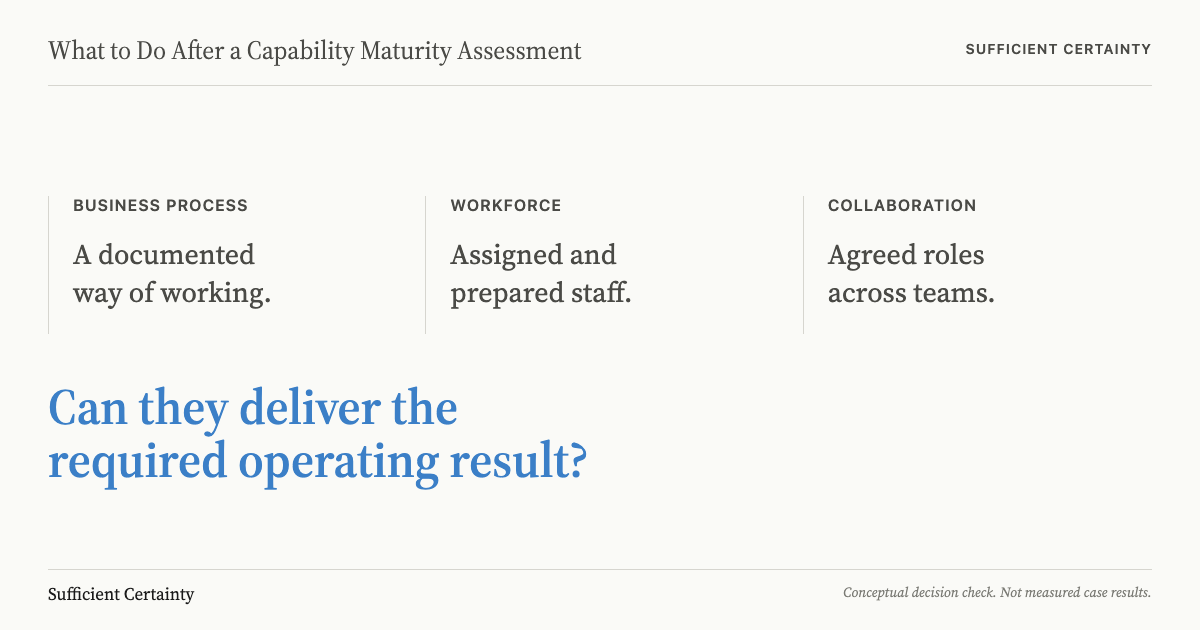
The bar is schematic, with no measured percentage or maturity score. It distinguishes evidence about documented practice from evidence about required performance. The organization need not reach some universal maximum before acting. It needs enough support for the particular improvement and the commitment that follows.
Specify what would count as adequate performance before choosing the means. A work-zone coordination proposal should identify the work that must be coordinated and the people involved. An incident response proposal should identify the relevant response responsibility. Avoid accepting a new committee or training course as the required result simply because the assessment recommends one.
Use the wider situation analysis to establish what the operation faces now. A capability that mattered in an earlier service arrangement may have a different role after responsibilities change. Check the proposed improvement against the current commitment, rather than assuming every gap retains equal importance until the next assessment.
Record what work already succeeds despite the reported gap. The existing arrangement may contain an effective informal practice worth preserving. It may also depend on one person who will not be available under the proposed operation. Either finding changes the improvement needed. Do not remove a working arrangement merely to make the documentation look more consistent.
Check what operating result would justify the next capability improvement. Start the Walk →
What does a higher maturity level establish?
A higher assessed level can establish that practices meet more demanding framework descriptions, within the scope and evidence examined. That is useful for comparing ways of working and discussing improvements. It is a different conclusion from showing that a proposed operating commitment can be delivered reliably under its expected conditions.
The certainty required comes from the commitment, rather than the next level on the model. A limited change that can be revised may need less supporting evidence than an arrangement on which several agencies will depend. State the consequences of inadequate performance before deciding what evidence is sufficient to proceed.
The FHWA transportation operations frameworks distinguish program areas such as work-zone management, road weather and traffic incident management. That program focus matters. A general organizational conclusion should be connected to the particular operating work the improvement will support.
Ask whether the assessment examined that work directly. Was the conclusion based on a documented arrangement, a workshop discussion or observed performance? Each can inform the decision. Preserve the distinction so the budget holder can see what remains uncertain. A formally assigned role does not by itself establish that the person can perform it under the required conditions.
A performance check should resolve a funding question, not repeat the maturity assessment. Identify what result would change the proposed allocation. Review relevant operating records or arrange a suitable demonstration of the disputed capability. Keep the check bounded by that question. More assessment detail is unnecessary if it cannot change the commitment.
The distinction is similar to deciding what to do after gap analysis. A difference from a preferred state needs a reason to close it. Here, that reason is the performance required from a defined operating responsibility, with evidence that the proposed change can support it.
Include the option of making a smaller change. If a focused coordination repair can meet the requirement, a broad maturity program needs a separate justification. If the limited change cannot do enough, record why a larger commitment is necessary. The assessment should help make that choice explicit.
Ask the person responsible for the operating result to review the proposed acceptance condition. The improvement team may be able to confirm that a procedure was written or training delivered. The operating owner must still determine whether that evidence addresses the required work. Record any difference before procurement or implementation begins. Resolving it early can change the scope of the improvement without requiring another complete maturity workshop or a new framework.
Colorado DOT linked its assessment to operations planning
The FHWA SHRP2 Reliability Lead Implementer Roundtable report describes Colorado DOT's use of the framework. Colorado tested the capability maturity assessment tool in 2010 and conducted an operations self-assessment in 2013. The account says the assessment helped a reorganization that merged traffic, safety and operations responsibilities.
A statewide CMM workshop followed in 2014. The agency then conducted program-specific assessments for work zones, road weather and traffic incident management. The account also describes an operations program plan and training. These are documented uses of the framework and subsequent organizational work.
The report is an implementation account from participating organizations. It does not provide a quantified causal effect on travel-time reliability or a numerical performance threshold for a funding decision. No particular maturity level, savings or reduction in incidents should be inferred from it.
The case shows assessment connected to operating work, with outcome evidence still requiring its own check. It supports examining a particular program rather than funding an abstract increase in maturity. It does not establish that every recommended action would be valuable in another agency, or that Colorado's organizational changes alone produced a measured result.
For a reader considering similar work, select the operating responsibility the improvement must support. Ask what happens when the required agencies or teams have to coordinate. Find evidence of whether the current arrangement can do it. If the evidence concerns only routine conditions, identify the additional demand that the proposed commitment introduces.
Use evidence relevant to that choice before approving progression. An exercise or operating record may establish a particular capability under stated conditions. Describe those conditions alongside the finding. Do not transfer the result to different staffing or responsibilities without checking what the transfer assumes.
The evidence must support the proposed change
Use the Universal Decision-Making Method to connect the improvement decision with the performance needed. Roger Estall and Grant Purdy describe the method in Deciding. Applied here, its five steps provide a sequence for deciding what capability change to fund.
- Frame. State the operating result and the commitment awaiting approval.
- Tentative Elements. Compare the proposed improvement with a smaller change and the current arrangement.
- Assumptions. Name what must be true for the selected change to improve the required work.
- Sufficient Certainty. Decide what evidence would support this commitment, given the consequences of inadequate performance.
- Implement+Monitor. Assign the change and the check that will show whether its supporting conditions persist.
Choose the required evidence before the improvement is treated as complete. This keeps a purchase or training attendance from becoming an automatic claim of operating capability. Where the evidence remains insufficient, change the commitment or obtain the missing support. Use explicit assumptions to show what still requires checking.
Keep the operating expectation with the funding decision. When responsibilities or staffing change, check whether the evidence still applies. Monitoring the decision should identify that loss of support. The maturity assessment then remains useful context for a specific improvement, rather than a standing instruction to fund the next level.
What evidence shows that another maturity level will improve the work your team must deliver?
Work through your decisionNo sign-up. Just pick your decision and start.
Grant Purdy is the co-author, with Roger Estall, of Deciding (2020), and the architect of the Universal Decision-Making Method.