
After capital budgeting, the step before committing funding is to mark each project's dependencies on the funding schedule. A funding paper can show each project within its limit while leaving a shared constraint unresolved. The committee still needs to know whether the selected projects can run together, in the proposed order.
The next decision concerns the complete funding plan. Which sequence delivers the intended result within the resources available? The data-driven decision-making hub examines how analysis supports choices when the decision extends beyond a reported result.
Capital budgeting evaluates proposed long-term investments and allocates available capital to selected projects.
Mark what each funded project needs first
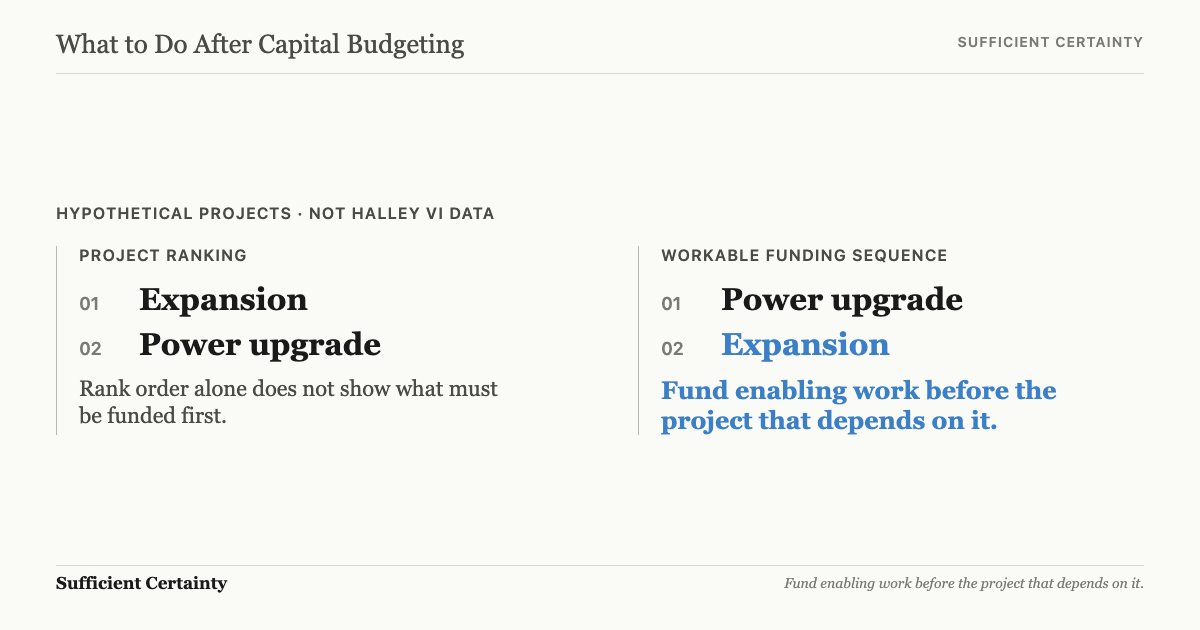
Start with the selected projects and their planned funding dates. Beside each one, identify any other project that must finish before its benefits can begin. Mark the funding needed for that earlier work. A lower-ranked enabling project may need money before a higher-ranked project can produce anything useful.
Check the schedule against existing commitments. Include the work already funded, even if it did not compete in this year's exercise. The same delivery team may be needed by several projects. A supplier deposit may be due before another funding source becomes available. These are checks on the combined plan, rather than reasons to calculate every return again.
The GAO's review of capital planning principles describes selecting investments within a portfolio that includes existing assets. It also treats a long-term capital plan as a way to identify future funding requirements. This is broader than approving the best individual proposal.
Capital budgeting can already include these checks. If the completed exercise has a funded, workable sequence, carry it forward. If it produced only a shortlist or annual allocation, finish that part before the approval becomes a contract. A selected project needs its enabling work funded at the right time.
The project prioritization matrix discussion explains why existing obligations matter when comparing new work. The funding schedule should make those obligations visible beside the proposed commitments.
Before choosing either route, state the result the portfolio must deliver. This may be reliable service, additional capacity or replacement of an obsolete asset. Make the required date explicit. The funding sequence must serve the purpose stated for the investment.
A capital allocation still needs a sequence that funds the work each project depends on. Start the Walk →
A capital ranking leaves the funding sequence unresolved
A ranking helps explain why one proposal receives funding ahead of another. Comparable estimates let the committee examine trade-offs and challenge a request for scarce capital. The completed work gives a starting point for a funding decision, including reasons to reject attractive projects that do not serve the organization's purpose.
Retain that analysis. A proposed change in sequence needs reasons, just as the original selection did. Reordering projects because one manager speaks more firmly defeats the discipline of the exercise. Reordering because an essential dependency has no funding addresses a different problem.
The UK Treasury's Green Book tells practitioners to consider dependencies and affordability. It also says an initial ranking by summary metrics is insufficient for a decision. This government guidance does not set a rule for every business. It supports the distinction between comparing options and deciding which complete option can be delivered.
Consider this hypothetical capital plan. Its project appraisal and allocation schedule contain the following statements. They describe an invented example, not reported company data.
Both entries can look reasonable on separate pages. Taken together, they give the expansion project a start date before the work it needs. A committee could fix the mismatch by funding power first, delaying expansion or choosing another way to add capacity.
Compare workable sequences, not isolated project positions. Each alternative must include the spending needed to make it usable. A cheaper first phase is not a credible alternative if it leaves an asset idle until unfunded work is complete.
Testing the assumptions carrying the decision includes checking that promised funding has authority behind it. An expected future allocation needs a different label from money already available.
The schedule also needs to show expenditure after construction. Funding an asset's purchase does not establish that its operation has been funded. Affordability includes the commitments created by the chosen sequence.
Why did Halley VI require another funding decision?
The Halley VI Antarctic research station provides an analogous capital decision. The source does not establish that the British Antarctic Survey used a particular capital-budgeting model or the Universal Decision-Making Method. The relevant event was a procurement price that exceeded the money available for the planned project.
In Big Science, the 2007 National Audit Office report, the tender was £16 million, or 75 percent, above expectations. The project budget could not cover it. The team reconsidered phasing and scale, and costed more options for achieving the science objectives.
The report described reducing the facility's size and combining construction with demolition of the existing Halley V station. Some science would be suspended during construction. At that time, the report put the resulting overall cost growth at £4 million. It also found that the original Halley VI business case omitted operating-cost estimates.
The alternative changed what the funding would buy, including the continuity of scientific work. That consequence belongs in the decision. It cannot be treated simply as a saving on the original building plan. A revised phase must be judged against the purpose it changes.
The 2007 position was not a final outcome. A later NAO review, published in 2016, reported Halley VI four years late and £15 million, or 45 percent, over budget. It attributed this to reported difficulties with the design specification. The figures describe different reporting dates and must not be combined into a claimed saving.
This case supports reopening the funding choice when the available money no longer covers the selected scope. It does not prove that rephasing secured a successful outcome. In a business portfolio, the equivalent question is which other commitments would change if one project needed additional money.
A change to one allocation may defer an enabling project elsewhere. Ask what that delay does to the purpose of the combined plan. The next step after cost-benefit analysis examines forecasts behind an appraisal. Here the task is different: determine which complete sequence remains feasible under the shared funding limit.
From a project shortlist to a fundable sequence
Take the dependency-marked schedule to the people who control the shared budget and the work. Resolve the mismatches before the next binding commitment. A forecast owner cannot confirm another department's funding. A project sponsor cannot promise delivery capacity that has already been committed elsewhere.
Compare the selected sequence with at least one credible alternative where a material constraint remains. This might fund enabling work first, deliver a smaller usable stage or defer a project while retaining existing capacity. Include the consequences of waiting. Deferral may require continued maintenance or leave a service need unmet.
Phasing works only when each funded stage has a usable result. Define that result before treating staged spending as a solution. Check what later spending remains essential, when it becomes necessary and who can authorize it. State which benefits disappear if the next stage never receives funding.
Use the Universal Decision-Making Method to examine the purpose and the available options before settling the sequence. This does not require repeating every calculation. It requires changing the frame from which projects look attractive to which combination can deliver the intended result.
Record why the chosen sequence remains preferable. Name the unresolved funding conditions and the person responsible for checking each one. The project-management decision discussion distinguishes a delivery plan from the decision that authorizes it. Both need to agree on what has actually been funded.
Make the approval specific to the scope and sequence reviewed. Check it again before signing a contract that commits another stage. If a tender exceeds the available allocation, return to the alternatives. If an enabling project slips, reconsider commitments that depend on its completion.
Commit funding to a sequence the organization can deliver. A signed allocation should identify the result it supports and the conditions that require another decision. That gives the committee a usable basis for approving capital after the appraisal is complete.
Which alternative funding sequence would still deliver the intended result if the shared budget cannot cover the shortlist?
Work through your decisionNo sign-up. Just pick your decision and start.
Grant Purdy is the co-author, with Roger Estall, of Deciding (2020), and the architect of the Universal Decision-Making Method.