
After a clinical risk assessment, the standard move is to act on the rating: set the observation level, write the care plan, approve the discharge. The step that decides whether any of that works is testing the assumptions the rating rests on, above all that the patient in front of the assessor is the patient who will leave. In Nottingham, that assumption went untested for more than two years, while the records that contradicted it sat in the file.
Clinical risk assessment is the structured judgement of how likely a patient is to come to harm, or to harm others, used to set observation, treatment and discharge decisions.
Nottinghamshire Healthcare and the assumption nobody checked
Between May 2020 and September 2022, Valdo Calocane was under the care of Nottinghamshire Healthcare NHS Foundation Trust for psychosis. He was admitted to hospital four times. Staff completed eight risk assessments between May 2020 and February 2022, recorded on an electronic patient record with a built-in tool that prompts for set information and then produces an assessment of risk to inform treatment plans.
The pattern in his records was consistent. In hospital he took his medication and his symptoms often improved. In the community he stopped, and medication was found in his flat. Relapse followed, and with it violence towards others that escalated in the later stages of his care. In January 2022 he was held at a place of safety after an alleged assault on a fellow student, assessed, and not detained because the doctor judged he could be managed in the community.
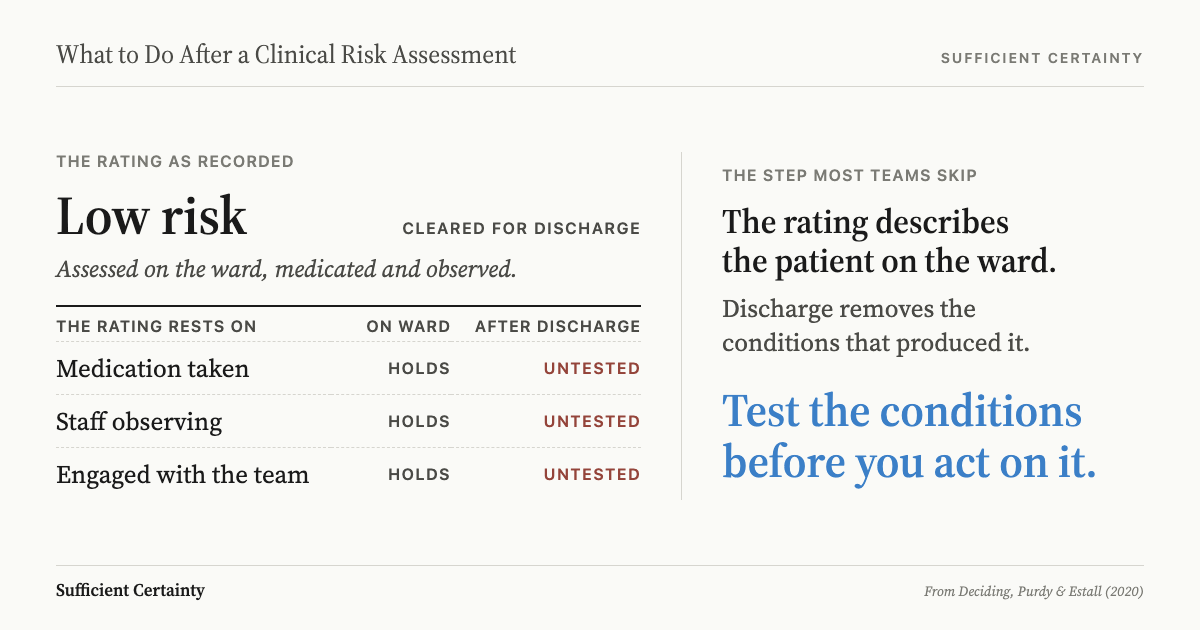
The risk assessments did not carry that pattern forward. The Care Quality Commission's special review, commissioned by the Secretary of State and published in August 2024, found they minimised or omitted key details: refusal of medication, persistent psychotic symptoms, the level of violence when his psychosis was poorly managed, and its escalation over time. They did not set out the scenarios in which the risk of violence would rise, or who would be exposed.
Discharge planning made the same move. The review found it looked mainly at how he presented at the point of each discharge, after a hospital stay in which he had been taking medication. His discharge on oral medication rested on his assurance that he would keep taking it, despite a significant history of stopping after leaving hospital. A depot injection combined with a community treatment order, which allows recall to hospital, was not discussed until his fourth admission.
That was the assumption nobody tested: that the patient assessed on the ward was the patient who would live in the community. Every discharge plan built on the inpatient presentation inherited it, and none of them named it.
In April 2022 his care was moved to two community psychiatric nurses because of concerns about risk. On 23 September 2022 he was discharged back to his GP for non-engagement. No updated risk summary appears to have been produced, and the review found no evidence that his family, the GP, the police or his university were consulted. The review linked that non-engagement to resistance to treatment, a symptom of his illness.
On 13 June 2023, Ian Coates, Grace O'Malley-Kumar and Barnaby Webber were killed in Nottingham. In January 2024, Calocane's pleas to manslaughter on the grounds of diminished responsibility were accepted, and he received a hospital order.
The CQC concluded that the evidence indicated "beyond any real doubt" that he would relapse into potentially aggressive behaviour without antipsychotic treatment and monitoring, and that the September 2022 discharge did not adequately consider or mitigate the risks of relapse and violence. The ratings existed. The assumption under them was never tested.
Take the rating behind your next discharge decision and write down what has to stay true after the patient leaves the ward for it to hold. Start the Walk →
What clinical risk assessment gets right and where it stops
Structured risk assessment earns its place on the ward. Prompts make sure history, current mental state, substance use and protective factors are asked about, not left to memory at the end of a night shift. Pressure injury and VTE assessments catch the routine risks that busy teams miss. A documented assessment gives the next shift, the next team and the family a shared starting point, and the conversation it forces is often where the useful information surfaces.
It also fits the wider risk assessment process that governance teams audit against: identify, analyse, rate, record, review, with risk evaluation deciding which ratings need action. Completion rates are measurable. That is where the trouble starts, because a completed assessment is easily mistaken for an accurate one.
Where it stops is prediction. Carter et al. (2017) pooled the positive predictive value of suicide risk scales and found that 5.5% of patients classed as high risk went on to die by suicide. Their conclusion: no "high-risk" classification was clinically useful. Violence tools do somewhat better. Fazel et al. (2012), across 73 samples, found violence risk tools had a median positive predictive value of 41%, and concluded that the evidence does not support using them as the sole basis for detention or release.
NICE drew the practical conclusion. Its 2022 self-harm guideline, NG225, advises against using risk assessment tools and scales to predict future suicide or repetition of self-harm, and against using them, or a global low, medium or high rating, to decide who is offered treatment or who is discharged. The guideline focuses clinicians instead on the person's needs and their safety.
The deeper limit is structural. A rating is a snapshot taken under the conditions of the assessment. The conditions that produce a low score are often supervision, medication, sobriety and engagement, and those are exactly what discharge removes. The tool records the score. It does not ask which of those conditions will hold, and the score then travels to people who each read it differently. Security managers see the same loss when a travel risk rating outlives the escort it assumed.
None of those readings is unreasonable on its own. Together they show what the rating has lost on its way out of the ward: the conditions it depended on. It is the same compression a risk matrix performs on an operational hazard. The judgement travels and the reasoning stays behind.
The checkpoint between analysis and action
The fix is a checkpoint, not a new tool. Before a rating sets an observation level, supports a discharge or triggers an intervention bundle, write down what would have to stay true for it to hold. For a discharge, that usually means adherence to medication, engagement with follow-up, stable housing, substance use and someone positioned to notice change. For a pressure injury score, it means the patient's mobility overnight, not at the morning assessment.
What would have to stay true after this patient leaves for the rating to hold?
Then test each condition against the record rather than the presentation. What happened after previous discharges? Did medication adherence hold last time? What is the family reporting? At Nottinghamshire the answers were already in the notes. Where the record contradicts the assumption, the record wins. Where an assumption cannot be tested, it becomes a monitoring trigger with a named owner and a stated response. The handoff of warning information also matters after a workplace violence risk assessment, where a reported concern must reach the person responsible for acting on it.
This is the Assumptions step of the five-step Universal Decision-Making Method: Frame, Tentative Elements, Assumptions, Sufficient Certainty, Implement and Monitor. Frame the decision the rating feeds, which is discharge or observation, not the score. Treat the care plan as a tentative element. Surface and test the assumptions under it. Decide whether the evidence gives sufficient certainty given what follows if it is wrong. Then hand the untested assumptions to the GP and family as the things to watch.
For risk and quality leads, the audit question changes. Completion of the form is the floor. The question worth asking is whether the assumptions under the decision were named, tested and passed on, the same gap that workplace risk assessments leave open, and that reappears in the action plans that follow a root cause analysis in healthcare.
A clinical risk rating describes a patient under particular conditions. The checkpoint asks whether those conditions will still hold once the decision takes effect.
You could build the care plan on the risk rating and still leave the conditions it was scored under untested.
Work through your decisionNo sign-up. Just pick your decision and start.
Grant Purdy is the co-author, with Roger Estall, of Deciding (2020), and the architect of the Universal Decision-Making Method.