
After a root cause analysis in healthcare, test the assumptions inside the action plan before implementing it: every corrective action assumes the identified cause is the real one and that the fix will change what staff actually do at the bedside. An action plan can pass every accreditation check and still describe a hospital that does not exist.
Root cause analysis in healthcare is a review of a sentinel or serious adverse event that produces causal statements and a corrective action plan, often under the RCA² method.
What a root cause analysis in healthcare delivers
In the United States, the formal trigger is usually a sentinel event. The Joint Commission adopted a formal sentinel event policy in 1996. It expects an accredited organisation to complete a comprehensive systematic analysis and an action plan within 45 business days of learning about the event. The analysis explains why the harm happened. The plan says what will change.
In 2015 the National Patient Safety Foundation published RCA²: Improving Root Cause Analyses and Actions to Prevent Harm, which reframed the exercise around action rather than investigation. The second "A" was the point. A review that identifies causes and then proposes nothing effective has not finished its job.
The core RCA² tool is the action hierarchy. Stronger actions change the system so the error becomes hard or impossible: forcing functions, physical redesign, standardised equipment. Intermediate actions reduce reliance on memory: checklists, redundancy, software enhancements. Weaker actions still depend on people choosing correctly: double checks, warnings, new policies and training. RCA² asks each review to include at least one stronger or intermediate action.
Each action then gets an owner, a completion date and a measure. Done properly, the review draws on the event timeline, interviews with the staff involved, and cause-mapping tools such as the ones covered in what to do after a fishbone diagram. The general pattern, outside clinical settings, is set out in what to do after root cause analysis. The forward-looking version inside clinical settings is covered in what to do after a clinical risk assessment.
RCA² is specific about measurement. Each action needs at least one process or outcome measure, with an expected compliance level, a date for assessment and a named person to report on it. A process measure can be as simple as documenting that the action was implemented. Process measures confirm implementation; outcome measures show whether the action worked, so the report advises a mix of both. Each action is then approved or rejected, preferably by the CEO, with the reason for any rejection recorded.
This is real value. The review moves attention from the individual who made the error to the conditions that made it likely, and it forces leadership to sign off on specific changes. A well-run RCA² review converts a harm event into named system weaknesses, each with an owner.
What it leaves unexamined
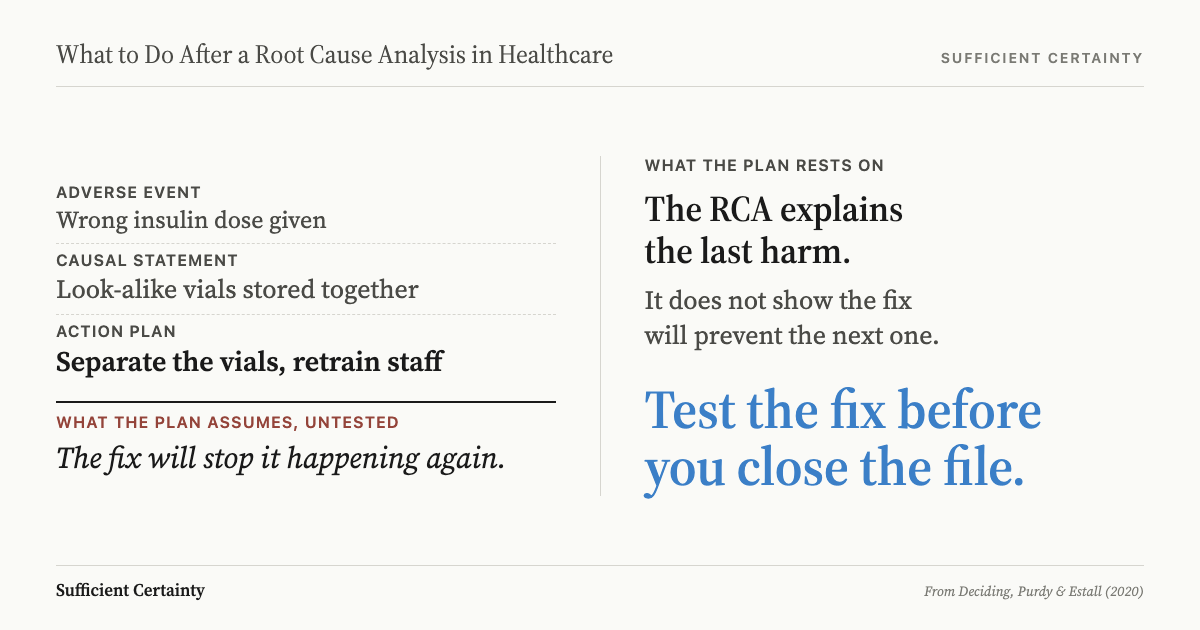
An action plan is a prediction. Each line says that if this change is made, this event will not recur. Two assumptions carry that prediction. The first is that the causal statement is correct, that the review stopped at the cause and not at the point where the team ran out of time. The second is that the action will change behaviour under real conditions: night shifts, agency staff, workarounds and the authority gradient between a senior surgeon and a junior nurse.
The first assumption is weaker than it looks. Peerally and colleagues, writing in BMJ Quality & Safety in 2017, argued that the name itself promotes a search for a single cause, and that timelines and the "five whys" tend to favour a linear story over a systems view. Reviews run against deadlines and are skewed by hindsight bias. Teams may stop at "a cause of mutual convenience", one that edits out causes deemed beyond the organisation's remit.
Neither assumption is usually tested. In Kellogg et al. (2017), researchers reviewed eight years of RCAs at one academic medical centre. Of 302 reviews, 106 proposed solutions, 731 in total. The most common were training (20%), process change (19.6%) and policy reinforcement (15.2%). Several event types recurred during the period despite repeated RCAs. The same event types came back after fixes that relied on people doing better.
This was flagged well before RCA² existed. Wu, Lipshutz and Pronovost (2008) argued in JAMA that no controlled trials had tested the RCA framework, that reeducation and new policies were the most common recommendations, and that best practice for follow-up and analysing results was absent.
The measure column often confirms the gap. It counts completion: training delivered, policy circulated, checklist issued. Completion says nothing about whether the action works, a blind spot that also shows up when teams decide what to do after an A3 report. Each action is a claim about behaviour, and like any assumption in a decision, it can be named and checked. An action plan that measures completion cannot tell whether the fix worked.
Write down what has to change on the ward for each corrective action to work, and ask who has checked it before the action plan is signed off. Start the Walk →
When the gap cost Rhode Island Hospital five wrong-site surgeries
By 2007 the Joint Commission's Universal Protocol, mandatory since July 2004, already required pre-procedure verification, site marking and a time-out before every operation. Rhode Island Hospital in Providence had those rules. In 2007 its surgeons still operated on the wrong side of three patients' heads.
In the first case, a resident skipped the pre-operative checklist; the doctor and nurse later said they had not been trained to use it. In late July, the consent form for an 86-year-old man did not record which side needed surgery. A nurse questioned it. The surgeon, with more than 20 years' experience, said he remembered which side. He was wrong.
The state ordered an independent review of neurosurgery practice and better verification of surgery plans, and the hospital added a second physician's review of site and side. On 23 November 2007 a chief resident began operating on the wrong side of an 82-year-old woman's head. The nurse did not stop him. The state health director said the improvements made in the operating room had not been extended to the rest of the hospital.
The response was a $50,000 fine, a neurosurgery checklist, staff training on it, and a requirement to report every failure to follow the rules to the state. Each measure was another rule or another check. Each assumed that the person with the information would speak and the person with the scalpel would listen. The fixes assumed a culture of challenge that the incidents had already shown was missing.
In October 2009 a surgeon operated on the wrong finger, the hospital's fifth wrong-site surgery since 2007. In November 2009 the state fined it $150,000 and ordered video and audio recording in every operating room and an observer from outside the surgical team for at least a year. That order put an outside observer in the room to see whether the rules were actually followed. The pattern is familiar from lessons learned that never change the next event.
One step before the action plan
The insertion point sits between the draft action plan and sign-off. It uses the five steps of the Universal Decision-Making Method: Frame, Tentative Elements, Assumptions, Sufficient Certainty, Implement and Monitor. The analysis has already done much of the work. The step treats the plan as a decision that can still be wrong.
Frame the purpose as preventing recurrence. Treat each proposed action as tentative. Then, for every action, write down what has to be true for it to work: the causal statement is right; staff will follow the step on a night shift with agency cover; a junior nurse will stop a senior doctor; nobody has a routine workaround that bypasses it.
Decide how much evidence is sufficient before committing. Observing the current process for a week, asking frontline staff how they would get around the new rule, or simulating the scenario are cheap tests. Any action whose key assumption fails gets redesigned, usually one level up the action hierarchy.
Apply that to the Rhode Island measures. The neurosurgery checklist assumes that a nurse who spots a discrepancy will halt a senior surgeon, and that the surgeon will stop. The July case had already shown what happens when a nurse raises a doubt and the surgeon overrules it. A cheap test before rollout: observe a sample of time-outs, and ask operating room nurses privately whether they would stop a case if the surgeon insisted.
The second-physician rule assumes the reviewer checks the plan independently against the imaging and the consent form. A simulated plan with a deliberate side error tests that. If the error passes, the second signature is catching nothing. Either way, the answer arrives before a patient depends on the rule.
Finally, build monitoring that watches behaviour and recurrence. The same checkpoint appears across the strategic problem-solving cluster. A corrective action is finished when the event stops recurring, not when the training record is signed.
You could close every item on the action plan and still leave untested the assumption that the fix will stop the next event.
Work through your decisionNo sign-up. Just pick your decision and start.
Grant Purdy is the co-author, with Roger Estall, of Deciding (2020), and the architect of the Universal Decision-Making Method.