
After sanctions screening, compare the screening result’s named parties with the parties in the transaction record before requesting release. The transaction queue may show a match score and a request for release. The reviewer needs evidence about the party and the transaction before recording a disposition.
Sanctions screening compares relevant party and transaction information with sanctions data to identify potential restrictions that need review.
An alert needs a recorded disposition
Start with the completed output, whether it is a possible match or a recorded screening result. Keep the search terms, relevant party details, source list and screening time accessible. Identify the transaction that will rely on it. A record from onboarding may answer a different question from the alert now delaying a payment.
If the information pack contains inconsistent versions of the party name or transaction details, preserve the discrepancy. Ask which record is authoritative and why. Correcting an obvious typing error may be appropriate, but silently changing the screening input makes the original result harder to explain. Keep the basis for any correction with the disposition.
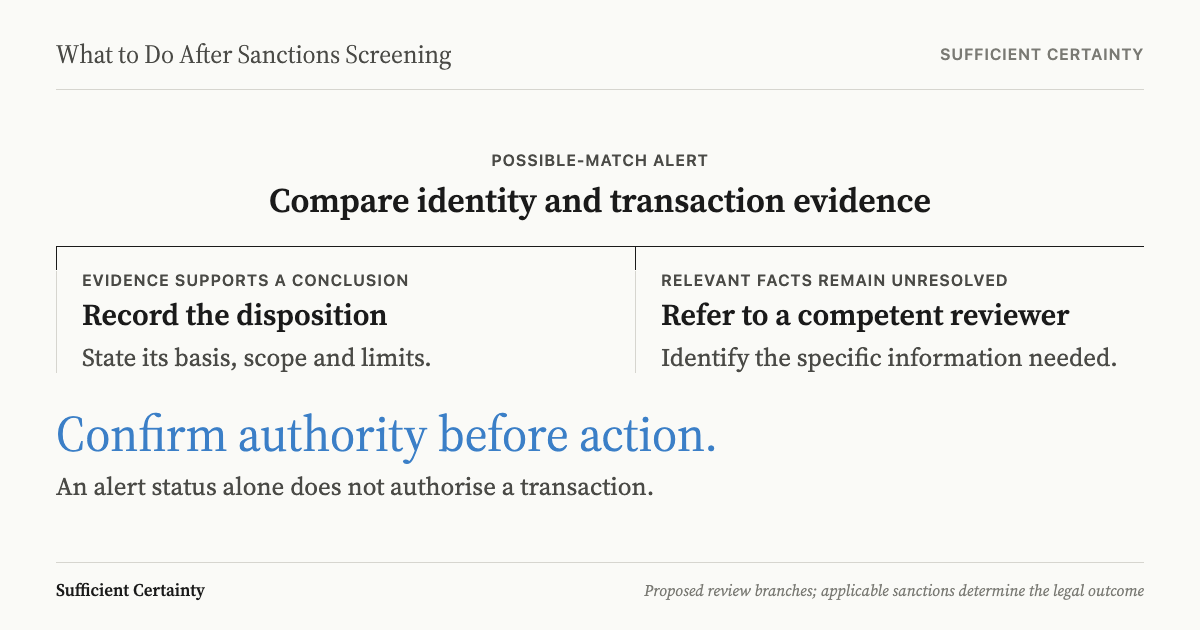
For a possible match, assign a reviewer with the competence and delegated authority to make or refer the decision. Separate the person requesting release from the person authorised to resolve the sanctions question. The request may carry business urgency, but it does not supply missing identity evidence or expand anyone’s authority.
Prepare an alert disposition record that shows the evidence considered, unresolved points and authorised next action. Reference the actual transaction rather than simply marking the customer file complete. Record whether further specialist review is required. A later reviewer should be able to understand how the available evidence supports the decision.
Use the broader risk assessment approach to examine what the transaction depends on. For this task, keep the commitment narrow: what may happen to this transaction after competent review? Improving the whole sanctions program may be necessary elsewhere, but it should not obscure an unresolved alert today.
The sequence below is a proposed internal handoff. Applicable restrictions, licences and reporting duties still require competent assessment under the relevant rules.
What can a name match establish?
Screening gives a reviewer a reason to investigate a possible connection. Similar names can refer to different people. Conversely, a transaction can involve restrictions that are not resolved by a name comparison. The output helps organise attention; its meaning depends on what was screened and which question the review must answer.
For US sanctions, OFAC’s guidance on assessing matches describes comparing the full listing with the available party information. Its September 2026 update also distinguishes list matches from other sanctions connections. It recommends complete records of the investigation and the information relied upon.
That guidance supports an evidence-based disposition rather than automatic acceptance of a score. Ask which details support or disqualify the apparent match. If a relevant detail is absent, label it missing. Do not silently treat the absence as a difference between the listed person and the transaction party.
The practical question resembles the one after legal due diligence: which conclusion does the available evidence support? Here the conclusion must address a defined alert and transaction. It should be specific enough for the transaction team to follow without interpreting an ambiguous comment such as cleared by compliance.
Keep the scope of each check visible. A reviewer may resolve a mistaken identity while another restriction still needs investigation. Ask the authorised specialist to confirm what the disposition covers and what remains open. Otherwise a narrow finding can become an unsupported instruction to release the whole transaction.
Which identity fact and authorised reviewer support the proposed transaction disposition? Start the Walk →
From screened names to the people behind a payment
A common design question is whose information the screening process actually considered. List the relevant parties using the transaction records. Compare that list with the completed screening evidence. A direct customer, buyer, intermediary and beneficial owner are different roles. The relevant legal analysis must determine which information matters for the transaction.
Another assumption concerns the information used. A clean result from a name search does not explain contradictory location or ownership information already held elsewhere. Ask the reviewer to investigate relevant inconsistencies. Avoid demanding more documents without identifying the question those documents should resolve.
A third assumption concerns authority. The person who can close a software alert may lack authority to decide a difficult legal issue. Record referral routes for that distinction. A system permission is evidence about access to a tool, not necessarily delegated authority for the underlying transaction decision.
The work after compliance risk assessment concerns whether planned responses can support a business commitment. Screening brings that issue to one transaction. Give the reviewer the relevant information together, with a clear question, rather than scattering it across separate support tickets.
BitPay screened merchants but missed buyer information
In February 2021, BitPay agreed to pay $507,375 to settle potential civil liability for 2,102 apparent sanctions violations. The OFAC enforcement release concerned transactions processed between June 2013 and September 2018. It was a civil settlement over apparent violations, not a court finding of criminal guilt.
OFAC reported that BitPay screened its direct merchant customers but failed to screen location information obtained about buyers. The transaction review did not fully analyse relevant identification and location data. The source therefore establishes a gap in screening coverage. It does not show that BitPay had cleared the specific buyers through a comprehensive review.
The historical programs and jurisdictions in the release are not a current sanctions checklist. Present rules and authorisations require current verification. The useful structural point is that a screening process can cover one role in a transaction while relevant information about another role remains outside the review.
Apply that point to the alert awaiting disposition. Ask whether its evidence covers the party and transaction now under review. If the business has relevant contradictory information, make it available to the reviewer. This is a proposed check, not evidence that a particular additional document would have changed the BitPay outcome.
Different readers may attach different meanings to the same status. The following readings illustrate why a disposition needs explicit scope.
The separate task after an enforcement action is to implement and monitor formal commitments. Here the manager must resolve a new transaction-specific question. An earlier settlement, training program or policy update cannot supply the missing identity evidence for that transaction.
Resolve identity and authority before release
Use the Universal Decision-Making Method to make the decision and its limits explicit. Retain the specialist sanctions analysis. The method organises the managerial commitment; it does not determine the legal outcome or authorise conduct that the applicable rules prohibit.
- Frame.
- Tentative Elements.
- Assumptions.
- Sufficient Certainty.
- Implement+Monitor.
Frame the decision: identify the transaction, relevant parties and the action awaiting authorisation. Set out tentative elements: describe the permitted procedural choices, such as gathering specified evidence or referring an unresolved issue. Ask the competent reviewer which choices are actually available before comparing them.
Identify assumptions: state which identity, ownership, location or authority facts the proposed disposition relies on. Establish sufficient certainty: ask what evidence the authorised reviewer needs to support the conclusion under the applicable rules. A business deadline cannot replace that evidence or lower a legal requirement.
Implement and monitor: carry out the authorised disposition, preserve its scope and assign any follow-up. If the parties, payment instructions or relevant information change, refer the change before relying on the earlier decision. Make clear who can stop the transaction and who must assess new evidence.
Before implementation, ask the transaction team to repeat back the authorised action and its limits. If the instruction can be understood in two ways, clarify the record before it is used. A reviewer’s detailed conclusion can lose its meaning when copied into a short status field or relayed through another team.
OFAC explains general and specific licences separately. Their conditions matter; a reference to a licence is not enough. Any proposed reliance on an authorisation needs competent review of its application to this transaction. Avoid turning a general discussion of licensing into a release instruction.
The discipline after an FCPA compliance review also keeps a finding tied to the business action relying on it. For screening, finish with a record that names the evidence, decision owner, authorised action and remaining limits. That record should let the transaction team act without guessing what was decided.
A screening result needs a recorded decision about this transaction before anyone relies on it.
Work through your decisionNo sign-up. Just pick your decision and start.
Grant Purdy is the co-author, with Roger Estall, of Deciding (2020), and the architect of the Universal Decision-Making Method.