
After a cost of quality analysis, trace the largest failure-cost entry to its incident records before approving an improvement project. A spending request can quote the analysis accurately while assuming that every recorded cost can be removed. Check that assumption before choosing the correction.
Cost of quality analysis examines resources spent on preventing defects, checking quality, and dealing with internal or external failures.
Reconcile failure costs before choosing an intervention
Start with the completed ledger and its cost definitions. Ask the finance lead and the process owner to examine the largest failure category together. Bring the incident records that support it, including the relevant material charges and work records. The purpose is to establish what happened and what each amount represents.
Give each incident a reference that follows it across records. Mark whether an entry records a purchased service, consumed material, or an estimate of staff time. Keep estimates visible. A number calculated from a standard labor rate should not appear to be an invoice that the business paid.
A recorded failure cost becomes a savings claim only when the proposed correction can remove it. Separate the amount already lost from the cost likely to recur. Then ask which recurring costs would actually change if the intervention worked.
For example, in a proposed review of a rework category, check whether the production system and the quality report both include the same operator hours. Keep the hours once. Retain the link between the records so the reviewer can explain the correction. This is a suggested check, not a claim about a documented company.
Record exclusions as well as inclusions. A customer-requested return may need handling without indicating a product defect. Keep it separate if the analysis measures failure to meet requirements. Ask finance to confirm how credits and recovered supplier charges affect the recorded net loss. The treatment should be clear enough for another person to repeat.
Agree these definitions before comparing interventions. Otherwise, a project with detailed records can appear more valuable than one whose losses were poorly recorded. This is part of using data to make decisions: check whether the evidence supports the specific spending choice.
Quality costs show where resources are used
A useful analysis separates prevention and appraisal spending from failure costs. ASQ defines these quality-cost categories. Prevention aims to avoid defects. Appraisal checks conformity. Failure costs arise when requirements are not met, either before delivery or after the customer receives the output.
That distinction matters when a manager sees a large inspection bill. Inspection spending may be necessary because a failure remains possible. Removing the inspection cost without controlling the defect could increase the cost borne by customers. Require the proposal to explain what would replace the protection.
The largest quality-cost category is a place to investigate, not an automatic instruction to cut spending. Use the categories to ask better questions about the work. Which defects generate repeat handling? Which checks detect them? Where could prevention reduce the need for correction?
A Pareto chart can rank categories by cost or frequency. Choose the measure deliberately. A cost ranking helps locate expensive losses. A frequency ranking helps locate repeated events. Neither establishes which intervention will work. The causal claim needs its own evidence, as the discussion of checking findings after root cause analysis explains.
Which recorded failure costs would the proposed correction actually remove? Start the Walk →
Which entries describe the same loss?
Follow an incident through the records before adding the totals. A return may generate a complaint entry, a replacement shipment, and a write-off. These can describe separate costs of the same incident. They can also repeat a cost already included in an aggregate charge. The incident reference helps distinguish the two situations.
Count each resource loss once, even when several departments report it. Ask what the total includes before adding a component. If the rework charge already includes wasted material, adding the material write-off again overstates the loss. If it excludes replacement freight, that separate charge may belong in the total.
The next assumption concerns avoidability. In a proposed review, distinguish overtime that could stop from regular staff hours that would become available. Both may matter. Only the former necessarily reduces the payroll bill. Explain what the business would do with released time before claiming a financial benefit from it.
Also check the period and denominator. Compare like periods and record changes in product mix or output. A falling cost-to-sales ratio needs interpretation when sales change. Keep the underlying cost available so a favorable ratio cannot hide a rising cash loss.
Do not fund a correction on a savings estimate that depends on duplicate entries or unexplained released capacity. Write the uncertain claims beside the proposed benefit. The approach in surfacing assumptions before a decision applies directly: identify the belief that would change the spending choice, then check it.
CRC Industries applied cost-of-quality evidence
CRC Industries provides a documented example of turning cost information into action. In her 2006 ASQ account, quality director Susanne Donovan describes work that began in 1997. Finance helped establish collection rules and resolve definitions, including the treatment of returns. CRC used its first year to develop a baseline.
The university-hosted copy of the full report describes failure categories and Pareto analysis. Quarterly management reviews examined incidents and related costs. Management could authorize improvement work and review its progress. Longer projects requiring capital approval or training remained on a pending list.
Donovan reported failure dollars declining from 0.70% to 0.21% of sales between 1997 and 2005. This was a failure-cost measure, narrower than total prevention, appraisal, and failure spending. The account describes several contributing initiatives. It does not isolate the causal effect of measuring quality costs.
CRC's account supports connecting defined costs to improvement decisions, not treating measurement alone as the cause of savings. Its reported reduction is not a forecast for another business. A reader must establish the local cost and the effect expected from the specific correction.
The practical application proposed here is to carry the supporting records into the approval discussion. Ask whether a category contains recurring defects that the proposed work can address. Agree which amount is expected to disappear. Keep customer effects visible when comparing projects, even where the ledger does not assign them a money value.
Verify the saving before approving corrective work
Before approving spending, ask the project owner to connect the proposed correction to a defined failure. The record should identify the recurring event and explain how the change would prevent it. It should also show the affected cost entries and the expense of implementing the correction.
Approve the cost the intervention can avoid, rather than the whole amount attached to the problem. Separate cash savings from the value of released capacity. Check what must remain in place, including necessary inspection. The related review after a cost-benefit analysis addresses the forecasts on which a recommendation depends.
Example: approve from totals
- Use the largest category as the budget.
- Treat recorded hours as cash savings.
- Leave duplicate charges unresolved.
Proposed check before approval
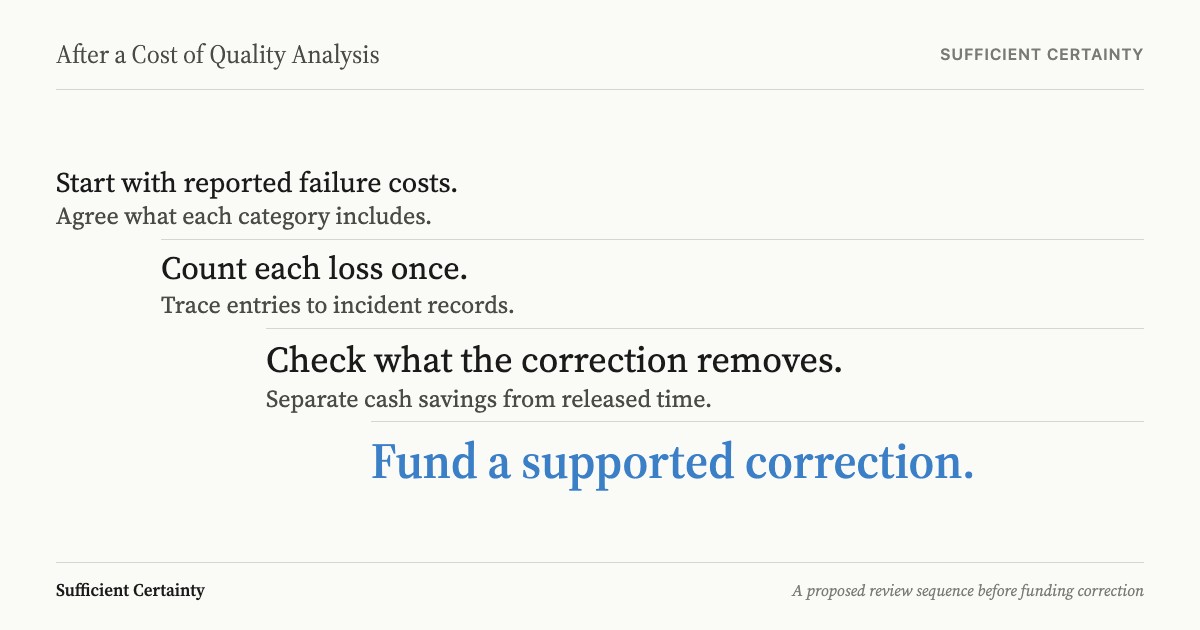
- Trace costs to distinct incident records.
- Separate avoidable spending from released time.
- Fund a correction with a supported benefit.
State what would make the proposal change. If the incident check shows that the largest category combines unrelated defects, narrow the intervention to the defect it can address. Recalculate the benefit on that basis. If the supported saving no longer justifies the expense, revise the scope or decline the request.
If the saving depends on an uncertain claim, choose a check that can change the decision. For a proposed equipment correction, that might mean observing whether the suspected defect occurs under the stated operating condition. If it does not, revisit the explanation before ordering the equipment. Use the actual failure mechanism to choose the check.
Keep the cost definition stable when judging whether the correction delivered its benefit. Record the baseline and source before work begins. Name who will obtain the later evidence. If the definition changes, explain the change rather than presenting the new number as directly comparable.
The Universal Decision-Making Method places assumptions before commitment. Here, the important assumptions concern the recorded loss and the saving the correction can deliver. Once the intervention is operating, the handover after a Six Sigma project addresses continuing controls. At this earlier point, the decision is whether the documented avoidable loss justifies funding the work.
A quality-cost ledger supports a spending decision only when its claimed savings survive a check of definitions and avoidability.
Work through your decisionNo sign-up. Just pick your decision and start.
Grant Purdy is the co-author, with Roger Estall, of Deciding (2020), and the architect of the Universal Decision-Making Method.