
After a Six Sigma project, give the process owner a control plan that states when to act. Closing the project can make its control plan more important: the project team is handing over the decisions about performance.
A Six Sigma project uses data and a structured improvement method to reduce process variation or defects.
A DMAIC project prepares the process for routine operation
For an existing process, DMAIC gives the improvement team a defined sequence of work. The team establishes the problem, measures performance, investigates causes, and evaluates changes. The final Control phase includes long-term measurement and reaction plans, as ASQ explains in its DMAIC guidance. Monitoring belongs inside the method.
That structure has practical value. It asks the team to establish a baseline and validate the measurement system before judging improvement. It also requires attention to the inputs that must remain controlled. A clear process map and a working measurement system give the process owner useful evidence for running the changed process.
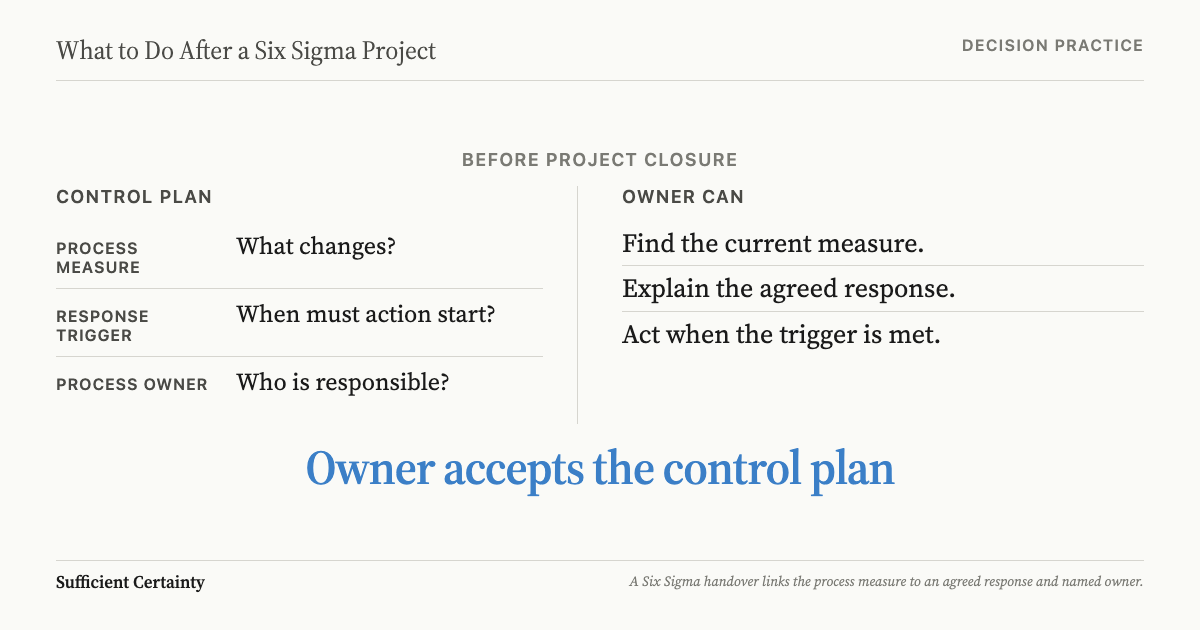
The Control phase should leave the process owner able to respond without waiting for the project team. Use the closing review to check that ability. Ask the owner to locate the current measure, explain what it means, and describe the response to a signal. A file marked complete is insufficient evidence of that ability.
The handover should connect the analysis to the operating instructions. The person receiving the process needs to know which changes were made and which conditions supported the result. Link the root-cause findings to the checks that will show whether the identified cause has returned.
Acceptance of the control plan should include acceptance of the response work. The owner may need access to a data source, authority to change an operating setting, or help from another team. Resolve those needs before removing the project team's support. Put unresolved work in the closing record with a named person and completion date.
This is a concrete application of strategic problem solving: preserve the useful analysis while making the next decision clear. The handover review need not repeat the investigation. It should establish that the operating team can use its results.
A completed DMAIC project still needs an owner who can act when its control measure changes. Start the Walk →
Who acts when the Six Sigma control measure changes?
A measure can be available while the response remains unclear. The control plan should answer a direct question: what observation requires someone to act? If the answer is only “review performance,” the owner still has to decide when a review is necessary and what action it permits.
A response trigger needs a named person and an agreed first action. Specify whether the person checks the measurement, investigates a cause, or escalates a service failure. Describe who can authorize a further change. A person who can view the chart may have no authority to alter the process it describes.
For statistical monitoring, use rules suited to the measure and process. NIST's control-chart guidance explains that a point outside control limits can warrant investigation. It also warns that systematic patterns can matter even when points remain inside those limits. The handover should identify which signals the operating team will use.
Keep the service target distinct from the control limits. NIST distinguishes control limits from specification limits: consistency and meeting requirements are different questions. A stable process can still need improvement. The owner should know both how to detect a change and how to judge whether performance meets the agreed requirement.
The chosen response must fit the signal that starts it. Do not use an arbitrary percentage copied from another project. Record the basis for the trigger and keep the relevant evidence accessible. If the team cannot justify the proposed rule, that is unfinished work for the closing review.
The ownership question also covers changes outside the process chart. Identify which operating conditions supported the improvement and who will notice if they change. A revised input or lost maintenance support may require a review of the control plan. State this as a proposed check for the particular process, rather than assuming every change requires another project.
The distinction between accountability and ownership matters at handover. Give one named owner responsibility for initiating the response. Identify a substitute when that person is absent. A department name alone leaves the first action open to interpretation.
Before closing, ask the receiving owner to explain the response using an actual observation from the project record. This checks whether the plan works. It should reveal missing access or unclear instructions while the people who prepared the analysis are still available.
Greensboro's Priority Air/Surface project missed its goal
The U.S. Postal Service Greensboro District ran a DMAIC project from April 15, 2016, to February 16, 2017. It aimed to improve on-time Priority Air/Surface service. The Office of Inspector General audit, NO-AR-18-001, recorded a pre-project score of 93.99% and a score of 94.01% in the last 20 weeks. The district's goal was 96%.
The difference was 0.02 percentage points. The team had not involved the required benefit validator, lacked a signed project charter, and had inconsistent, outdated documentation. The OIG recommended stronger controls and independent evaluation of project costs and savings.
The lesson for a closing review is to reconcile the measured result with the agreed goal. That is an application of the audit findings, not a claim that a different handover would have produced a particular service score. Do not infer from this one DMAIC project that all Six Sigma projects fail.
The missing documents matter to the next owner because they should make the agreement traceable. The owner needs a confirmed result and a clear account of outstanding work. Where the result falls short, the closing decision should state whether to continue improvement work or accept the remaining gap with reasons.
This proposed review connects a performance measure to a decision. It asks the sponsor to acknowledge what was achieved before authorizing closure. It also asks the process owner to accept the continuing work. Neither acceptance should rely on an unsupported claim of success.
A claimed benefit should be checked separately from completion of project tasks. Preserve any independent validation required by the organization. The proposed owner-and-trigger handover adds an operational question: who will respond when the process next needs attention? It does not replace benefit validation or repair an unverified result. Where the benefit is a claimed cost saving, the follow-up to a cost of quality analysis checks whether the recorded failure costs are distinct and avoidable by the proposed correction.
Put the control plan into the process owner's hands
Use the final closing review as the checkpoint. Bring the control plan, the recorded result, and the operating instructions together. Ask the named process owner to accept the monitoring work explicitly. The Universal Decision-Making Method connects implementation with monitoring, so the review should cover the decisions that remain after handover.
Keep one short handover record alongside the control plan. Write the measure's definition, source, and measurement interval in plain words. Name the person who obtains it and the person who responds. If the same person performs both tasks, say so. Include the location of the operating instructions.
Write the response trigger as an instruction the owner can follow. Identify the agreed signal and first action without inventing a universal threshold. Include the escalation route if the owner cannot resolve the issue. The principle of monitoring a decision is useful only when the observation can change what happens next.
Add the next review date and record what must be checked then. For an unmet objective, specify the remaining decision and who makes it. For a validated improvement, check that the operating team still has the resources and authority needed to maintain it. Use the organization's actual requirements to set the review interval.
Then exercise the handover. Have the owner retrieve the measure from its real source and find the response instruction. Ask who receives an escalation if action exceeds the owner's authority. Fix missing access and unclear responsibilities before the project team withdraws. Record any remaining limitation with the person responsible for resolving it.
Close the project when its continuing controls have an accepted owner. Keep the evidence supporting closure with the handover record. That gives the operating team a practical basis for responding to changed performance, without requiring it to reconstruct the project or wait for its former team.
Before closing the Six Sigma project, confirm who will respond when the agreed monitoring trigger is reached.
Work through your decisionNo sign-up. Just pick your decision and start.
Grant Purdy is the co-author, with Roger Estall, of Deciding (2020), and the architect of the Universal Decision-Making Method.