
After a dispute adjudication, ask counsel to mark the required actions and deadlines in the issued decision before approving further dispute spending. In S&T v Grove, the 2018 Court of Appeal upheld the validity of Grove's pay-less notice. The case shows why the immediate obligation must be identified from the actual decision and its legal setting.
Dispute adjudication is a process in which an appointed adjudicator determines a referred dispute under the applicable legal or contractual rules.
The Grove appeal separated notice validity from valuation
The approved Court of Appeal judgment records S&T seeking enforcement of an adjudicator's award of about £14 million plus VAT. The appeal upheld the conclusion that Grove's pay-less notice was valid. It is therefore wrong to describe the outcome as a court order requiring Grove to pay that full amount despite the notice.
The court also considered a separate question: when an employer could seek a true valuation where the notified sum had to be paid. It concluded that the required payment came before a true-value adjudication. That proposition belongs to the statutory and contractual payment route considered. It is not a rule for every adjudication in every jurisdiction.
The amount claimed, the adjudicator's award and the current legal obligation may differ. A manager receiving a decision needs counsel to distinguish them. The financial headline alone cannot tell the accounts team what to pay or tell the board which step may lawfully come next.
Create an action schedule from the operative decision. Ask counsel to identify each direction, its recipient and the time for compliance. Include any relevant later court order or agreed variation. If the current status is unclear, resolve that uncertainty promptly. Do not allow different departments to work from different versions of the obligation.
The schedule should separate an action already required from an option still being considered. Paying a confirmed amount and funding a further valuation dispute are different commitments. The organization may need enough certainty to carry out the first before it has decided whether the second is worthwhile.
Uncertainty about the final dispute outcome does not itself settle what must be done now. The decision record should show the advice supporting the immediate action. It should also identify who authorized funds and who will confirm completion. That gives the people implementing the decision a usable instruction.
This is an implementation question within organizational governance. The adjudication has produced a decision. The next task is to understand and carry out what that decision currently requires, while counsel identifies the options still available. Repeating the merits argument without that schedule can leave a real deadline unmanaged.
Make the confirmed instruction available to the person carrying it out. Attach the relevant part of the decision and the legal advice approved for that use. Avoid asking an accounts clerk or site manager to infer the legal effect from correspondence about the wider dispute. Their task is to implement a clear instruction within their authority.
Confirm the issued decision’s immediate obligation with counsel. Start the Walk →
What does an adjudicator's decision settle today?
A construction adjudicator's decision can establish a binding position while a route to final determination remains available. For contracts within its scope, section 108 of the Housing Grants, Construction and Regeneration Act 1996 requires the decision to bind pending final determination through the specified processes or agreement. Counsel must confirm the provision's application to the contract and current dispute.
That position serves a practical purpose for the recipient of a decision. The organization can identify what must happen while the larger disagreement continues. The governing terms matter. The Scheme for Construction Contracts specifies duties and powers for adjudicators where that scheme applies. A general description of adjudication cannot replace the operative terms of a particular case.
The first certainty threshold concerns the next required action, rather than the ultimate merits of the whole dispute. Ask whether the advice is clear enough to identify the amount or conduct required and its deadline. If different readings would change the action, obtain clarification through counsel. A budget approval should not conceal an unresolved legal interpretation.
The checkpoint after settlement analysis concerns whether to accept a proposed bargain. An issued adjudication decision presents a different task. The organization must understand an existing determination before deciding how to respond. It cannot assume the same freedom to accept, reject or defer the immediate action.
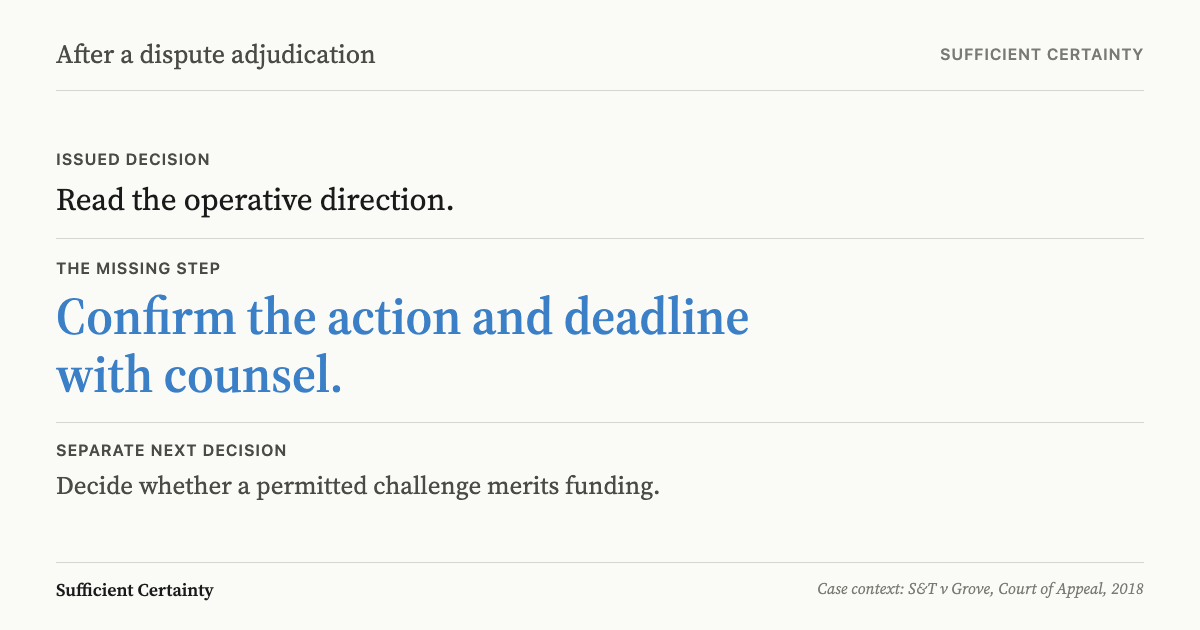
Ask the responsible finance or operations person to confirm that the instruction can be carried out. A direction to pay needs the correct recipient and the means to release funds. A direction concerning work needs a responsible manager who understands what must change. Legal clarity and practical readiness are separate checks on the same action.
A confirmed duty needs an owner who can implement it within the applicable time. Record any internal dependency before the deadline becomes urgent. If a transfer needs an additional approval, identify the approver. If the instruction cannot be implemented as understood, return that problem to counsel immediately.
The remaining decision is whether a permitted further step justifies its cost and consequences. Ask counsel which options remain open and which actions are prerequisites. Keep that advice beside the separate spending proposal. The person authorizing additional work needs to know what it could change, rather than assuming that further proceedings remove the present duty.
Confirm the next obligation before funding the challenge
Prepare a short implementation note before the next internal approval meeting. List the confirmed actions first. Give each an owner and deadline, with the source of the legal instruction. Mark any unresolved point for counsel. Then state the separate question on which management must decide, such as whether to fund a permitted further valuation process.
Choose the evidence needed for each commitment separately. Confirming a payment instruction may require counsel's interpretation of an issued decision. Approving further spending requires a defined purpose and a realistic account of what that step can achieve. Do not use uncertainty in one question to postpone answering the other.
The Universal Decision-Making Method provides a way to organize that work without replacing legal advice. Apply its steps to the management decision being made:
- Frame: State the immediate purpose, including compliance with the confirmed decision.
- Tentative Elements: Identify the required actions and the separately available options.
- Assumptions: Identify what the implementation plan assumes about authority and access to funds.
- Sufficient Certainty: Obtain the legal and practical evidence needed for the next authorization.
- Implement+Monitor: Carry out the action and retain evidence that it was completed.
Keep counsel responsible for the legal conclusions. Management remains responsible for allocating people and funds to implement the approved response. The note should make that division clear, especially where several business units have received the decision. A copy sent to everyone is not an assignment to anyone.
Ask the assigned owner to acknowledge the task and identify any missing information. Record where completion evidence will be kept. These small administrative actions matter because a decision can be legally clear while its internal implementation remains uncertain. Resolve that gap before reporting that the organization has responded.
The assumption check can expose a practical gap. An instruction may assume that a signatory is available or that funds can be released through the normal process. Verify a dependency that could prevent timely action. Where a problem appears, seek a lawful response through counsel rather than inventing an informal extension.
Internal authority to release funds can take time. Begin that process early enough to meet the confirmed legal deadline.
After implementation, obtain evidence of the required result. Use that evidence to update the action schedule. If an action remains incomplete, retain its open status and escalate it to the responsible person. The monitoring discussion explains why a progress report needs to change the response when the intended action has not occurred.
The completed note should distinguish what was required, what was done and what remains a separate decision. That distinction lets the organization consider further proceedings on their own purpose and evidence. It also prevents a continuing disagreement from obscuring the issued decision that must be addressed today.
A further dispute option needs its own purpose after the present duty is clear.
Work through your decisionNo sign-up. Just pick your decision and start.
Grant Purdy is the co-author, with Roger Estall, of Deciding (2020), and the architect of the Universal Decision-Making Method.