
After a settlement analysis, the standard move is to accept or reject the offer on the strength of the expected-value number. The step that decides whether that call holds is testing the assumptions behind the number: the win probability, the damages range, the procedural path and what the other side can actually do. In April 1987, Pennzoil turned down $2 billion from Texaco. Within days, Texaco was in Chapter 11.
Settlement analysis compares a settlement offer with the expected value of continuing to trial or appeal, weighing win probability, damages, legal costs and delay.
Texaco, Pennzoil and the assumption nobody checked
In early 1984, Pennzoil and Getty Oil agreed merger terms. Before the documents were signed, Texaco offered more and bought Getty. Pennzoil sued in Texas, alleging Texaco had induced Getty to break a binding agreement. On 19 November 1985, a Houston jury awarded Pennzoil $10.53 billion: $7.53 billion in actual damages and $3 billion in punitive damages.
Texaco's position rested on the verdict not surviving. At trial it had not put its own damages figure to the jury. As a New York litigator told The Christian Science Monitor in 1987, "The only evidence the jury had on damages was what Pennzoil put in."
The obstacle was procedural. To suspend enforcement of the judgment while it appealed, Texas law required Texaco to post a bond of at least the judgment, interest and costs: more than $13 billion. The Supreme Court later wrote that "Texaco would not have been able to post such a bond."
So Texaco went to federal court in New York, which found its constitutional claims had "a very clear probability of success" and blocked enforcement. The Second Circuit affirmed. With that injunction, Texaco could appeal while posting $1 billion instead of more than $13 billion, and its bargaining position depended on the shield holding.
On 12 February 1987, the Texas Court of Appeals cut the punitive award by $2 billion, leaving a principal of $8.53 billion. On 6 April, the Supreme Court ruled that the federal courts should have abstained.
Pennzoil's next move became a standard case in decision analysis under uncertainty. In Clemen and Reilly's textbook Making Hard Decisions, Texaco offers $2 billion just before Pennzoil begins filing liens, and chairman Hugh Liedtke's advisers call $3 billion to $5 billion fair. In the same account, Texaco's chief executive, James Kinnear, has promised to fight to the Supreme Court if necessary. The tree gives Liedtke two choices: take the $2 billion or counter at $5 billion.
The branches are tidy. Texaco refuses to negotiate (0.5), counters at $3 billion (0.33) or accepts $5 billion (0.17). If the case returns to court, Pennzoil collects $10.3 billion (0.2), $5 billion (0.5) or nothing (0.3). On the textbook's numbers, the counteroffer is worth about $4.6 billion against a certain $2 billion. The tree has no branch for bankruptcy, although Kinnear had said that Texaco would file if Pennzoil moved to secure liens.
Liedtke refused the offer. On 12 April 1987, Texaco filed for Chapter 11, the biggest company ever to do so at the time. Kinnear said Pennzoil had "rejected any reasonable basis for settling the absurd $11.1 billion Texas judgment." Pennzoil was now an unsecured creditor, and its shares fell $15.25 the next trading day.
In December 1987, the two companies agreed a $3 billion settlement as part of Texaco's reorganisation. The money was paid on 7 April 1988, and Texaco left bankruptcy after nearly a year.
Pennzoil's tree, as taught, assumed Texaco would keep negotiating. Texaco's posture assumed a federal court would keep the $13 billion bond off the table. Each rested on a move that someone else controlled.
Write down the probability your settlement number depends on most and ask what the other side could do that the tree does not allow for. Start the Walk →
What settlement analysis gets right and where it stops
The method earns its place. A settlement analysis forces a party to put a certain offer and an uncertain verdict on the same scale, and to price the fees, delay and appeal risk that sit between them. A decision tree separates the probability of each ruling from its payoff, so a vague disagreement about the case becomes a specific disagreement about one branch.
The evidence says the discipline is needed. Kiser, Asher and McShane (2008) studied 2,054 California cases that went to trial or arbitration after settlement talks failed. Plaintiffs ended up with an award no better than the defendant's last offer in 61.2 per cent of cases. Defendants erred less often, in 24.3 per cent, but their mean cost of error was $1.14 million against $43,100 for plaintiffs.
The authors found that error rates tracked context, such as case type and forum, more than attorney experience. Rejecting an offer is a forecast about the verdict, and in that sample the forecasts were often wrong.
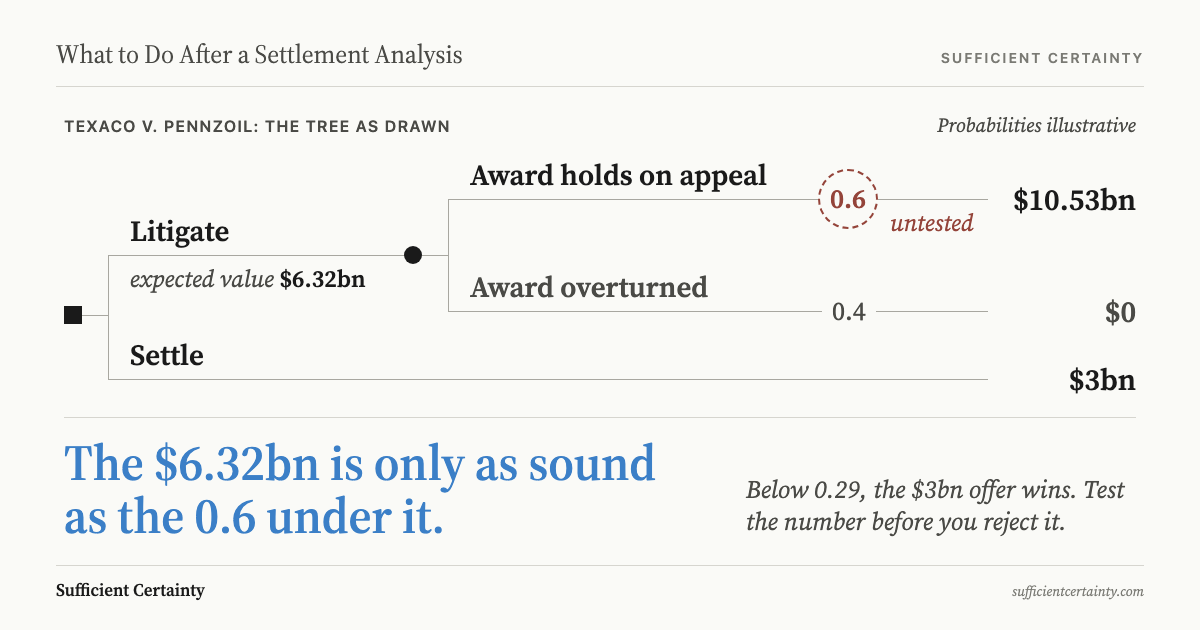
The limit lies in what the tree takes as given. Every probability on it is a judgment, usually counsel's, entered as a decimal. Every branch is one somebody thought to draw. The expected value is computed faithfully from both, and it inherits every gap in them.
In the illustration above, moving the chance that the award survives appeal from 0.6 to below 0.29 hands the decision to a hypothetical $3 billion offer. A sensitivity analysis shows how far an input can move. It does not show whether the tree has the right branches.
Three assumptions tend to go untested. The first is the procedural path: which court, which appeal, and whether a stay, bond rule or injunction will last. The second is the counterparty's constraints: whether the other side can pay, post security, absorb delay, or change the game entirely.
The third is survivability. An expected value averages outcomes a party may not live through, and how much downside to accept is a different question from which option has the higher mean. Each is a question of deciding under uncertainty, not of arithmetic.
What can the other side do that this tree does not let them do?
Like any situation analysis, a settlement analysis describes the position as it stands on the day it is run. It tells a party what the case is worth if the tree is right. It cannot say whether the tree is right.
The checkpoint between analysis and action
The checkpoint sits between the expected-value number and the letter to opposing counsel. Before accepting, rejecting or countering, list what the number depends on and test the items that would flip the decision if they were wrong. The same step follows a due diligence review, where a clean report can hide the assumption the deal rests on.
The five-step Universal Decision-Making Method gives the checkpoint an order. Frame the decision around the organisation's purpose in the dispute, which is rarely just the size of the payout. Treat the settlement recommendation as a tentative element rather than a conclusion. Then surface the assumptions under the number: the win probability, the damages range, the procedural path, the other side's constraints and the cost of delay.
Next, decide what counts as sufficient certainty for a call of this size. Some probabilities can be tested cheaply, with an independent estimate from second counsel or a check of the bond and stay rules in each forum. Others cannot be tested at all, and more analysis will not change that. The aim is to know which branches would change the decision.
Then implement and monitor. A settlement posture is a position held over months, and the conditions under it move: a ruling on a stay, a change in the other side's finances, a new appeal. Name the signals that would reopen the analysis before they arrive. Texaco went from losing its federal injunction to Chapter 11 in six days.
A settlement analysis prices the case. The checkpoint tests whether the price rests on anything that can still move.
You could reject the offer on its expected value and still leave the probability that set that value untested.
Work through your decisionNo sign-up. Just pick your decision and start.
Grant Purdy is the co-author, with Roger Estall, of Deciding (2020), and the architect of the Universal Decision-Making Method.