
A corporate development manager rang me two days before her investment committee met. Her data room held just over 4,000 documents. Eleven workstreams had reported. The findings memo ran to 90 pages, with 62 open items colour-coded amber and a covering note from external counsel confirming the review had been carried out in accordance with the agreed scope.
She could tell me exactly what had been examined and by whom. She could not tell me whether the company was worth buying. That gap is what due diligence has become in most organisations.
She did not need the term explained to her. Nobody who has been handed a live transaction does. What she needed was the part every glossary leaves out: how much due diligence is enough, and what to do when the findings come back mixed, which is what they always do.
Verifying the facts is the whole promise, and it is a smaller promise than the people selling the work would like you to notice.
Due diligence is enough when every assumption the decision turns on carries evidence proportionate to how much that assumption is holding up.
What a due diligence process actually covers
The American Bar Association's account of legal review in M&A is as clean a description of standard practice as you will find. You build a request list and collect against it, category by category, from corporate records through to litigation. You read what comes back. Then you use it to change how the price is paid or to hold back part of the consideration. Financial due diligence does the same work on the accounts, commercial review on the market and the customer base.
The request list is not a neutral instrument. It is a record of what previous buyers wished they had asked, wearing the costume of a description of what this decision depends on, and the costume is the damage. Notice also that nobody has ever shortened one. No adviser has been criticised for requesting one document too many, and the people who maintain the list are not the people who pay for the collecting.
The reviewed pile is a situation analysis of the target at a single moment, taken by people who were told which direction to point the camera. It is evidence. It is not a judgment, and it does not become one by getting thicker.
A complete due diligence checklist is still not enough
Boston Consulting Group put a number on where this ends. In Successful Due Diligence they report that as many as 55% of all M&A deals destroy shareholder value, and they name the mechanism: a standard checklist can still leave deal-breaking gaps in analysis. Their examples are not obscure. Customer concentration and the quality of the management team sink deals regularly, and neither one arrives in the data room as a document you can request.
A checklist is organised by category. The questions that kill transactions are organised by what the buyer is counting on, which is the difference between a filled-in worksheet and a short list of assumptions worth testing. If your reason for buying is that the target's sales team can be plugged into your distribution, no volume of contracts or title searches will tell you whether that is true. The item is not missing through carelessness. It is missing because the list was never built to hold it.
So the review finishes, the memo lands, and everyone in the room performs the same quiet trick: they treat the absence of red flags in the categories that were checked as evidence about the categories that were not. It is the oldest move in decision-making under uncertainty, borrowing confidence from the wrong place.
Nobody says it aloud. The 90 pages say it for them. I have watched that inference get made by experienced people who would throw it out instantly in any other setting.
Ask whether the review was complete and the honest answer is always yes, because complete means the agreed list was covered, and that ambiguity is useful to everybody in the room except the person who has to sign. It protects the reviewers, who are judged against the scope. It protects the adviser who wrote the scope in the first place.
Rank the assumptions behind your deal and decide which unanswered finding is serious enough to stop the purchase. Start the Walk →
HP bought Autonomy on assumptions nobody wrote down
On 20 November 2012, HP filed an 8-K reporting an approximately $8.8 billion non-cash impairment in its Software segment. HP said most of that charge related to accounting improprieties and disclosure failures at Autonomy before the acquisition, and to what HP had been told during the deal.
The reflex reading is that the due diligence was inadequate. Read it the other way round.
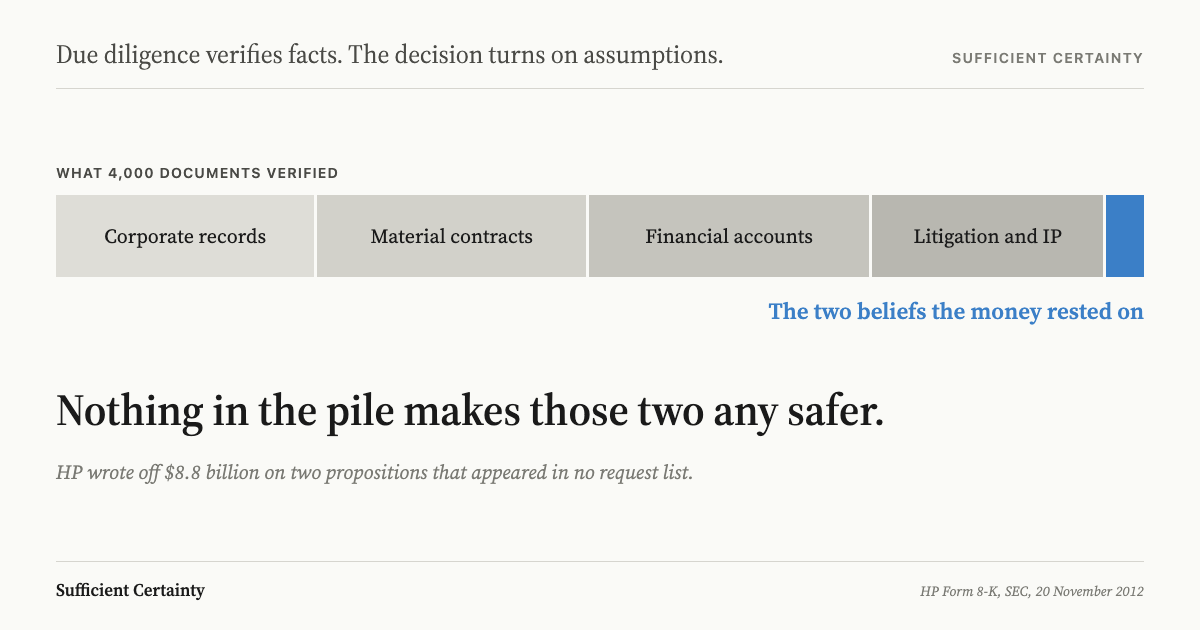
HP's decision rested on a small number of things being true, chief among them that reported revenue reflected economically real sales, and that what management told the buyer could be relied upon. Neither of those is a document. Each one is an assumption, and an assumption is not made safer by putting more files next to it. That is the line between risk and uncertainty, and a review only operates on one side of it.
The commitment stood on two propositions that appeared nowhere in the request list, carried no owner, and had no evidence attached in proportion to what they were holding up.
A thick report and a defensible decision are different achievements, and you can see which one the money is buying.
Eleven workstreams bill by the workstream, and a workstream that reports two pages has visibly done less than one reporting twelve. External counsel is paid to confirm the agreed scope was covered and is exposed to nothing at all if the business turns out to be worthless. The transaction-services practice earns its fee on the completion of the review, never on the outcome of the deal.
Everybody who adds a line to the request list is paid for the addition, and not one of them signs the cheque. Length is the only quality any of them can be judged on before the outcome arrives, so length is what you get.
This is what the review is for in most organisations now. It spreads responsibility for the commitment thinly enough that nobody is left holding it. A board that receives 90 pages and asks no further question has been handed something better than an answer. It has been given cover.
Turn every finding into an assumption you can rank
The fix is a second column on the findings memo.
Before the request list goes out, write down what has to be true for this transaction to work. Not what you would like to be true. What the money depends on.
Then, as each finding comes back, record two things against it: what this item is being taken to prove, and how far the decision moves if that turns out to be wrong. Roger Estall and I built the Universal Decision-Making Method around that discipline. It works because assumptions are the unit that decisions actually rest on, and they stay invisible until somebody writes them in a column.
Once they are written, rank them. We set that ranking out in Deciding as a grid of confidence against influence. An assumption you hold with high confidence and which barely moves the outcome deserves no further work, however easy it would be to investigate. An assumption the deal turns on, held on weak evidence, is the only place further review earns its cost. Most due diligence budgets are spent in the wrong quadrant, because the cheap, checkable, low-influence questions are the comfortable ones, and they produce pages.
Run the same test over the findings you already have. In my experience about a fifth of a typical memo is fact and the rest is inference presented in the grammar of fact. "The customer base is stable" is a conclusion drawn from two years of invoices and a management interview. Written as an assumption, with its evidence and its significance beside it, it stops being a finding and becomes a question with a price attached.
There is a second reason to write them down, and it concerns who is holding the pen at the end. A findings memo is addressed to a decision-maker but written by people with no authority to commit anything, which makes the handover ceremonial.
An assumption register survives that handover, because it names the beliefs the buyer is taking on rather than the files the reviewers opened. Run the review this way and the accountable person receives a short list of things that must be true, each carrying a note on how sure the organisation honestly is, which is a document they can act on and be judged against.
How much due diligence is enough
Enough is when the assumptions the decision turns on carry evidence proportionate to how much they are holding up. That is what sufficient certainty means in practice, and no checklist can hand it to you, because a checklist closes when its items are ticked.
It also tells you what to do with a red flag. When the SEC set out what happened at Yahoo, it recorded a breach affecting 500 million user accounts that was known internally in late 2014 but not properly reflected while the Verizon transaction was being negotiated.
Once it surfaced, Verizon did not walk. It repriced, cutting $350 million from the purchase price, a reduction of 7.25%. I would call that the correct handling of a finding. It did not answer whether to buy. It changed what one assumption was worth, and the price moved to match.
Quaker Oats had the opposite outcome. It paid $1.7 billion for Snapple in December 1994 and sold it to Triarc for $300 million in May 1997, booking a pretax loss of $1.4 billion on the disposal.
Nothing in the legal or financial file was wrong. The contracts were real, the assets existed, the accounts held up. The belief that failed was about distribution: that a brand built on independent regional distributors would prosper inside a supermarket-and-convenience system built for sports drinks.
I have never found that room forgivable. They tested the title searches to a professional standard and left the one belief carrying $1.4 billion to a conversation nobody minuted, because the title searches were billable and the belief belonged to whoever was brave enough to raise it.
What happens after a due diligence review closes is the part everyone forgets the day the deal signs. Name the specific conditions that would make you reopen each assumption you settled: the customer whose renewal you assumed, the regulator whose silence you priced in. Put a name against each one and a date by which somebody has to look. The same monitoring discipline applies to any situation analysis, and in my experience it is the first thing dropped once the announcement has gone out.
Write the assumption list before you write the request list. When the ones that matter have evidence behind them in proportion to their weight, the review is finished, and you can say so in a sentence.
You could sign off ninety pages of findings and still not know whether to buy.
Work through your decisionNo sign-up. Just pick your decision and start.
Grant Purdy is the co-author, with Roger Estall, of Deciding (2020), and the architect of the Universal Decision-Making Method.