
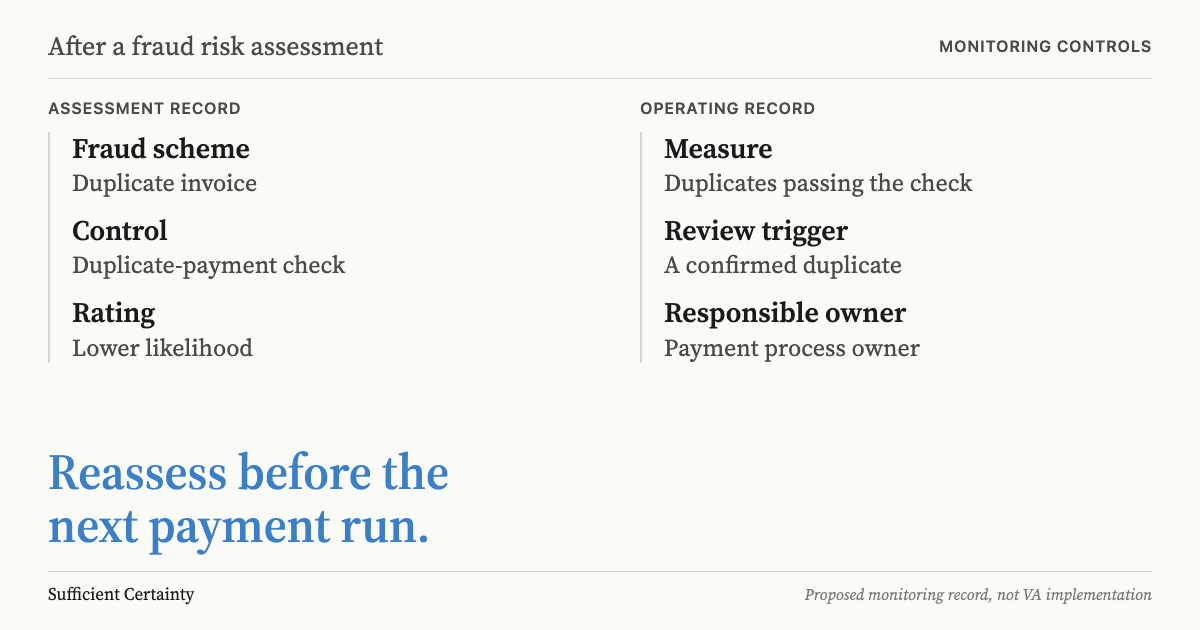
After a fraud risk assessment, write one control failure that would require an earlier review of the risk rating. Look at the completed row: the control has a name, but the next review may depend only on a calendar date. Add the event that would require an earlier review.
The assessment now needs an operating record. That record should show whether the control still supports the rating while transactions continue.
A fraud risk assessment identifies potential fraud schemes, considers their likelihood and impact, and assesses controls intended to address them.
VA lowered ratings before checking control performance
The Department of Veterans Affairs reimburses eligible travel for medical care through its Beneficiary Travel Program. Its fiscal year 2024 fraud risk assessment lowered some likelihood ratings because changes in two claims systems were expected to reduce fraud risks. The systems were BTSSS and eCAMS. GAO documented this in its June 2026 report.
VA had completed annual assessments since fiscal year 2018. These recorded some fraud risks, responses and controls. GAO also found that VA had not regularly evaluated whether relevant controls operated effectively. Its payment analysis covered earlier transactions, from fiscal years 2018 through 2023. Those results cannot establish how well every later control performed.
The lower rating needed evidence from the controls operating after the changes. An assessment can reasonably identify an expected improvement. Continued reliance on that improvement needs a way to detect whether it occurs.
The report's recommendations included regular monitoring of duplicate-payment and payment-amount controls. VA agreed with all nine recommendations. Agreement should not be described as completed implementation. GAO also distinguished improper payments from adjudicated fraud; a payment error does not, by itself, prove intentional deception.
The checklist in the next section contains five illustrative review statements. One records assessment content; four ask whether controls work in operation. The bars count those statements, not VA control tests.
For an organization using a similar rating change, the practical question is what would make that rating unsafe to retain. A report that lists installed software cannot answer that question alone. The decision owner needs a current result from the transactions covered by the control.
A reassessment trigger should connect an observed failure to a named decision. For example, an unexplained duplicate payment could require a review of the likelihood rating and the payment process. This is a proposed reader application, not a procedure attributed to VA.
Specify what the review could change. The owner might restore a higher rating, add a temporary review or change the control. Merely noting the exception leaves future payments under the same arrangement. A trigger has practical value only when someone can act on it.
Keep the scale of the claim narrow. Evidence about a duplicate check supports a judgment about that check. It does not establish that address verification or manual payment changes are reliable.
Monitoring is part of proper fraud management. GAO's Fraud Risk Framework emphasizes ongoing monitoring and feedback across its components. The problem arises when an organization completes the assessment but leaves the operating checks unspecified.
The same distinction matters after risk analysis: a rating summarizes a judgment, while evidence supports a particular reason for that judgment.
Which result would reopen the fraud rating lowered by a new control? Start the Walk →
What can a fraud risk assessment establish?
A completed assessment gives the owner a basis for choosing controls. It can identify where false claims might enter a process and which responses deserve attention. It also gives reviewers a written account of the judgment. The risk assessment collection examines how to use these outputs when making a decision.
A completed assessment is the starting record for monitoring. Keep its descriptions of schemes, controls and expected effects. Add the results that could change those descriptions. This extends the assessment into operations without asking the owner to repeat every interview or rebuild every rating each month.
Separate a control's activity from its effect. Counting invoices scanned tells the owner whether scanning took place. Checking for duplicate payments that passed the scan gives evidence about the result. Both may be needed, but they answer different questions. This distinction also matters after a KPI review.
Use the checklist below as an illustrative review of an assessment file. The first item can be verified directly from the report. The other labels show questions needing operating evidence. Change every status to reflect the actual record before using it.
Missing monitoring data should trigger review, not reassurance. An empty exception report could mean no exceptions occurred. It could also mean the export failed or excluded manual transactions. Ask which explanation the evidence supports before retaining the lower rating.
Document the population as well as the result. If the check covers only invoices submitted through one system, the measure should say so. Report transactions handled through another route separately. Otherwise, a clean result from one route may be used to justify a rating that covers the whole process.
Do not use control monitoring to make unsupported accusations. An exception should enter the appropriate review process. Preserve the distinction between an observed payment issue and a conclusion about intent. The immediate management task is to decide whether the control still supports continued reliance.
Set a review trigger beside each claimed control
Start with the assessment row selected in the opening sentence. Write the control's claimed effect in plain words. For a duplicate check, the claim could be that it prevents a second payment for the same invoice. Keep the monitoring record alongside that row.
Choose a measure that could show the control failing. A proposed measure is the count of confirmed duplicate payments that passed the check during the review period. Record the transactions covered by the measure. Include the data source and the person who checks its completeness.
Then set the trigger. For that proposed measure, one confirmed duplicate passing the check could require reassessment before the next payment run. The owner must choose a trigger suited to the process and possible consequences. This example is a starting point, not a universal numerical standard.
Record the response before the trigger is reached. Name who reviews the evidence and who can alter the process. State when the response is due. A finance analyst may find an exception but lack authority to change payment approval. The record must identify the person who has that authority.
Include changes to the process as review triggers. A new supplier route or a system change can alter what the existing control covers. The 2025 Green Book revision requires documentation of a change assessment process for significant changes. The reader's monitoring record should specify which local changes warrant review.
Check the report at the chosen interval and when a trigger occurs. Use the evidence to retain, revise or replace the control and its associated rating. This continues the work after risk evaluation. Keep the reason for that decision. This is the practical question a decision dashboard must answer.
Set a separate response for a failed data check. If the monitoring export is unavailable, the owner should not record that the control passed. Require the missing report to be restored and reviewed. Decide whether temporary manual checks are needed while the evidence is unavailable.
Keep the previous result beside the current one. A sudden change can prompt a check of transaction volume or reporting coverage before the owner changes the rating. Record that explanation so the next reviewer can distinguish a real improvement from a change in the data.
The rating should change when its supporting evidence changes. The Universal Decision-Making Method puts monitoring into the decision before implementation. Apply that principle here by recording the event that reopens the decision and the person responsible for responding.
Make the result visible to the people relying on the assessment. A brief record of the measure, trigger and response helps them see why the current rating remains appropriate. That supports transparent decisions when a control needs attention.
A completed fraud assessment needs a clear signal for when continued reliance on its controls must change.
Work through your decisionNo sign-up. Just pick your decision and start.
Grant Purdy is the co-author, with Roger Estall, of Deciding (2020), and the architect of the Universal Decision-Making Method.