
After a KPI review, the step before assigning corrective actions is to compare one reported KPI with the pending work behind it. In 2014, the Phoenix VA investigation found unreliable wait-time reporting and veterans on unofficial waiting lists. That finding matters when a review will determine staffing, spending or whether a service needs attention.
A KPI review compares key performance indicators with objectives, targets and previous results to decide whether action is needed.
A KPI review identifies results that need a response
A useful review starts with a specific purpose. For an appointment service, that might be to provide care when patients need it. For a maintenance team, it might be to keep equipment available. Write that purpose beside the indicator before discussing its colour. This makes it easier to ask whether the measure covers the result that matters.
Then examine the result over time. A single month can show a change, but a series can help distinguish a recurring problem from an isolated event. Compare like periods and explain any change in collection. The Government Digital Service guidance on performance metrics recommends a baseline, continuous measurement where possible, and segments that show differences within an overall result.
A review can expose a specific task for investigation. A completion measure might show where people leave a service. A cost measure might identify a process needing closer examination. Keep the observed result separate from its proposed explanation. A fall in completions does not, by itself, establish whether the cause is capacity, a technical fault or changed demand.
For a wider strategy, the Balanced Scorecard can connect several measures to objectives. The distinction between a Balanced Scorecard and individual KPIs matters here. One indicator can support a narrow operational decision without answering whether the overall strategy is working.
The review should record the decision each important result could change. Name the person who can make that decision. Identify what they need to know before acting. An instruction to explain a variance is incomplete if nobody knows whether the explanation could change staffing, service design or the target itself.
Keep the actions proportionate. A result supported by clear records may justify a small adjustment. A result that depends on an unexplained exclusion may first require a data check. Continuing the current arrangement is also an option. Record why it remains suitable and what new evidence would end that choice.
A useful handover preserves the evidence as well as the action. Attach the calculation used at the review and the date of its source records. State any known coverage limit beside the result. This helps the next reviewer understand which numbers matter for the decision and whether later figures can be compared with them.
What pending work is missing from the KPI?
Ask the data owner to show the underlying records, the calculation and the exclusions. A waiting-time KPI needs a clear start date and end date. It also needs a clear answer about requests that have not reached the end date. A measure of completed appointments can be accurate for those appointments while saying little about people still waiting.
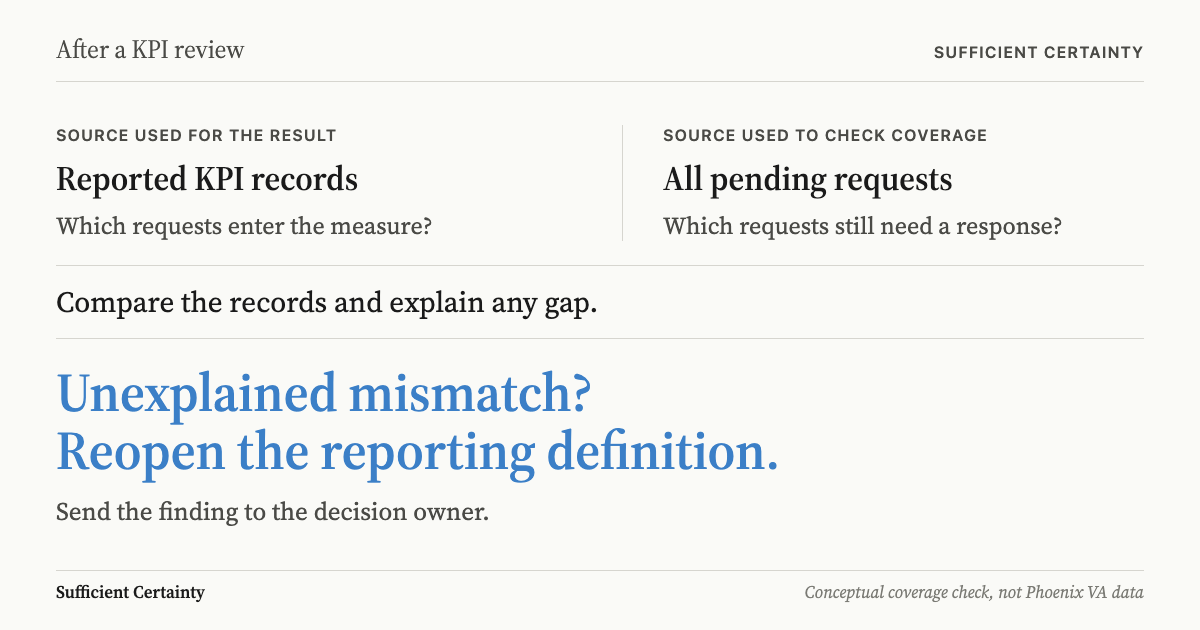
Check the reported population against another operational source. Compare the appointment system with incoming requests, referrals or unresolved enquiries. For maintenance, compare closed jobs with outstanding work orders. The purpose is to find whether the measure represents the work the decision concerns. This is a proposed check, not evidence that every dashboard hides a queue.
The US Government Accountability Office's data reliability guide treats accuracy, completeness and applicability as separate questions. Applied to a KPI review, that means checking more than arithmetic. A correctly calculated average can still be unsuitable for deciding whether enough capacity exists.
An unexplained gap between the KPI records and pending work should trigger a review of the reporting definition. Do not wait for the published result to miss its target. Ask whether requests enter the measure late, leave it early or remain outside it. Record which of these possibilities has been checked and which remains unresolved.
Review what the target encourages. If staff receive credit when a case closes, check what closure means. Does the work finish, move elsewhere or return under a new reference? These questions can be answered from records and staff explanations. They do not require a new scorecard. When a measure informs pay or development, the follow-up to a performance review checks the documented work and the resources available to the employee.
Keep the operational problem and the measurement problem visible at the same time. Correcting the calculation does not complete the pending work. Adding capacity does not repair a reporting rule that excludes requests. The next review needs evidence for both. This is part of choosing KPIs that fit the objective, rather than choosing a convenient number.
Before a KPI result changes staffing or spending, check whether it includes the work still waiting. Start the Walk →
Phoenix VA reported waits from incomplete queues
The VA Office of Inspector General's August 2014 report found that inappropriate scheduling practices made reported waiting times unreliable. Alongside veterans properly recorded on the electronic waiting list, investigators found additional veterans. Many were on unofficial lists.
The report recommended routine checks of scheduling accuracy. It also called for performance-data validation by an internal group with direct access to the Under Secretary for Health. Another recommendation addressed goals that diverted attention from timely, quality care.
The report could not assert that the absence of timely, quality care caused the veterans' deaths. It does not document a named KPI-review workshop. Its relevance here is the gap between reported access measures and the records of people seeking appointments.
For a service owner, the practical question is whether the records used for a capacity decision include all relevant demand. If they do not, an apparently satisfactory result cannot settle that decision. Someone must reconcile the sources and explain the gap. Meanwhile, the people or jobs outside the measure still need a response.
A reporting discrepancy needs a route to someone who can change the decision. Giving the check only to the person responsible for producing the score may leave the decision owner unaware of the problem. Choose a reviewer who can inspect the source records and raise unresolved findings directly.
These are decision-making lessons drawn from the investigation. They do not establish that every missed target involves manipulation. They establish a reason to verify coverage before treating an indicator as evidence of sufficient service capacity.
Set a trigger that reopens the KPI decision
Before closing the review, add a short monitoring note to the action record. Name the decision, the supporting KPI, the source records and the condition that will require reconsideration. The Universal Decision-Making Method makes monitoring part of implementation. The note should tell the next reviewer what to check, rather than merely when to meet.
Choose a trigger suited to the decision. For a queue, that could be an unexplained mismatch between new requests and cases entering the reporting system. For a quality measure, it could be evidence that closed cases reopen. Define how the mismatch will be detected and who must investigate it. Avoid inventing a universal percentage that supposedly suits every service.
Give the same result a clear meaning for each person who must act on it. Specify who checks the trigger, who receives the finding and who can change the plan. Include the date by which a finding needs a response. An alert without a named recipient leaves the next action uncertain.
Use statistical signals when the measure and data support them. The NIST guidance on control charts explains how control limits can signal a change requiring investigation. Those limits concern process behaviour. A management target concerns the desired result. Keep their meanings separate when choosing a trigger.
Record what happens if the evidence arrives late. The owner may need to make a temporary decision using incomplete information. State that limit and when the decision will be checked again. This keeps the conditions for changing the decision visible instead of treating the last dashboard as current evidence indefinitely.
Close the review with a recorded response to new evidence, not only an action due date. The record might require correcting a definition, checking capacity or reconsidering the target. Link it to the next monitoring check so the finding can change the decision while a useful response remains possible.
Which change in the pending work would make the KPI decision need another review?
Work through your decisionNo sign-up. Just pick your decision and start.
Grant Purdy is the co-author, with Roger Estall, of Deciding (2020), and the architect of the Universal Decision-Making Method.