
After a HACCP plan, the step before the next production run is to assign a named person to review its control records. In September 2012, an E. coli recall at XL Foods was followed by suspension of the plant's operating licence. The investigation found defects in both the written system and its implementation.
A HACCP plan is a written set of procedures for controlling significant food safety hazards through hazard analysis and critical control points.
Assign each control check before the next production run
The next step is to put the plan into use. That includes giving operators the current instructions, arranging training and making the required records available. The NACMCF application guidelines hosted by FDA describe continuing implementation and maintenance, including scheduled verification and revision when needed. Completion of the document begins that work. Ingredient authenticity needs a separate supply check: the follow-up to a food fraud vulnerability assessment matches a supplier claim to the batch evidence.
Start with the plan's existing control table. For each check, identify the person doing it, the record they complete and the person who reviews it. Use the approved procedure's frequency and limits. Give each task an owner for the actual shift, including cover when that person is absent. A job title that leaves two supervisors expecting the other to act is insufficient.
Separate monitoring from verification. Monitoring checks the process against the plan while work proceeds. Verification checks whether the system is being applied and remains effective. Current CFIA verification guidance calls for a competent verifier other than the person doing the monitoring or corrective action. It includes observing work and reviewing records. This is guidance for Canadian preventive control plans, rather than a universal staffing rule.
Bring the production supervisor and food safety lead together over the records that will reach them. Check how each will receive an exception during production, not just after the run. Ask the assigned operator to show the current form and explain the reporting route. This is a practical way to test whether the written allocation can work.
The checklist below describes questions to check at implementation. Its untested labels do not report findings about a particular plant. They identify matters the local team still needs to confirm.
Connect this allocation to ownership of the work. A person can own review without being allowed to release product or authorize restart. Write those separate authorities beside the relevant procedure. The reader should be able to find who acts, who checks and who decides from the same working record. If affected product has left the site, the follow-up to a food recall checks removal evidence beyond the first recipient before recommending closure.
Control records support decisions about the affected product
Records make the plan usable during a deviation. The reviewer needs to connect a reading or observation with the affected process, time and product. Otherwise, an entry may show that a check occurred without showing what it means for the next decision. Keep the product identity connected to the control record through the site's established traceability procedures.
The FDA's juice HACCP training material distinguishes the monitoring arrangements from corrective action and verification records. Its sector-specific guidance asks what is monitored, how, how often and by whom. Those fields help a reviewer understand what the record actually supports. The applicable plan must still supply the product-specific requirements.
Consider a supervisor reviewing a record after a missed check. The useful question is which production period the missing evidence affects. The reviewer then needs the plan's deviation procedure and the person authorized to assess product disposition. A later acceptable reading does not itself explain what happened during the unchecked period. A missing record needs an explicit decision, rather than an assumption that nothing went wrong.
Trend review adds a different question. Is the pattern changing even though the response to each individual event appears complete? Choose the time grouping from the process and the validated control system. Do not let a convenient weekly summary replace a shorter interval that the hazard requires. Keep the original records available when a summary raises a concern.
This is where monitoring a decision becomes concrete. Name the record the reviewer will examine and the finding that changes what happens next. The purpose of the wider risk assessment is served when that evidence reaches the person who can act on it.
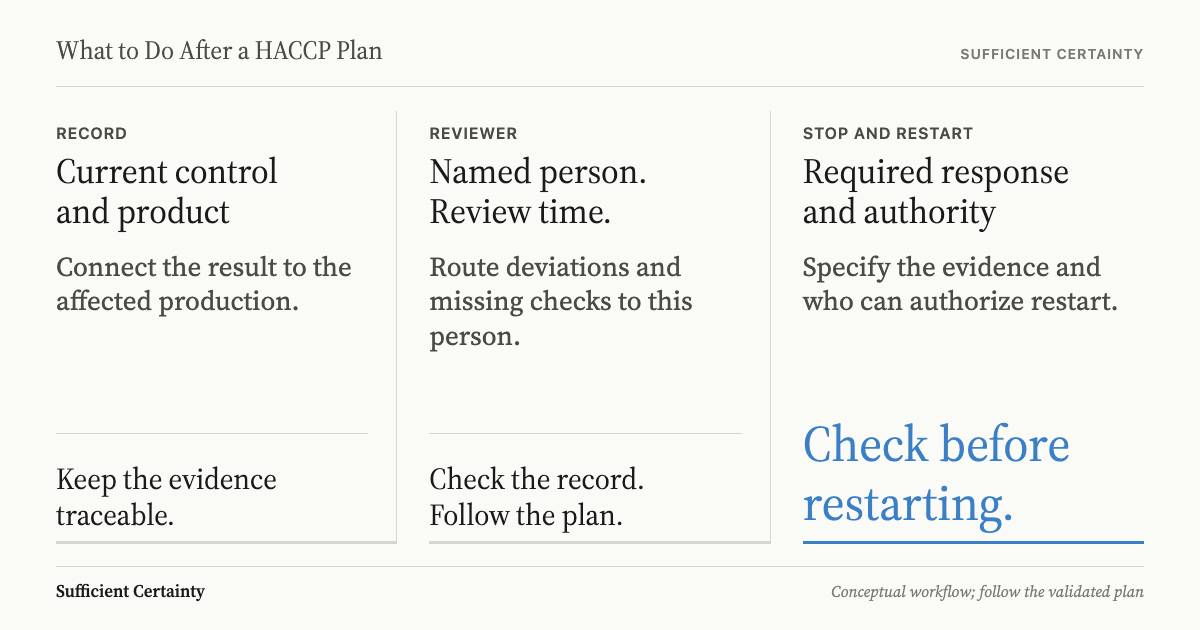
These decisions should remain visible after a deviation closes. Record what evidence supported the action and what further review remains due. That makes the next reviewer less dependent on a verbal explanation from someone who may have left the shift.
Who reviews the HACCP control records before the next production decision depends on them? Start the Walk →
Why did XL Foods need more than a revised plan?
The CFIA assessment of XL Foods Establishment 38 described an initially verified HACCP plan that was not fully implemented or regularly updated. Its detailed findings also identified design defects. Responsibility for maintenance was unidentified, reassessment procedures were absent and follow-up records for positive samples were incomplete. Guidance did not account adequately for high positive occurrences by hour or shift.
Later, CFIA found revised written programs acceptable and verified their implementation on site. Temporary cutting and de-boning operated under enhanced oversight, with meat still detained. The report's conditions for normal operations included satisfactory enhanced sampling, CFIA verification that all corrective actions were effectively implemented and demonstrated effective implementation of planned enhancements. Restart also required satisfactory pre-operational inspection and limited throughput under a submitted plan, with increases subject to CFIA approval.
These were conditions for a Canadian beef establishment in 2012. The archived assessment identified several contributing deficiencies, rather than one cause. It does not establish operating permission for another plant.
The practical issue for a reader is narrower than recreating that investigation. A plan can specify a response yet leave the person maintaining that response unclear. It can collect results yet group them in a way that obscures a developing problem. Check both issues against the actual process before relying on the next review.
HACCP already includes monitoring, corrective action and verification. The follow-through is to confirm that these provisions function in practice. Reopening the plan must have a named owner, just as checking a record does. A useful allocation of decision rights gives that owner a route to the people who can change the process.
Ask the team to trace one recent exception from detection to closure. Find the original result, the product affected, the response record and the check on the response. Where a handoff cannot be traced, establish what remains unknown and which decision depends on resolving it. This is a proposed review exercise, not a claim about what XL Foods did.
From completed plan to checked stop and restart decisions
Use the Universal Decision-Making Method to clarify the decision around the technical plan. Identify the intended outcome of the production run and the evidence it depends on. Keep food safety controls within the validated plan and applicable requirements. The method helps organize the review; it does not replace hazard-specific expertise or authorize operation.
Make the response route visible beside the control record. For a critical-limit deviation, the operator follows the plan's corrective action procedure, including the required action on the process and affected product. For a missing check or an adverse trend, the reviewer invokes the relevant procedure and escalates unresolved evidence to the food safety lead. Use the plan's limits and response rules, rather than inventing a new numerical threshold in a management meeting.
Distinguish correcting an event from reassessing the plan. If the same failure returns, ask whether the response is effective. If an ingredient, process, intended use or other relevant condition changes, the plan's owner must consider whether its hazard analysis still applies. The scheduled review should not be the only route by which that question reaches the team.
The timeline below marks a review point during implementation. It describes a proposed workflow, not the chronology of the XL Foods recall.
Define restart evidence before a stoppage occurs. The responsible food safety specialist should specify what shows control has been restored, what affected-product decisions remain open and who can authorize resumption. Where regulatory authorization is required, make that dependency explicit. Restoring production and releasing product are separate decisions; each needs the evidence and authority specified for it.
Keep a short decision note with the deviation records. State the finding, the action taken and the evidence reviewed. Name the person who authorized the next step and any conditions attached. Use the existing record system so the note remains connected to the affected work. This gives the decision record a practical purpose during the next shift.
Before the next production run, the assigned reviewer should be able to show where the current control records are held. The operator should know which finding requires immediate action. The plan owner should know which change requires reassessment. Finish the handoff with those three answers, then check that the evidence reaches the people responsible when work begins.
A completed HACCP plan still needs checked records, a reassessment owner and evidence for each restart decision.
Work through your decisionNo sign-up. Just pick your decision and start.
Grant Purdy is the co-author, with Roger Estall, of Deciding (2020), and the architect of the Universal Decision-Making Method.