
After post-merger integration planning, ask the owner of one day-one service to show how it will keep running through the handoff. The integration meeting can have a named lead for every workstream while nobody owns the transfer between them. Take one service from the completed plan and follow it across that boundary before approving the next milestone.
Post-merger integration planning sets out how acquired and acquiring businesses will combine selected activities to deliver the intended benefits.
Assign the integration milestones to service owners
The completed plan provides the starting point. It brings together functional schedules, budgets and responsibilities. The next task is to authorise the work that can proceed, with clear conditions for the commitments that depend on unfinished work.
Start with a service that must operate when ownership changes. Choose a service with a handoff between the businesses, rather than an internal task that one team controls. Ask its operational owner to explain what the recipient must receive. An integration lead can coordinate the transfer, but someone must remain accountable for delivery after the project meeting ends.
PRITCHETT's integration methodology moves from functional plans into execution and monitoring. Its planning stage includes an integrated schedule with milestones. Use those existing milestones to locate the decision. Avoid creating a second approval process with different dates and owners.
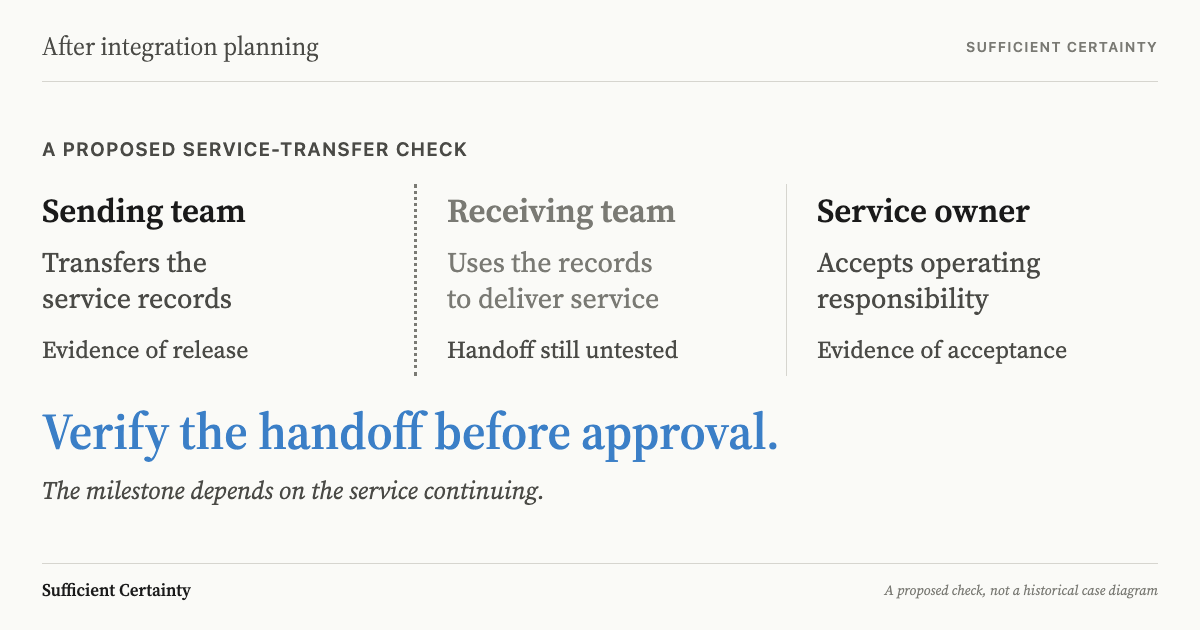
Assign responsibility for the service across the handoff, including the point where responsibility changes. A functional lead may have completed their own work while the receiving team still lacks access. Record who accepts the transfer and what evidence they need.
Keep a record of what the receiving owner inspected. A signed attendance sheet shows who attended a rehearsal. The useful evidence shows whether the recipient completed the service using the transferred information. Record any manual help required from the sending team, because that help may disappear when the transfer is complete. Leave the acceptance open until that dependency is resolved.
These checks concern the proposed operating arrangement. They sit beside the adoption work in a change management plan. Communication about a transfer does not establish that the transfer can work.
Which service handoff still depends on an assumption in the completed integration plan? Start the Walk →
A combined plan makes dependencies visible
A shared integration plan helps an executive see where one team's progress depends on another team. It can expose competing demands on staff and identify work that must finish before a system is retired. That view supports decisions about sequence and resources.
Deloitte's day-one readiness guidance connects readiness checkpoints to continuity of normal business. Its examples include service alignment and supplier readiness. This gives approval a practical focus: the organisation must keep delivering while the transaction changes how work is done.
The useful milestone states what must work when the date arrives. A system migration milestone should identify the operating responsibility that depends on the system. Otherwise the schedule can report a completed installation without answering whether staff can deliver the service.
Look at the milestone immediately before the transfer as well as the transfer date. A training task may depend on access being available early enough for staff to practise. If access arrives only at completion, the training milestone needs a different basis for acceptance.
Keep the combined view. It helps reveal that several changes require the same specialist or approval. Then use the service owner to examine the particular handoff. The change management hub places that check within the wider task of making an organisational change work.
A milestone can coordinate dependent work without proving that the dependency has been satisfied. That distinction matters when the executive authorises an irreversible step, such as removing the previous service arrangement.
Can the service continue through the handoff?
The assumption sits between two completed activities. The sending team has prepared the transfer. The receiving team has prepared its new operation. Approval still depends on those preparations joining up under the conditions in which the service must run.
Ask for evidence from both sides of the same handoff. Does the receiver have the data that the sender will actually provide? Can the receiver use it with the permissions available after completion? Has someone with authority accepted the unresolved exceptions? Review the transfer itself, rather than comparing separate progress reports.
Test the condition that permits the handoff before withdrawing the arrangement that currently supports the service. Where temporary support comes from a seller, check the agreed scope. Deloitte's guidance on transition service agreements describes the contract that specifies post-transaction support. A general expectation of help cannot establish what that contract covers.
The following is a proposed failure chain for a service transfer. It is an example to test against a plan, not a report of an actual merger.
The executive can change the commitment at the first unresolved dependency. That may mean retaining temporary support or narrowing the transfer. The question differs from a general business continuity review: this check tests the planned change in responsibility between organisations.
Separate confidence in each team's preparation from evidence that the two teams can complete the transfer. A rehearsal should include an exception that requires action on both sides.
Danaher described the work of integrating Pall
Danaher acquired Pall on 31 August 2015 for approximately $13.6 billion, net of assumed debt and acquired cash. Its 2016 Form 10-K placed Pall within the Life Sciences segment. The report described expected cost synergies as Pall and Cepheid were integrated, linked to the Danaher Business System and combined purchasing power.
The same filing identified acquisition risks involving the integration of personnel and systems. It also identified the challenge of retaining key employees and customers. These disclosures show the operating work behind an acquisition benefit. They do not establish that a specific Pall service failed or that Danaher left a handoff untested.
An expected integration benefit remains conditional on the operating changes needed to deliver it. The filing does not turn expected synergies into verified realised savings. Its segment margin movements include acquisition-related accounting effects and other factors. They cannot be attributed entirely to integration.
The proposed application for an acquirer is narrower than an assessment of the whole transaction. Take one planned service transfer that supports an expected benefit. Identify which team currently performs it and who must perform it after transfer. Then ask what must work before the former arrangement can end.
A planned purchasing change, for example, would need evidence that the receiving operation can fulfil the required service. This is a proposed reader check, not a claim about a Pall purchasing handoff. Keep it separate from testing customer purchases behind acquisition revenue benefits. Here, the commitment concerns the ability to keep operating during integration.
Verify one day-one service before its milestone
Bring the selected milestone to its approval meeting with one service-transfer record. State the service that must continue. Identify the sending owner and receiving owner. Attach the evidence from their joint check, with any gap that still prevents acceptance.
Use the Universal Decision-Making Method to connect that evidence to the commitment. The immediate purpose is to preserve the required service while changing how it is delivered. The executive needs enough certainty about the dependency to approve the particular step.
Approve the transfer on evidence that the receiving operation can deliver the required service. If evidence is missing, name the check that will resolve it. Assign someone who can obtain the evidence before the current support arrangement ends.
Make the response to failure explicit. If the joint check fails, the milestone should remain open while the owner resolves the dependency. Where continuing support is possible, confirm that it is authorised and available. Where it is unavailable, reconsider the scope or timing of the transfer.
Keep evidence of acceptance alongside the plan version it supports. If the proposed system or receiving team changes, ask the owner whether the earlier check still applies. Reopen acceptance when the change removes a condition on which the test depended.
The receiving owner should also know who can hold the next change if service deteriorates. That authority matters in a rollout where operations must continue. Record the observed condition that would require a hold. Keep that condition attached to the milestone so approval remains tied to service delivery.
Before approving the next integration milestone, what evidence shows that the receiving team can keep the service running?
Work through your decisionNo sign-up. Just pick your decision and start.
Grant Purdy is the co-author, with Roger Estall, of Deciding (2020), and the architect of the Universal Decision-Making Method.