
After commercial due diligence, write down which customer purchases must deliver the proposed acquisition's commercial benefit.
Consider a deal meeting where the adviser presents a sound market report and the buyer approves a cross-selling forecast. The report concerns the target's existing customers. The forecast depends on those customers buying something different after the purchase. Before approving the deal, connect that change to evidence.
Commercial due diligence contributes to a situation analysis of the purchase. The next task is to use its findings to frame the decision the buyer actually faces.
Commercial due diligence examines a business's market position and customer demand to challenge the commercial claims behind a proposed investment.
Trace the revenue claim to a customer purchase
Start with the purchase proposal, rather than the diligence report's executive summary. Find the commercial benefit used to justify buying this business. It might be continued revenue from existing customers. It might be access to a new customer group or additional sales through the buyer's distribution.
For each important revenue claim, identify the paying customer and the purchase involved. Record what the customer buys today. Then state what must change after acquisition. A claim about selling more products needs a customer who wants those products at the proposed price. Access to a customer list does not establish that demand.
The customer action is the connection between the acquisition and its promised benefit. Describe it plainly enough that the commercial team can check it. Replace “unlock distribution synergies” with the specific offer, customer group and route through which a purchase would occur.
Next, match that action to the diligence findings. Does the evidence cover the relevant customer group? Does it concern existing purchases or the new offer? Does it show willingness to pay, or only interest in a conversation? Put unanswered questions beside the revenue claims they affect. For a franchise offer, the follow-up to a franchise assessment checks the store margin with mandatory fees and lawful staffing costs included.
The work after financial due diligence concerns the financial basis of the purchase. This commercial checkpoint asks whether customers will support the proposed business after ownership changes. Use both findings when deciding what to buy and on what terms.
Bring this marked proposal to the approval meeting. It gives the decision-maker something specific to challenge before the transaction becomes a commitment.
Keep the proposed benefit distinct from the target's size. Owning more customers can be useful, but only if ownership serves the buyer's stated purpose. A larger customer base does not explain whether a different offer will retain those customers or persuade them to spend more. Before commissioning that diligence, the follow-up to M&A target screening tests the missing evidence behind the initial shortlist.
The report tests the target's commercial position
A useful report makes the investment case more open to challenge. The ICAEW commercial due diligence guideline describes an objective enquiry into commercial matters, including the business plan and projections. It draws on evidence about markets and customers, alongside the target's performance.
That enquiry can establish whether reported growth fits demand in the relevant market. It can expose dependence on a small customer group. It can also challenge management's account of why customers choose the business. These findings help the buyer judge whether the proposed price relies on a credible commercial story.
Good diligence can change the proposal before money is committed. Findings about weak demand may support a smaller acquisition or a different offer. Evidence of strong repeat purchases may support keeping an existing product separate from the buyer's range.
The distinction also matters after market research. Evidence should answer the decision's question. A strong answer about current demand cannot automatically answer a different question about demand under new ownership.
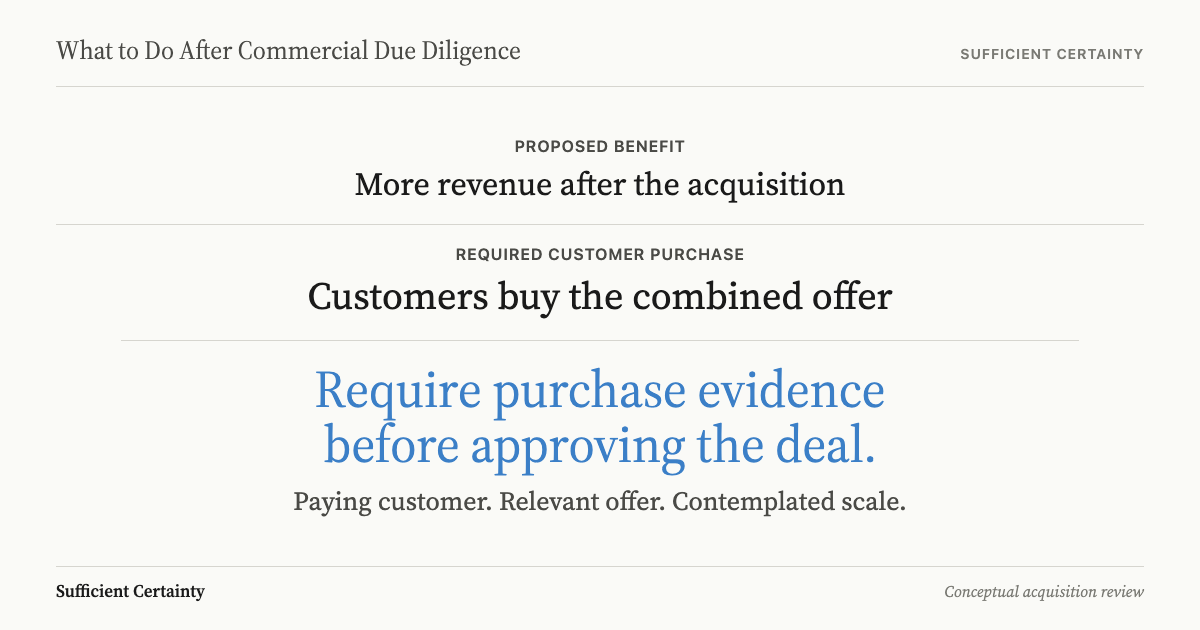
Before approving the acquisition, connect its promised commercial benefit to the customer purchase that must produce it. Start the Walk →
Will the buyer change what customers buy?
An acquisition can change the offer that made the target attractive. The buyer may bundle products or move customers to its sales channel. It may raise prices to fund the purchase. Each change creates a commercial question that evidence about the target alone may leave unanswered.
Separate the target's existing demand from the buyer's proposed additional demand. Otherwise, the same customer evidence can appear to justify both the standalone business and benefits that require new behaviour. The proposal should show where that second claim begins.
Ask who receives a useful benefit from the combined offer. Then ask who pays. A service can attract users without generating the revenue the buyer needs. An additional feature can be technically useful while doing little to change purchase decisions.
Test the claim at the scale contemplated in the proposal. Interviews with enthusiastic customers can explain interest. They do not establish that enough customers will buy at the assumed price. Evidence for a narrow segment should support a decision about that segment, with expansion treated as a separate question.
Where access permits, seek purchase evidence for the proposed offer. A paid trial can establish more than a statement of interest. Existing sales of a comparable bundle may be relevant if its customers and buying conditions match. Record those limits rather than treating any positive response as confirmation.
Use the assumptions behind the decision to direct further work. If customer adoption carries the purchase's benefit, it deserves attention before minor commercial details. A new owner cannot treat a desired customer response as an acquired asset.
eBay bought communications that did not fit its commerce business
The eBay purchase of Skype shows why commercial strength and usefulness to a particular buyer need separate attention. In its September 2005 acquisition announcement, eBay said Skype would strengthen its marketplace and payments platform. The announcement also described new business and revenue opportunities from combining commerce with communications.
That was a buyer-specific commercial rationale. It concerned what the combination could achieve, beyond owning an internet communications business. The decision therefore depended on the relationship between communications and purchases through eBay.
eBay's later account of the Skype transaction records the acquisition at $2.6 billion in 2005. It states that eBay took a $1.4 billion write-down in 2007 because the acquisition had not performed as expected. In 2009, its board decided to divest Skype because of a lack of synergies with its core businesses and focus on commerce.
A communications business could have value while the expected fit with eBay remained weak. The completed sale announcement valued Skype at $2.75 billion and recorded eBay retaining approximately 30% equity. The case does not support treating Skype as commercially worthless.
These public statements do not establish what formal commercial due diligence eBay performed. They also do not reveal every internal test before purchase. The useful lesson concerns the difference between the announced purpose and the later explanation for divestment.
For a buyer today, the corresponding question is concrete: what customer purchase makes this combination worth owning? Evidence of demand for the target's service answers only part of that question. The additional benefit claimed for this buyer needs its own support.
Rewrite the purchase proposal before approving it
Use the findings to restate the purpose of the purchase. Then examine whether acquisition is the best available way to achieve it. A distribution agreement may provide customer access without buying the whole business. A limited commercial partnership may let the buyer test a combined offer first.
This is framing a decision through situation analysis: the evidence informs which options deserve consideration. A purchase should compete with other ways to achieve the same purpose. Work already spent on diligence does not settle that comparison.
Approving the acquisition story
- Accept demand for the target's current offer.
- Carry the buyer's additional revenue into the proposal.
- Discuss customer adoption after completion.
Framing the customer purchase
- Name the purchase that delivers the buyer's benefit.
- Require evidence at the contemplated customer scale.
- Compare acquisition with a smaller commercial commitment.
Attach a short customer-evidence note to the revised proposal. Name the customer group and offer. State the purchase behaviour required, with the evidence supporting it. Explain where the evidence stops. Give the person approving the deal a clear account of the uncertainty they would accept.
The Universal Decision-Making Method connects framing to sufficient certainty before implementation. Here, that means judging whether the customer evidence is sufficient for the purchase being contemplated. If it supports only a smaller commitment, revise the commitment before approval.
For an approved purchase, name who will check actual adoption against the commercial claim. Specify when weak uptake would require a revised offer. That follow-through begins with a purchase proposal grounded in what customers have reason to buy.
If the necessary customer evidence cannot be obtained before signing, make that limit explicit in the approval note. Consider whether a smaller offer still serves the purpose. The decision-maker must be able to see which benefit remains uncertain and how much of the commitment depends on it.
Does the customer evidence support the combined offer the buyer intends to own?
Work through your decisionNo sign-up. Just pick your decision and start.
Grant Purdy is the co-author, with Roger Estall, of Deciding (2020), and the architect of the Universal Decision-Making Method.