
After a McKinsey 7S analysis, and before the change plan is approved, write down the belief the strategy depends on and the evidence that would show it is wrong. A 7S review can find strong fit and still leave that belief untested. It checks whether the seven elements support the strategy, not whether the strategy is right.
McKinsey 7S is a diagnostic that checks whether seven interdependent elements of an organisation fit together: strategy, structure, systems, shared values, style, staff and skills.
HBOS lined up all seven elements behind lending growth
HBOS was formed in 2001 when Halifax merged with Bank of Scotland. Its first annual report called it the "new force in banking". Chief executive James Crosby set a public target to lift return on equity from 17 per cent in 2001 to 20 per cent by 2004, through rapid growth across all divisions. HBOS reported 19.8 per cent in 2004.
Neither official report records a 7S exercise. But the Parliamentary Commission on Banking Standards' 2013 report describes each of the seven elements, and they all point the same way. The strategy was "aggressive, asset-led growth across divisions". The structure was federal: each division had its own chief executive and its own risk and control structures. The systems ran on targets.
The PRA and FCA review of 2015 found that HBOS reviewed its strategy mainly through the annual divisional business plans, so discussions of strategy and risk appetite "tended to focus on performance targets". Shared values and style matched. The Commission described the culture at the top as "brash", built on a belief that HBOS's gains in market share came from "a special set of skills" its competitors lacked.
Staff and skills followed the same pattern. The first two Group Risk Directors each moved on within 14 months, both promoted into the business. Crosby conceded it was "unusual" that two successive holders had no specific experience in risk functions. The Commission found the risk function's status "low relative to the operating divisions". Scored on fit alone, HBOS would have done well.
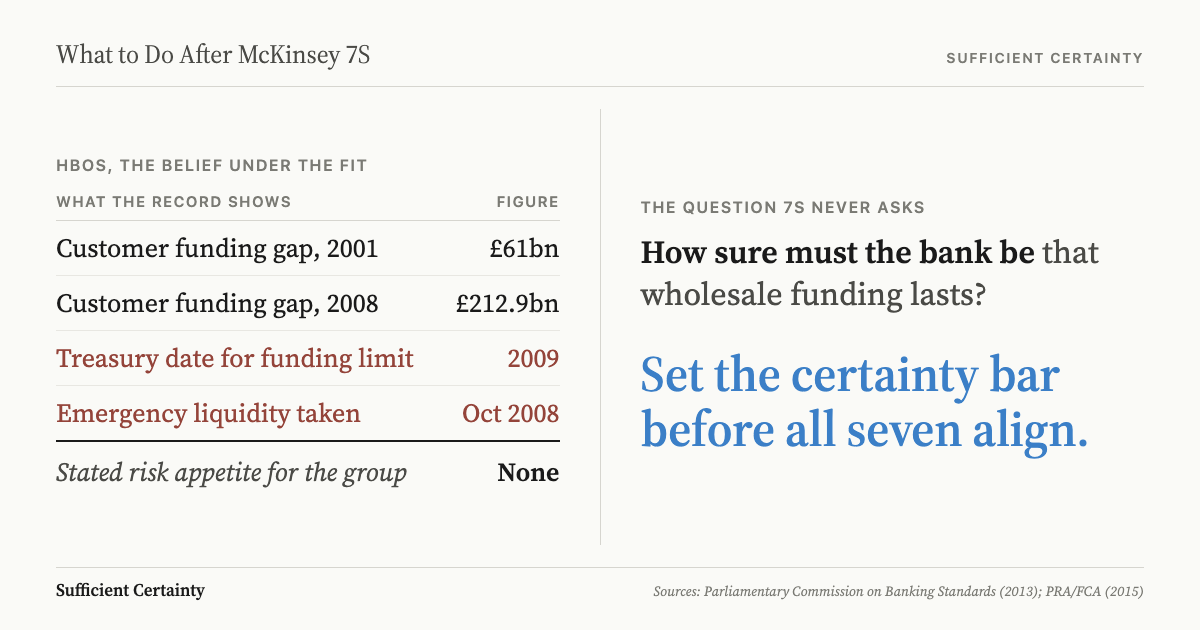
The fit rested on a belief about funding. From 2001 to 2008 loans grew about 13 per cent a year and customer deposits 8 per cent. The customer funding gap rose from £61 billion to £212.9 billion, and wholesale markets filled it. In November 2002 the finance director told the board the five-year plan would make HBOS "the largest wholesale funded clearing bank in the UK".
In 2006 the head of the Treasury Division, Lindsay Mackay, told the executive committee that the bank's wholesale funding capacity would be reached in 2009 under the current plan. HBOS had "the highest wholesale funding need of any of the UK banks", and he called the longer-term position "untenable and unsustainable". Crosby later told the Commission that wholesale funding was seen as a risk to the strategy but not a risk to the bank.
HBOS did respond. It diversified its funding and borrowed for longer, but the Commission found it used the longer-term money to fund more asset growth rather than to cut short-term borrowing. Wholesale funding due within a year rose from £90 billion in 2001 to £119 billion at the end of 2008.
The second belief sat in the Corporate Division, whose domestic loan book grew 22 per cent in 2007 alone. In 2006 its chief executive, Peter Cummings, set the aim to "be the best real estate bank in the UK". By the end of 2008 property and construction made up over a third of its loans.
The funding belief failed first. When Lehman Brothers collapsed in mid-September 2008, HBOS lost around £30 to £35 billion of customer deposits, mostly from non-bank financial and large corporate customers, and wholesale markets closed except overnight. Lloyds TSB announced its takeover on 18 September, and on 1 October HBOS took Emergency Liquidity Assistance from the Bank of England.
The lending belief failed too. The Commission estimated Corporate Division loan impairments from 2008 to 2011 at some £25 billion, about 20 per cent of its end-2008 book. It rejected the defence that closed markets caused them: "The lending approach of the Corporate Division would have been bad lending in any market." The Treasury and Lloyds put £28 billion of equity into HBOS.
Every element was set up to serve those two beliefs, yet neither was held to a stated level of certainty. The board approved the plan without asking how sure it was of either belief, which is how many governance failures start.
Write down the one belief your 7S alignment is built to serve and the point at which it stops holding, then decide how sure you need to be of it before the realignment plan is approved. Start the Walk →
What does a 7S change plan cover, and what does it leave out?
The framework is useful. Waterman, Peters and Phillips (1980) argued that structure is not organisation: redrawing the chart changes little unless the other elements move with it. McKinsey's own retrospective gives the reason: "significant progress in one part of the organization will be difficult without working on the others." That is why 7S is used at mergers and restructures, as one tool within strategic thinking.
After the analysis, the usual next step is to describe each element twice: as it is now, and as the strategy needs it to be. Structure might move from regional units to product lines. Systems might need new incentives and reporting. The difference between the two descriptions is a gap analysis for each element, and the list of gaps becomes the change management plan.
Sequencing comes next. Many teams start with the hard elements (strategy, structure and systems), which management can change directly. Others start with shared values, at the centre of the 7S diagram, because the other six are meant to line up with them. Either way, linked elements have to move together: a new structure paired with the old incentive system tends to drift back.
Each element then gets an owner and a review cadence, commonly quarterly, where the seven elements are scored again against the target state. This catches real problems: a new strategy bolted onto old incentives, or a values statement the promotion system contradicts. Done well, it produces the organisational alignment the framework promises.
All of these steps take the strategy element as given. The target state is defined by the strategy, the gap analysis measures the distance to it, and the quarterly review asks whether the elements have moved. None of them asks the people approving the plan to say how sure they are of the belief the strategy depends on.
At HBOS the board minuted in February 2004 that it "would not seek to second guess executive management's formulation of strategy". A 7S review run under that rule would have checked how well the bank delivered growth and left the strategy alone.
Close alignment also makes a wrong belief harder to correct. In September 2007 the HBOS finance director told the executive committee that lending "could not simply be 'turned off'." Growth targets for 2008 were cut by £10 billion, yet Corporate Division lending kept accelerating. Targets, culture and a weak risk function all pushed towards more lending.
Write down what has to stay true for the strategy to work
Do this before the change plan is approved. Four people need to be in the room: the executive sponsoring the change, the person who owns the strategy, the CFO or treasurer, who knows how the plan is funded, and one person given the job of arguing the other side.
Three questions do most of the work. What has to stay true for this strategy to work? What would be seen first if it stopped being true? What would it cost to reverse the realignment if it did? Narrow the answers to the one or two beliefs that, if wrong, would make the rest of the plan pointless.
Then write five things on one page. The belief, in a sentence a lender or a competitor could dispute. The evidence for it now, including the evidence against. The level of certainty the plan needs, given what it locks in. The signal and threshold that would reopen the decision. And the name of the person who watches that signal and has the standing to raise it.
The more elements the plan realigns, the harder it is to reverse, so the more certain the organisation needs to be. A risk appetite statement is meant to answer this. The PRA and FCA found HBOS had no clearly defined one for the group as a whole.
For HBOS in 2006, after the Treasury warning, the page might have read as follows. This is a hypothetical example, not a bank record. Belief: wholesale lenders will keep funding a customer funding gap that has been widening since 2001, when it stood at £61 billion. Evidence for: markets have funded it so far. Evidence against: the Treasury's own estimate that capacity runs out in 2009 under the current plan.
Certainty needed: very high, because every division is set up for growth. Signal: wholesale funding due within a year keeps rising in pounds, or term markets close for more than a month. Owner: the head of Treasury, reporting to the board. In fact, later heads of Treasury were not on the board and reported through divisional heads whose growth relied on that funding.
That page would have forced the funding question in 2006 rather than 2008. The options would have included slowing asset growth, staging the plan, keeping one element deliberately out of step, or dropping the plan. The obvious element to keep out of step was risk: a Group Risk function with authority to slow the divisions, which makes this a risk culture question as much as a structural one.
Write the signal and threshold into the change plan itself, so the decision reopens when the evidence moves rather than at the next quarterly review. In the Universal Decision-Making Method, this is where sufficient certainty is judged: after the analysis, and before the change plan is approved.
HBOS had seven elements pulling in one direction. What it lacked was a stated bar for how sure it needed to be that wholesale funding would last.
Work through your decisionNo sign-up. Just pick your decision and start.
Grant Purdy is the co-author, with Roger Estall, of Deciding (2020), and the architect of the Universal Decision-Making Method.