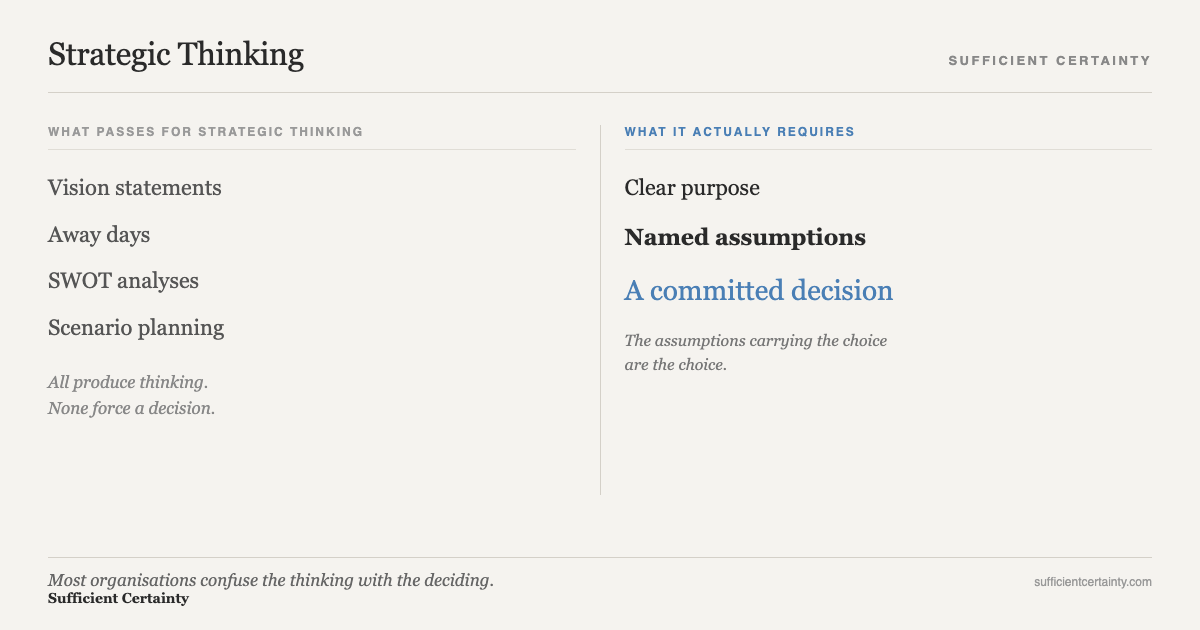
Strategic thinking describes how to think about direction and then stops before anyone commits. The gap between analysis and a decision somebody owns is where most strategies die. Thinking is necessary. Without a method for converting it into a testable commitment, it is analysis theatre.
Most guides to strategic thinking describe how to think and then stop. They offer mental models, checklists, and frameworks for analysis. What they rarely address is how any of that analysis becomes a committed decision that somebody owns and monitors. The gap between thinking and deciding is where most strategies die. A value-chain analysis needs a check on how changing one activity affects the activities that depend on it.
I have spent decades working with organisations that had no shortage of strategic thought. What they lacked was a method for converting that thought into action under uncertainty. It matters. But without a decision method, it is analysis theatre.
Strategic thinking is the work of setting direction before committing resources: clarifying purpose, identifying what is possible, and naming the assumptions behind each path.
What strategic thinking actually is
Strategic thinking is the upstream work of setting direction, not brainstorming, blue-sky ideation, or the retreat where everybody produces sticky notes and nobody produces a decision. It is the disciplined work of framing purpose, developing options, and surfacing the assumptions behind each option before committing resources. A business model canvas needs a check on the tasks and costs required to deliver one proposed offer before wider funding.
That makes it different from critical thinking, which tests individual claims for logic and evidence. Critical thinking asks: is this true? Direction-setting asks: given our purpose and context, which path should we commit to? Both are necessary. They are different cognitive jobs. A person who is superb at evaluating evidence may still have no method for setting direction, and a person with strong directional instinct may commit to options built on untested assumptions.
It is also different from strategic problem solving, which starts with a defined problem and works toward a solution. It sits further upstream. Before you can solve anything, someone must decide which problem matters. That is direction-setting, and it is the part most organisations skip.
The practical test is simple. If nobody in the room can name the purpose the decision serves, the assumptions it rests on, and the conditions under which those assumptions would fail, then what is happening is not this work. It is discussion. Before funding acquisition diligence, the follow-up to M&A target screening identifies missing evidence that could disqualify the leading candidate.
The two are not interchangeable: which one comes first changes the outcome.
Strategic thinking vs strategic planning
Strategic planning produces the document. Strategic thinking is the judgment that should inform it. Most organisations have the document without the judgment. The plan becomes a belief system: a set of commitments that persist because nobody revisits the assumptions underneath them. When conditions change, the plan does not, because no mechanism exists for noticing that its basis has shifted. Even a theory of change, which writes its assumptions down, rarely tests them. A decision to retain or exit an offer needs the follow-up to profitability analysis to distinguish attributed costs from the future effect on the whole business.
The distinction matters because you can have a thorough planning process and still have none of this discipline in it. If the plan was built by extrapolating last year's numbers and nobody asked what must hold true for those numbers to remain valid, the plan is an act of faith dressed as analysis. The same is true after strategic visioning, when a vision is cascaded into goals and budgets before anyone checks the future it describes.
I set out the fuller case in the difference between deciding and recording the decision, where the real test is whether the work changed a decision or merely produced a deck.
Why most strategic thinking stays theoretical
It stays theoretical because analysis is comfortable and commitment is not. An organisation can commission research, build models, sort its businesses on a BCG matrix, run scenarios, and hold workshops without anyone having to choose. The apparatus of strategic thought becomes a substitute for the decision it was meant to support. Before acting on a retirement shortlist, the follow-up to portfolio rationalization checks exit dependencies and whether savings survive the transition.
There is an old joke about Sherlock Holmes and Dr Watson on a camping trip. Watson wakes in the middle of the night, studies the sky, and produces elaborate astronomical and meteorological inferences. Holmes listens patiently and then says: "Watson, someone has stolen our tent." The joke works because it captures exactly how intelligent analysis can miss the one change that actually matters. Most organisations are Watson. They have more analytical talent than they know what to do with. What they lack is the discipline to notice the stolen tent.
This pattern shows up everywhere in decisions under uncertainty. Confronted with genuine uncertainty about the future, organisations default to producing more analysis rather than naming the assumptions that would change their direction. The analysis becomes self-justifying. People feel productive because they are working, even though no commitment has been made and no monitoring has been designed. The thinking is real. The deciding never happened.
Roger Estall and I called this "analysis theatre" because it has all the elements of strategic work except the one that matters: a human being with authority saying, "Given what we know and what we have assumed, I am committing us to this path, and here is how we will know if the basis shifts."
Take the strategy insight you are sitting on and convert it into a decision with testable assumptions. Start the Walk →
The elements of effective strategic thinking
Effective strategic thinking has identifiable elements: clarity of purpose, reading of context, generation of genuine options, and the surfacing of assumptions that carry each option. These are not soft skills. They are structural requirements. Miss any one of them and the thinking collapses into either analysis or guesswork. A market entry analysis that compares entry modes but never asks whether staying out was a possible answer has already skipped the third. The Universal Decision-Making Method sets out how these elements work together in practice and how they resolve into a committed decision.
For an international route, the follow-up to a CAGE distance analysis turns a distance finding into an operating obligation for the proposed partner.
The element most organisations skip is assumptions. They set direction based on beliefs about customers, costs, competitors, and regulation that nobody has made visible. The number from a market sizing exercise is the usual carrier: it moves into the business case while the adoption and price drivers beneath it stay unwritten. The segments from a market segmentation travel the same way. When those beliefs turn out to be wrong, the organisation calls it a surprise. It was not a surprise. It was an assumption in decision-making that was never surfaced and therefore never monitored. Before approving a price, the follow-up to pricing analysis tests a specific offer for a named buyer group against substitution and retained contribution. Before signing a franchise agreement, the follow-up to a franchise assessment tests the store margin against mandatory fees and the operator's available choices.
For a proposed competitive position, the follow-up to a strategic group analysis checks the channel access needed to reach customers there. After a VRIO analysis, check the evidence behind a claimed resource advantage before funding the investment that depends on it.
The question is what strategic thinking skills actually produce when they work. It is not broader vision or better analysis. The useful skill is naming the bet before commitment closes the door.
Strategic thinking in practice
Consider how Uber assembled its model. Satellite location, smartphone ubiquity, digital mapping, cheap mobile roaming, flexible payment systems, customer dissatisfaction with conventional taxis, and safety concerns about unlicensed transport. Each of these changes was visible to anyone in the taxi industry. None of them was invisible or proprietary. The strategic insight was joining the dots: seeing how apparently unrelated changes in technology, regulation, and consumer behaviour combined into a single commercial opportunity, the kind of new market space blue ocean strategy sets out to create. The incumbents failed not because they lacked information but because nobody in their organisations was practising the kind of context reading that notices combined effects.
A manufacturer committing to a new product line, the move an Ansoff matrix files as product development, faces the same challenge at a different scale. The commitment is future-facing. Its payoff depends on conditions that have not yet arrived: customer demand, raw-material costs, regulatory requirements, and whatever a competitive analysis concluded about competitor behaviour. If the organisation launches the product line without naming those assumptions, it has a plan but not a strategy. The same applies to a government changing tax policy to stimulate growth. The policy is a bet on future context. If nobody records what must hold true for the bet to pay off, nobody will know when to change course.
I have long treated strategic plans themselves as bundles of assumptions, each of which should be rated for likely volatility in both frequency and amplitude of change. A strategic plan with volatility-rated assumptions is a living instrument. A strategic plan without them is a shelf document that decays the moment conditions shift. The same pattern appears after a strategic gap analysis: teams move from identified gaps to roadmaps without testing whether the gaps rest on verified conditions. The same holds after a Wardley map, where each component's position on the evolution axis is a judgment about volatility drawn as if it were a fact. A growth strategy review usually ends the same way: targets set and budgets approved, with the demand assumptions underneath them never rated at all. So does a strategic alliance review, which recommends renewal on the partner's past record while the partner's future condition goes unrated.
If you want strategic thinking examples rather than another trait list, look for the ones that name an assumption and the condition that would force a return to the decision.
Strategic thinking and decision-making
Strategic thinking is the input. Decision-making is the commitment. Without the bridge between them, organisations accumulate insight and never act on it.
The bridge is a method. In Deciding, Roger Estall and I described five steps: frame the decision, develop options, recognise assumptions, achieve sufficient certainty, and design monitoring. The first three steps are where the thinking lives. The fourth step is where it resolves into a commitment. The fifth step is what keeps the commitment honest after the world has moved on.
Most decision-making frameworks handle pieces of this sequence. Some are good at framing, some at option evaluation, like a GE-McKinsey matrix, some at stakeholder alignment, some at internal fit, like a McKinsey 7S analysis. What they rarely do is insist that the Decider name the assumptions underlying the decision and design monitoring for the ones that remain unresolved. That insistence is what separates a decision method from an analytical exercise.
Without this bridge, the familiar organisational pattern emerges: thoughtful people who agree that something must change, a consultant report that confirms the direction, and no mechanism for converting either into a decision that someone owns. The thinking was sound. The deciding never happened.
Developing strategic thinking in your organisation
You do not develop strategic thinking by sending people on courses. You develop it by making real decisions using a method that forces participants to name assumptions, test them, and commit. The practice is in situ, not in vitro. It happens on live decisions with real consequences, not in classrooms with hypothetical scenarios. Before funding process improvements, the follow-up to an innovation audit tests the reported weakness against a recently completed project.
The mechanism that keeps the discipline alive after the decision is monitoring. Most organisations monitor outcomes: revenue, costs, milestones. Fewer monitor the assumptions on which the decision rested. A balanced scorecard is supposed to fix that, but most implementations revert to outcome tracking within a quarter. When a strategic direction was chosen because the team believed raw-material prices would remain stable, somebody must be watching raw-material prices and authorised to act when they do not. Without that, yesterday's direction-setting decays into today's unexamined belief.
The organisational challenge is not talent. Most senior teams have enough strategic thinkers. What they lack is a decision architecture that uses that thinking: clear authority over who decides, a method that surfaces assumptions before commitment, and monitoring that closes the loop. If the organisation has those three things, it becomes a repeatable practice. If it does not, the thinking stays in the retreat room.
The route to developing strategic thinking runs through those live decisions, not through another offsite.
When that architecture is absent, the defect sits in the wiring, not in the people. Leadership teams with capable thinkers still produce reactive decisions if the governance does not give challenge a protected route to the table.
You could keep thinking about it. Or you could decide.
Work through your decisionNo sign-up. Just pick your decision and start.
Grant Purdy is the co-author, with Roger Estall, of Deciding (2020), and the architect of the Universal Decision-Making Method.