
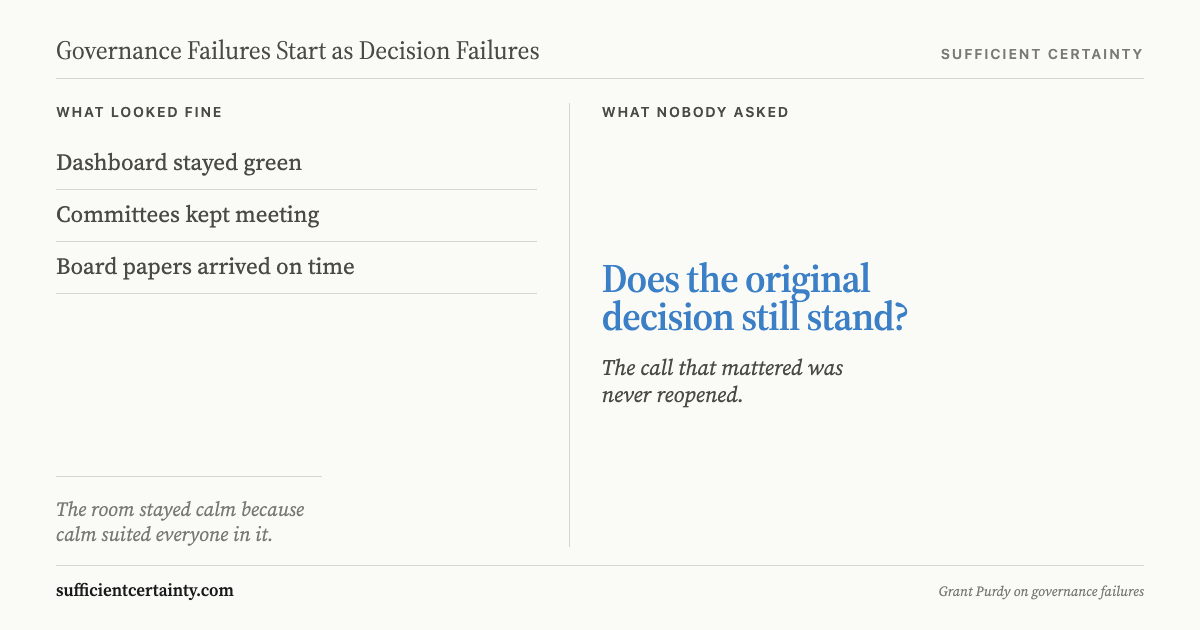
Governance failures start as decision failures. The paperwork looks fine. The dashboard is green. The committee minutes are neat. Then one assumption underneath a commitment collapses, and the question is always the same: who decided, and what did they check before signing?
I have seen board packs thick enough to stop a door. The dashboard was green. The committee minutes were neat. In my experience, that is where governance failures begin, not in the smoking crater everyone points to later.
When Roger Estall and I wrote Deciding, one case that stayed with me was the Australian banking Royal Commission. The banks had risk committees and formal reporting, the apparatus boards and regulators were meant to trust. Customers were still charged for services never provided. I do not care how complete the apparatus looked if nobody used it to reopen the decision path that let the misconduct keep paying.
Governance failures are breakdowns in oversight that leave the real decision untested, even when the formal structure looks complete.
What Governance Oversight Should Catch
Most writing on governance waits for the public scandal, then writes a sad little autopsy. I look earlier. A governance structure earns its cost only if it forces four things into the open before a decision hardens: a visible decision that someone is actually making, a named Decider who carries the outcome, a recorded basis for challenge, and a trigger that tells the organisation when to reopen the call.
Strip any of those away and the structure is administration dressed as oversight. Committees can meet weekly, dashboards can stay green, reporting can arrive on schedule. None of it matters if nobody can state in plain language what the decision was, who owns it, and what would force the organisation to change its mind. A risk register that faithfully records danger after the live decision has drifted past is a historical document. It is useful to lawyers. It is no use to Deciders. We should be suspicious the instant paperwork starts replacing a fresh decision. That suspicion is where risk-based decision making begins.
Corporate Governance Failures Hidden by Compliance
The room stays calm because calm suits people who do not want the call reopened. The Bell Review of The Star is a clean example. After damaging findings about Suncity and Alvin Chau had already surfaced, no further risk assessment was undertaken. The signal had arrived. It still suited people collecting the revenue, and people paid to preserve a respectable process, to treat the matter as more paper rather than a fresh decision. There was no shortage of committees. There was a shortage of anyone willing to ask, in plain English, whether the junket strategy still deserved backing.
Parliament's report on BHS made the same point in a seedier register. BHS was sold for GBP 1. The pension deficit stood at GBP 571 million on a section 75 basis, and around 11,000 jobs were put at risk. The full board was only informed of the sale terms around two weeks after completion. By then the board was being used as after-the-fact theatre around a decision already taken, a tidy arrangement if you are the person trying to leave someone else with the bill.
People like to call this a culture problem. I think that lets too many people off lightly. In both cases the governance failure sat inside the decision itself. The compliance apparatus was complete, but against the standard: neither had a named Decider who could be challenged, a recorded basis that would survive scrutiny, or a trigger that would force anyone to revisit.
Take a decision that looks compliant on paper and trace the assumption good reporting never forced into daylight. Start the Walk →
Why Governance Failures Survive Good Reporting
I think Danske Bank's report on its Estonian non-resident portfolio is the cleanest example of this failure surviving good reporting. The branch handled around EUR 200 billion in flows from roughly 10,000 customers. Back in 2007, the Estonian regulator told the bank that actual practice did not comply with its own anti-money-laundering rules. Later board reporting still gave comfort that controls were appropriate. That comfort suited the people making money from the flows, and the people whose jobs were easier if the reporting stayed tidy.
Toshiba's independent investigation shows how easily a listed company can look mature while behaving like a frightened sales desk. The corrections produced a negative impact of JPY 151.8 billion. The report said the measures that should have prevented or detected the misconduct did not function effectively. I read that more bluntly. Pressure from the top was protecting the number, and the oversight structure learned not to spoil the story. That is a handsome arrangement if your career depends on the quarterly picture.
Once warnings become reporting artefacts, people start talking as if the act of reporting is itself the act of governance. I have never bought that. A board pack can tell you that a matter has been escalated. It cannot tell you whether the basis of the decision still stands. That is why I have criticised the IIA Three Lines model. The labels become office furniture, then the paperwork outranks the decision that was supposed to be watched.
What Good Governance Would Have Forced
A governance framework earns its cost only when it forces the real decision into the open early enough to change it. I start with the Decider, then I want a decision record plain enough for challenge. If you are taking a plant-closure decision to the board in six weeks, I do not care how polished the appendix is. I want to know which assumption makes the closure acceptable, and what fact would force the board to reopen it. That is the point at which governance becomes useful to Sarah, not decorative to everyone else.
That is why the Universal Decision-Making Method matters to governance. It forces people to state the decision plainly, then show the assumptions before they harden into committee folklore. In my experience, we only need one brutal monitoring question: how will we know, quickly enough, that the basis of this call has failed? If the organisation cannot answer that within days, its governance is decoration (expensive decoration, admittedly).
The remedy is not another layer of machinery. I want one accountable Decider with a visible basis for challenge, and monitoring tied to the assumptions that made the call acceptable in the first place. That is the version of organisational governance I trust, because it helps an organisation change its mind before the headlines do it for them. The clean-up industry can sort itself out afterward, as it always does.
Governance failures begin when procedure is used to protect a decision that should have been reopened. I have seen that pattern often enough to distrust tidy paperwork on sight.
You could approve the next governance review and still leave the real decision unexamined.
Work through your decisionNo sign-up. Just pick your decision and start.
Grant Purdy is the co-author, with Roger Estall, of Deciding (2020), and the architect of the Universal Decision-Making Method.