
After setting a net-zero target, ask the owner of one project due for funding to show its cost and delivery schedule. In its June 2026 assessment, the UK Climate Change Committee found credible plans covered 44% of the emissions reductions needed for the UK’s 2030 climate commitment.
That national assessment concerns delivery credibility, not the probability that any organisation will succeed. It raises a practical question for a target owner: what evidence is enough to approve the next commitment?
A net-zero target sets a date for balancing specified greenhouse gas emissions with removals, within a stated boundary.
A net-zero target sets the destination and accounting boundary
A useful target gives the organisation a date, a defined emissions boundary and a basis for tracking progress. The IPCC definition of net-zero greenhouse gas emissions concerns the balance between human-caused emissions and removals over a specified period. The target needs to say which emissions and removals it includes.
Before turning that target into projects, preserve the accounting details. Record the baseline year, the activities covered and the treatment of changes to the organisation. Keep these details beside the target, rather than in a separate document that a budget approver might miss.
The GHG Protocol Corporate Standard provides an accounting framework for corporate emissions inventories. An inventory gives the delivery team a starting point for identifying emissions sources. It also lets the team distinguish a change in reported emissions from a change in the activities being counted. Before funding a claimed reduction, the follow-up to a carbon footprint audit checks the activity record and calculation boundary behind the inventory.
A target then helps departments connect purchasing, maintenance and investment decisions to a common outcome. A facility replacement can be considered alongside procurement changes, rather than judged only by its own budget. This is part of organisational governance: people need to know what outcome their decisions must support.
- Target date and emissions boundary
- Planned contributions to emissions reduction
- Evidence behind the next contribution
- Budget for required enabling work
- Owner with authority to deliver
- Threshold for approving the commitment
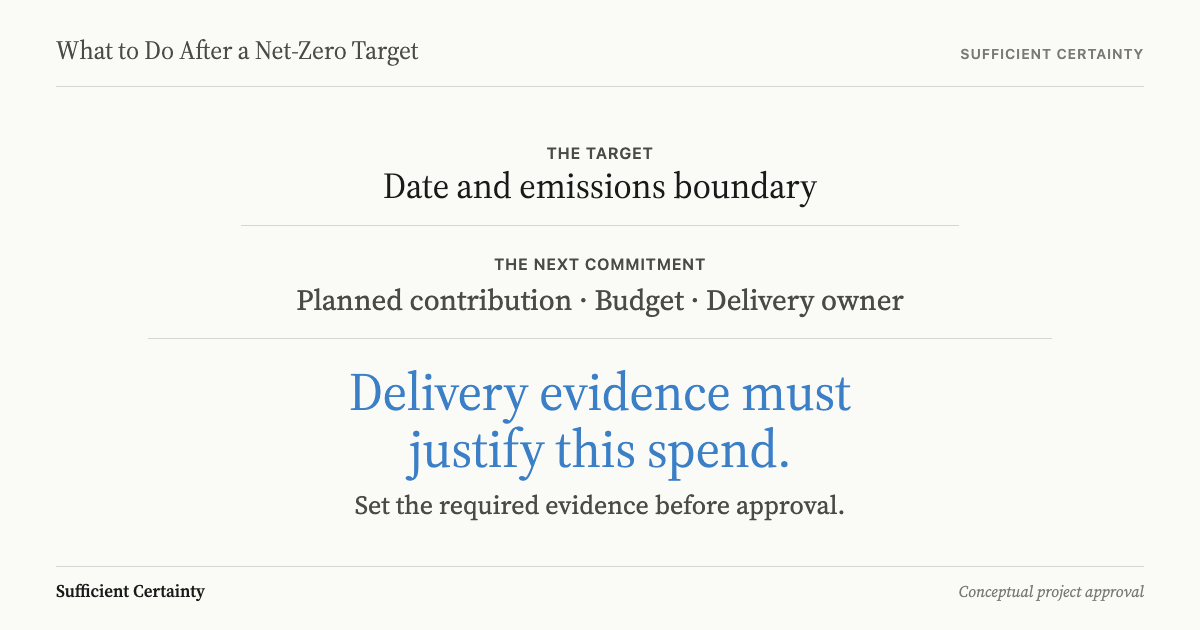
These details are useful inputs to the next decision. They let an approver ask what a proposed project contributes, when that contribution starts and which emissions it affects. The target should make the promised contribution clear enough to challenge before money is committed.
It is also worth keeping the target separate from the project approval. Agreeing the destination does not approve every proposed route. A gap analysis can identify the distance still to cover, while the spending decision determines which part to address next.
Before funding the next net-zero project, state which delivery evidence would make its commitment justified. Start the Walk →
What evidence would justify the next spending decision?
The next question is narrower than whether the entire net-zero plan is certain. Take one near-term commitment: a purchase, a contract renewal or a facility change. Find the contribution assigned to it in the delivery plan. Then ask which missing fact could change the decision to fund it.
For a proposed equipment replacement, that fact might be whether the site can operate the equipment as intended. Installation access, power supply or operating requirements could change the cost and start date. This is a hypothetical approval check, not evidence about how often such projects fail. Physical adaptation needs a separate check: the follow-up to a climate risk assessment tests whether the proposed measure can operate under the assessed conditions.
Write the relevant condition beside the projected reduction. Name the evidence needed to support it, the person who must obtain that evidence and the approval deadline. A supplier’s general product claim may answer a different question from a site assessment. Evidence must support the proposed use, cost and delivery date, rather than merely describe an available technology.
The required evidence depends on the commitment. A small trial with a clear stop point can leave some questions open. A long contract or a major facility conversion needs stronger support for conditions that would make the spending ineffective. The aim is enough information to decide, with the remaining uncertainty stated.
Set the threshold before the approval meeting. For example, an approver could require a site-specific assessment and confirmation that the full installation cost fits the authorised budget. This is an illustrative threshold for one decision. It is not a universal technical standard or a substitute for required specialist checks.
Keep the budget and owner attached to that evidence requirement. If funding for enabling work is absent, record it as absent. If the project depends on another department’s delivery date, obtain that department’s agreement. Assigning a name without the authority or resources to act leaves the dependency unresolved.
Reopen the proposed commitment when the available evidence falls below the agreed threshold. The response could be a smaller first stage, a different project or additional investigation. This review concerns the delivery decision. It does not require every assumption across the whole net-zero plan to be checked first.
The UK assessment separated promised reductions from credible delivery
The Climate Change Committee’s 2026 statutory progress report was published on 24 June. Its policy assessment was completed on 27 May 2026. It examined the Government’s October 2025 Carbon Budget and Growth Delivery Plan, which replaced the 2023 plan.
The UK’s 2030 Nationally Determined Contribution requires at least a 68% emissions reduction against 1990, excluding international aviation and shipping. The Committee assessed 44% of the required reductions as supported by credible plans. The rest included plans with delivery risks, insufficient plans and reductions absent from the Government’s pathway.
These are shares of the emissions reductions needed for that national commitment. They are not probabilities of success. The 2030 commitment is also distinct from the UK’s 2050 net-zero target. The report assessed the credibility of delivery plans at a stated date; it did not establish a certain future failure.
The practical lesson here is an application of the Universal Decision-Making Method. There is no claim that the Government used that method. A target owner can make the same distinction between a contribution written into a plan and a contribution supported by sufficient delivery evidence.
That distinction helps an approver decide where to direct attention. One project may have confirmed funding and a deliverable contract. Another may depend on an unresolved operating condition. Combining them in a single total does not resolve the second project’s dependency. Nor does the national percentage tell an organisation what certainty threshold to use.
A cost-benefit analysis can help compare proposed contributions. The approval still needs to address the conditions behind the contribution selected. A credible delivery claim needs evidence matched to the specific commitment being approved.
Set the evidence threshold before approving the next commitment
Bring the delivery plan into the next funding decision. Select one project whose delay or shortfall would materially affect the near-term pathway. Put its expected contribution, budget, owner and missing evidence on a single approval page. Keep links to technical material available for review.
Use the five-step Universal Decision-Making Method to work through that commitment:
- Frame. State the organisation’s purpose, the contribution sought and the period the decision must cover. Identify the operating constraints.
- Tentative Elements. Describe the proposed work, spending, sequence and responsibilities. Include a smaller commitment if it could achieve a useful result.
- Assumptions. Identify the conditions on which that contribution depends. Give attention to conditions with greater influence and weaker support.
- Sufficient Certainty. Decide whether the evidence justifies this commitment. If it does not, change the proposal or obtain evidence and reconsider.
- Implement+Monitor. Assign delivery and monitoring duties. Specify when a changed condition must return to the person authorised to revise the decision.
Write the approval condition in terms that another person can check. State which evidence is required and what result would be acceptable. Avoid a condition such as “confidence improved”, which leaves the owner guessing what to supply. The approval page should show why the remaining uncertainty is acceptable for this commitment.
Monitoring should follow the same delivery conditions. For a project dependent on an installation date, record the latest date that still supports its planned contribution. If that date slips, specify who can change the sequence or reassign funding. Resource allocation becomes a decision to revisit, rather than an annual budget entry left untouched.
Keep confirmed work moving where its own conditions remain sound. Hold or alter the part that lacks support. The next useful step after a net-zero target is to approve one delivery commitment on evidence sufficient for that commitment.
The next net-zero commitment needs a clear evidence threshold, a funded plan and an owner who can act.
Work through your decisionNo sign-up. Just pick your decision and start.
Grant Purdy is the co-author, with Roger Estall, of Deciding (2020), and the architect of the Universal Decision-Making Method.