
After a PCI DSS assessment, trace one live payment route from collection to its final destination against the assessed data-flow diagram before signing the attestation. In 2012, Global Payments reported an intrusion-related charge and an independent review for returning to compliant-provider lists. An attestation needs a checked account of the payment environment it describes.
A PCI DSS assessment examines a defined payment environment against applicable requirements of the Payment Card Industry Data Security Standard.
Global Payments faced independent review after its intrusion
Global Payments’ 2012 financial-results filing reported an $84.4 million pretax charge related to its intrusion. It included estimated card-brand charges and investigation and remediation expenses. The filing said a qualified security assessor was conducting the independent review needed for the company’s return to lists of PCI-compliant service providers.
The filing establishes a post-intrusion review and a reported cost. It does not establish the date, scope, or findings of an earlier assessment. It cannot prove the company was continuously compliant when the intrusion occurred. The historical event also does not define current PCI DSS requirements.
A statement about assessment status must retain the environment and evidence it actually covers.
The suggested checkpoint here concerns the payment routes described by the assessment awaiting attestation. It is not a claim that a missing route caused the Global Payments intrusion. That cause is not established by this filing. The practical question is whether the report’s scope still corresponds to the environment the organization is about to attest to.
Ask the payment operations owner to identify an actual current acceptance channel. Open the assessed data-flow diagram and the supporting scope record. Follow the route with the people responsible for the application and payment processing. Use approved test arrangements and existing technical evidence. Do not copy real card numbers into a working note.
Record where data enters and where the route ends. Mark each component and external handoff on the diagram. Identify any point whose operation is uncertain. A route should not be accepted as understood merely because the diagram has a line between two named systems.
The check should follow card-data movement through the current environment.
A payment route can include steps beyond the customer’s initial purchase. Ask how the route changes during a refund or an exception handled by support. These are proposed questions for the route review, not a claim about the historical case. Use the applicable assessment process and specialist judgment to decide which paths require further examination.
The responsible manager needs this reconciliation before signing. Broader organizational governance connects the statement to the person accountable for it. A different review after a SOC 2 audit concerns reliance on a provider’s examined service. Here the artifact is the organization’s own card-data route against its PCI DSS assessment scope.
Does each live card-data handoff appear in the scope supporting the attestation? Start the Walk →
What payment routes did the assessment actually cover?
A PCI DSS assessment examines an environment against applicable payment-data security requirements. Its findings are useful because they have an identified scope. The Council’s modern-network scoping guidance announcement addresses the difficulty of defining that scope across contemporary architectures. Do not infer that a familiar network boundary captures every relevant payment component.
An accurate scope record must explain the live route rather than merely list systems.
For each handoff, ask what information passes, which component receives it, and whether it is retained. Compare the answer with configuration evidence and the assessed description. Ask the appropriate specialist to determine the scoping consequence. A manager should not declare a component outside scope solely because its team calls it a support system.
Examine the places where the route could create an unexpected copy. Support workflows, exports, and diagnostic records deserve attention when they are part of the actual process. This is a route-tracing procedure, rather than a claim that all such records contain account data. Confirm what the environment does before deciding the scope.
Ask the application owner to explain how the diagram was checked against the deployed configuration. A design document may describe an intended route while the operating system uses another destination. Keep a reference to the inspected configuration or other suitable technical evidence. Record its date so the signatory can see whether the reconciliation preceded a material deployment.
A mismatch needs a documented scoping decision before the attestation describes the environment.
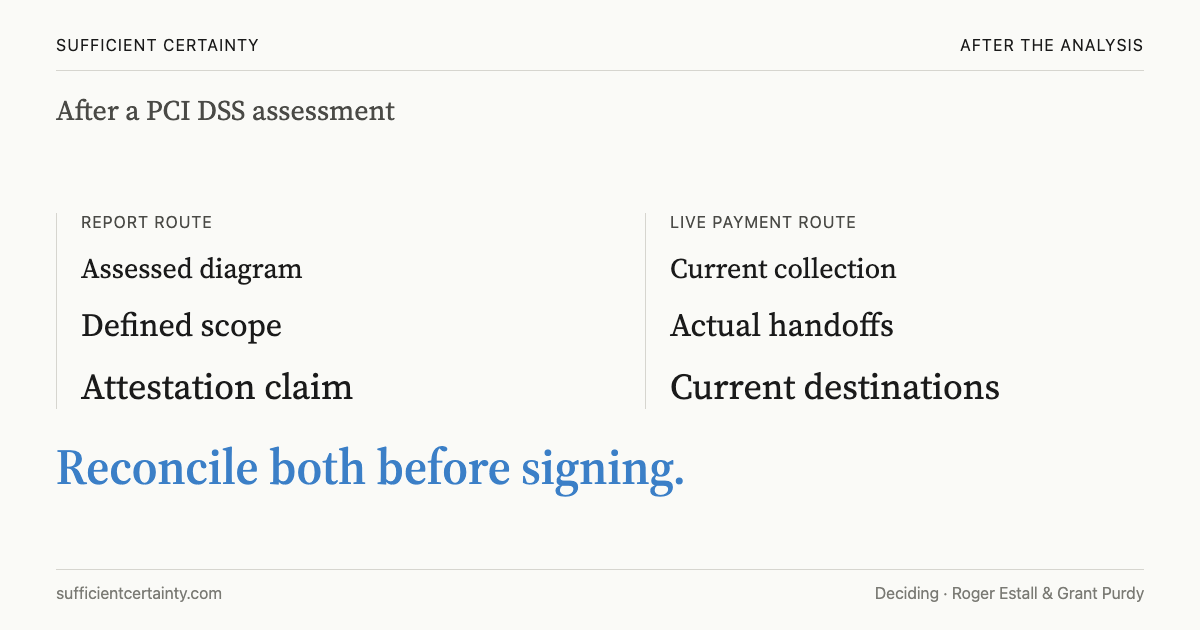
If the diagram omits a current handoff, record the mismatch and refer it to the assessor or responsible PCI specialist. Determine whether the assessment description or supporting examination needs to change. Preserve the earlier record so reviewers can see what was discovered and what evidence resolved it.
Check the boundaries around outsourced processing as well. Identify where the organization’s route reaches the provider and which local components can affect that handoff. Outsourcing changes the arrangement to examine. It should not become a shortcut for assuming that the organization has no relevant payment-data responsibilities.
The Council’s maintaining-compliance supplement announcement places security practices in daily operations. It also distinguishes its guidance from validation and reporting programs managed by card brands and acquiring banks. Confirm the applicable submission arrangements with those parties. Do not treat a general article as authority to choose an attestation type.
Likewise, the Council’s self-assessment explanation describes questionnaires for different merchant environments. Check eligibility with the appropriate parties when it is uncertain. The review after an ISO 27001 audit addresses corrective effectiveness in a management system. This checkpoint asks whether current card-data routes match the assessment supporting the statement.
Trace live card data before signing the attestation
Put the assessed scope and the current route record beside the proposed attestation. Ask the signatory to review any unresolved mismatch. Identify which routes are supported by the evidence and which remain under examination. The signature should follow a defined review rather than the arrival of a completion email.
Sign against a reconciled scope, with unresolved changes visible to the responsible person.
Where several acceptance channels exist, begin with one route to establish the checking method, then cover the routes relevant to the statement. Completing a single trace does not establish that all channels are covered. Track the remaining work explicitly. A signatory should see the scope of the reconciliation as well as the scope of the assessment.
Use the existing change record to retain the result. Record the diagram version and the evidence reference for each material correction. Name who accepted the scoping conclusion. If the evidence is insufficient, state what remains to be established before the affected claim can be made.
The Universal Decision-Making Method makes the supporting assumptions visible before commitment:
- Frame: name the attestation and the environment it describes.
- Tentative Elements: identify the assessed payment arrangement.
- Assumptions: list the material connections between live routes and scope.
- Sufficient Certainty: obtain the review needed to resolve consequential mismatches.
- Implement+Monitor: assign route-change triggers and the person who reviews them.
A change trigger must reopen the route record before the old assessment is relied on for the changed arrangement.
Choose triggers tied to the environment. A new acceptance channel or a changed processing integration can alter the route. A support process that begins receiving different information can also require review. Name who reports each relevant change and who decides its effect on the assessed scope.
Keep this review inside existing payment change management. Ask for the route record when the changed arrangement is proposed. Assign any necessary specialist review before implementation. The article on monitoring decisions explains why a signal needs an owner and a response, rather than a place on an annual checklist.
The immediate result is a traceable basis for the statement being signed. It shows the live route, the assessed environment, and the resolution of material differences. Retain that basis with the attestation. The existing decision record can hold the reasoning without creating another security reporting system.
Use neutral working records that identify components and evidence without reproducing payment account data. The reviewer needs to understand the route and its boundary. Access to underlying sensitive evidence should follow the organization’s approved arrangements. The decision record can point to that evidence without becoming another account-data repository.
A signed assessment statement needs payment routes that still match its examined environment.
Work through your decisionNo sign-up. Just pick your decision and start.
Grant Purdy is the co-author, with Roger Estall, of Deciding (2020), and the architect of the Universal Decision-Making Method.