
After a SOC 2 audit, open the report and mark which controls your organisation must perform before relying on it. A completed report can reach an approval meeting with its customer responsibilities still unread. Put those responsibilities beside the service you intend to approve. Include its data and access arrangements. This applies whether the report covers your own service or a provider you use. The next decision needs evidence about that use, alongside the auditor's findings.
A SOC 2 audit examines a service organisation's system description and controls against applicable description and Trust Services Criteria.
The report covers a defined system
A SOC 2 report gives the reader something more useful than a supplier's claim that its service is secure. It describes a system and records an independent examination. The AICPA illustrative Type 2 report includes management's assertion, the system description, the auditor's report, and control tests with their results. These parts let a reader examine what supports the opinion.
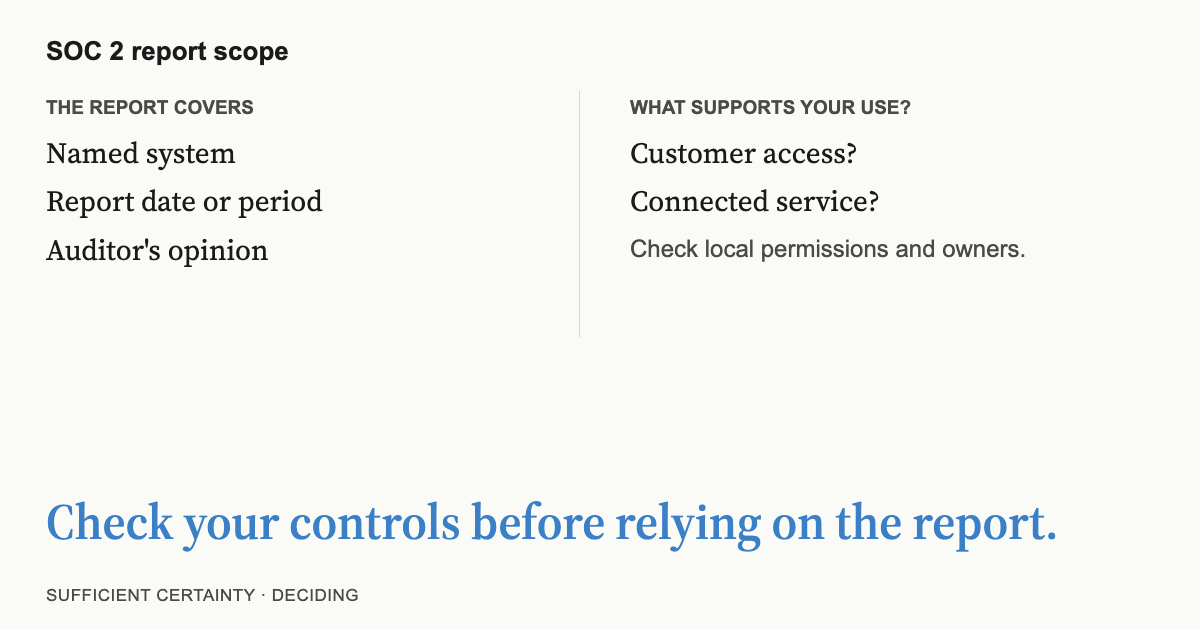
Start with the named system, the report type, the covered dates and the auditor's opinion. Microsoft explains in its SOC 2 guidance that Type 1 examinations do not look back over a performance period. Its Type 2 examinations cover a specified period. Microsoft also identifies customer control responsibilities and distinguishes its own bridge letters from auditor examinations.
Read the scope before accepting the assurance. Compare the named service with the product you actually use. Check whether the relevant features and connections appear in the description. Then read any tests and exceptions relevant to your intended use. An exception deserves a question about its effect on your decision, rather than an automatic rejection or an automatic dismissal.
Consider an illustrative review with four questions: Is the service covered? Are the conditions unchanged? Are customer controls working? Can operations continue without the integration? Suppose only coverage has been checked. The bars below count these four review questions. They do not measure the provider's security or the quality of the audit.
A covered service can still be used badly. The distinction matters for governance and compliance. An examination provides evidence within its stated terms. The person approving the service must decide whether that evidence supports the planned use.
Which customer controls must work before you can rely on this SOC 2 report? Start the Walk →
Which controls remain with the customer?
Find any complementary user entity controls in the system description. Read customer responsibilities elsewhere in the report too. Keep the two labels distinct when the report does. The practical question is the same: which actions must your organisation perform for the intended protection to work? A report stored in a procurement folder does not show that those actions happen.
Customer controls need customer evidence. For each applicable requirement, write the action and name the responsible person. Add the evidence available today. If the requirement concerns authorised access, inspect the current access list and recent approvals. If it concerns removing access, check an actual departure. These are proposed checks. The exact checks must follow the report and your service configuration.
When a report assigns access removal to the customer, the reliance decision has three layers. This example separates the provider's examined controls from the customer's responsibility and the failure that could follow. It describes a proposed reading check, not a finding about any named report.
The report does not perform your access review. A customer can accept the provider's results while leaving its own part unfinished. Resolve that gap before approval. Make the responsible person visible, as the distinction between accountability and ownership requires.
Record missing evidence as missing. A policy may describe an action without proving it occurred. Ask what observation would justify relying on the control for this use. That turns an assumption behind the decision into a checkable question. Where the report excludes another provider's controls, establish what separate evidence the connection needs.
For a new integration, include the permissions granted outside the examined service. A limited provider role can connect to a much broader customer role elsewhere. Draw the connection and name who can change or revoke it. This is a review of the planned arrangement, not a claim that the audit missed it.
Heroku token theft crossed an integration boundary
Heroku's April 2022 incident shows why connections deserve their own attention. According to its incident review, an attacker accessed a Heroku database on 7 April and downloaded customer GitHub integration OAuth tokens. Heroku said the initial access used a compromised machine-account token found in an archived private GitHub repository. It assessed that access to that repository came through a third-party integration, but could not definitively identify which integration.
GitHub's security alert described stolen tokens issued to Heroku and Travis CI integrations being used to download private repositories. GitHub did not believe the tokens came from a compromise of its own systems. Its investigation distinguished repository listing from downloading repository contents. That distinction mattered when notifying affected customers.
A connection can expose another system's data. The attacker did not need every connected organisation to suffer the same initial compromise. Tokens supplied an authenticated route into repositories. Heroku revoked existing GitHub integration tokens and prevented new ones from being created. Its review acknowledged that disabling the integration and rotating credentials affected customers.
This is a control-boundary analogy. The cited incident documents do not establish what a SOC 2 auditor examined, or whether any opinion covered the affected controls. They provide no basis for claiming that a SOC 2 audit approved the compromised arrangement. The documented event supports a narrower question: what access does a connected service hold, and what happens if that access is abused or withdrawn?
For a reader reviewing assurance, the proposed application is to inspect the integration as it exists today. Identify the repositories or data it can reach. Confirm who can revoke its access. Ask how work would continue if the connection were disabled. These checks supplement the report; they are not actions attributed to Heroku's customers.
Check the permissions across the boundary. A third-party assessment can help identify dependencies. The reliance decision still needs the actual permissions and responsible people. Establish the operational consequences of this particular connection.
Match the report to the service in use
Before approving reliance, make one short record for the intended use. State what the service must enable and which failure would make that use unacceptable. Name the data and users involved. Include the integrations they need. Attach the report sections that support the proposed use, rather than recording only that a report was received.
Beside each relevant customer control, record its owner and current evidence. Where evidence is missing, state the consequence for approval. The options can include restricting access, delaying a sensitive workload, obtaining further evidence or choosing another arrangement. Choose an action that addresses the specific gap. Another general questionnaire may add little.
Resolve the gap that could change approval. For an integration that can read private repositories, confirm the necessary scope of access. Establish whether that access fits the work being approved. If a narrower permission is available, consider it. If access must remain broad, record why the benefit justifies that arrangement and what evidence supports the decision.
Check for relevant changes since the report date or the end of its covered period. Ask the provider about changes relevant to the planned use. Treat additional statements according to who made them and what examination supports them. A current date alone does not answer whether a changed feature or connection received the same scrutiny.
This is an application of the Universal Decision-Making Method: name the decision and test the assumptions it needs. The wider organisational governance task is to make that reasoning visible to the person who can approve reliance or restrict it. That person also needs authority to stop reliance.
Set a specific review trigger before closing the record. A new integration, expanded permission, relevant incident or failed customer control can reopen the decision. Assign who receives the signal and who decides what happens next. The approach complements follow-up after an internal audit by connecting evidence to an actual decision.
Approve a defined use with defined conditions. Keep the report with the local control evidence. Attach the decision so the next reviewer can see what justified reliance. Record the remaining uncertainty and the change that would require another decision.
A SOC 2 opinion leaves a decision to make: does the examined system, together with your controls, support this use?
Work through your decisionNo sign-up. Just pick your decision and start.
Grant Purdy is the co-author, with Roger Estall, of Deciding (2020), and the architect of the Universal Decision-Making Method.