
After requirements gathering, write down how a user will show that one important requirement has been met. A review pack can contain agreed wording while leaving the acceptance test open to different interpretations. Before that wording governs a contract or delivery plan, check what the user must be able to do.
The immediate task is to prepare a requirements baseline for approval. Keep the collected statements, but make the important ones specific enough to test.
Requirements gathering collects stakeholder needs and constraints to establish what a proposed product or service must do.
Turn collected requirements into a proposed baseline
Start with the requirements document produced by the interviews or workshops. Identify its version and the decision it supports. A sponsor approving procurement needs to know which requirements suppliers must price. A delivery team needs to know which requirements will determine whether completed work is accepted.
Give each requirement an identifier. Separate duplicates and flag statements that conflict. Record the person who can explain the original need. This creates a proposed baseline that people can review together, instead of separate lists that change during each conversation.
Keep unresolved requirements visible until someone with authority decides what they mean. Mark them as unresolved rather than quietly replacing unclear wording with the analyst's preferred interpretation. Where a decision changes the scope, show that change to the sponsor before approval.
NASA's technical requirements guidance places validation before establishing the baseline. Its checks include whether requirements meet stakeholder expectations and can be verified. The sequence makes sense for a smaller procurement too, without adopting NASA's full engineering process.
For each material requirement, add the proposed acceptance condition. If it concerns a user task, describe what completing that task would show. If it imposes a delivery constraint, state what evidence will establish compliance. Ask the delivery team whether that evidence can be produced.
Review exclusions with the same care as included work. If the proposed baseline leaves a task outside the contract, identify who will still perform it. Check that the sponsor accepts the remaining work. An exclusion should not disappear inside a supplier note that the user never reads.
Choose the first requirement to examine by its consequence. Start where a misunderstanding would change the supplier's price or prevent important work. A minor label can wait if a major requirement still has competing meanings. The decision-making frameworks hub examines this gap between an analytical output and the commitment made from it.
Use the Walk to examine the assumptions behind the requirements baseline before approval. Start the Walk →
User statements identify work worth supporting
Requirements gathering gives users a way to explain work that the sponsor may never see. It records the conditions under which they use a service. Keep those accounts attached to the requirements, so a later reviewer can understand why the requested capability matters.
A requirement needs a reason that remains visible when its wording changes. Otherwise, editing can make a statement easier to deliver while removing what the user needed. Compare revised wording with the original task before accepting the edit.
The GOV.UK guidance on writing user stories ties a requested capability to the user's goal. It describes acceptance criteria as outcomes used to check whether a service meets the need. That connection gives a sponsor something more useful than agreement on a feature name.
The authority to approve a requirement also needs checking. Someone who describes a task may lack authority to settle a conflict with another department. The check after stakeholder analysis helps distinguish a recorded stakeholder position from the conditions on which that position depends.
Who can show that the requirement is met?
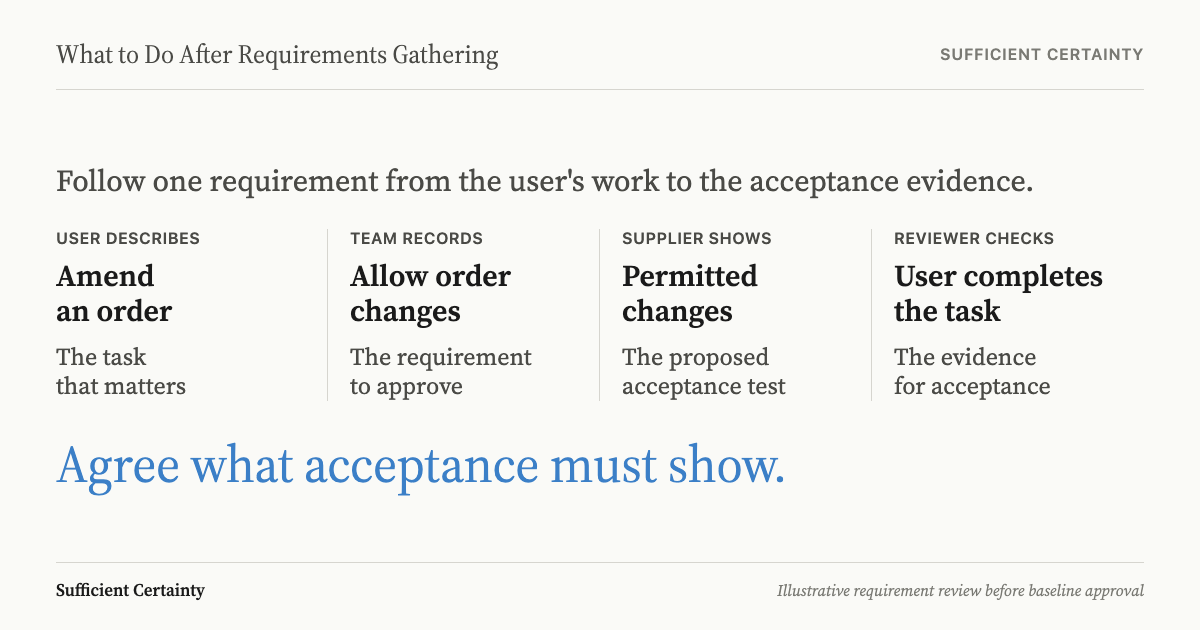
A requirement can be clear to its writer and still leave the acceptance decision unresolved. Ask the user to explain what successful work would look like. Then ask the person responsible for delivery what evidence they would submit. Compare the answers before either becomes a contractual obligation.
The acceptance condition must describe evidence that both sides can examine. Words such as convenient or flexible need an explanation tied to the task. A supplier's demonstration of a feature may leave that explanation unanswered. A completed task gives the review a more precise subject.
For an illustrative purchasing system, a requirement might say that staff can amend an order. Ask whether that includes an order already sent to a supplier. Establish who may make the change and what happens to the earlier version. These are proposed review questions, not facts about a particular project.
The NASA requirements management guidance describes traceability back to a requirement's source and through related requirements. In a modest project, the same connection can be recorded in the existing document. A new software tool is unnecessary if the reviewer can follow the evidence.
Traceability helps locate the source of a claim; the claim still needs checking. Ask the named user whether the proposed condition covers the work described during gathering. Record disagreements beside the requirement. The approach to surfacing assumptions before a decision applies here: identify the interpretation on which approval depends, then obtain evidence about it.
GOV.UK tested the second-address question
The GOV.UK Service Manual records an early register-to-vote question about whether a user also lived at another address. Research found that some people could not decide whether their circumstances counted. The team changed the affirmative answer into separate choices for people living in two homes and students with home and term-time addresses. The manual reports that the revised question became easier to answer.
The documented question-design example describes user research and a revision. It does not establish that a formal requirements-gathering process had finished. It supplies no numerical improvement. Its relevance is limited but direct: people needed more specific language to connect a question with their circumstances.
A question can be implemented as written while users remain unsure how to answer it. A requirement that merely calls for an address question could allow that outcome. That is an application of the example to requirements approval, rather than a claim about the team's actual requirements document.
For a proposed service with a similar question, the sponsor could ask what acceptance must establish. Checking that the question appears would confirm its presence. Observing whether a relevant user can select the answer that fits their circumstances would examine the interpretation on which useful completion depends.
That observation would need users whose circumstances matter to the decision. An internal reviewer who already knows the intended meaning may explain it without noticing. Record any explanation needed during a task trial, because that help may be absent when the service is used.
Use observed confusion to revise the acceptance condition before committing to delivery. The task differs from choosing a prototype after a design sprint. Here, the sponsor is deciding which requirements will govern the work and what evidence will permit acceptance.
Write one observable acceptance condition
Return to the requirement selected for review. Write a condition that names the user task and states what will be observed. Add the circumstances in which it must hold. Ask the person who owns the need to confirm that meeting the condition would support that work.
Resolve conflicting interpretations before the baseline makes either one binding. If a user expects a capability the supplier has excluded, show the difference explicitly. The sponsor can change the requirement or accept a narrower scope. Record the reason alongside the approved version.
If the narrower scope affects a promised benefit, carry that change into the benefits record used after a business case. Check that the sponsor accepts the revised expectation before delivery proceeds.
A task demonstration before approval tests the requirement's meaning. It does not certify an unfinished product. Later acceptance must still use the agreed evidence. Give that review a named owner, so the question remains answerable when delivery begins.
Approval should state which version and acceptance conditions govern delivery. Keep a record of changes after that point. When new evidence challenges the agreed meaning, return it to the responsible decision-maker before the team treats it as an approved instruction.
The Universal Decision-Making Method connects an intended outcome to the assumptions behind a commitment. Apply it here to baseline approval: keep the user's task beside the acceptance condition. Make the unresolved interpretation explicit. Approve when the evidence supports the scope being commissioned.
How confident are you that the acceptance conditions cover the work users need to do?
Work through your decisionNo sign-up. Just pick your decision and start.
Grant Purdy is the co-author, with Roger Estall, of Deciding (2020), and the architect of the Universal Decision-Making Method.