
After a business case is approved, copy its main promised benefit into a live benefits record. The delivery pack shows spending and completed work, while the benefit figure still comes from the approved case. Keep that benefit open for review as delivery proceeds. A changed user need can alter the spending decision even when the work follows its plan.
A business case sets out why an investment is justified, with expected benefits and costs against which its continuing value can be assessed.
Keep the promised benefit visible during delivery
Approval starts work under agreed authority. The project team can appoint suppliers, schedule tasks and report progress against the delivery plan. Keep those controls. They show whether the work is proceeding as agreed and make delays or overspending visible.
Alongside them, keep the approved benefit and the conditions needed to achieve it. If the case promises shorter waiting times, identify which service must improve. If it promises a cash saving, identify which expense must fall. Record the starting position so later reports can distinguish an improvement from a revised estimate.
Completed work must be connected to a benefit. Installing a system is an output. Staff using it to remove an unnecessary task is a change in practice. A reduction in the cost of that task is evidence about the promised benefit. Reporting only the installation leaves the investment's continuing value unresolved.
The UK guidance on the senior responsible owner assigns ownership of the business case and benefits to that role. It requires attention to the context in which the project will deliver. These are public-sector responsibilities, but the distinction between delivering work and securing its benefit applies more widely.
Use the approval as the starting record. The challenge before approval concerns whether to commit. The task here is to keep the case current after that commitment. The next spending decision needs current benefit evidence.
An approved case gives benefits a baseline
A sound business case makes the purpose of the investment explicit. It connects proposed work to an expected result and gives the organization a basis for judging value. Those links remain useful after approval. They let the person responsible ask whether delivery is still serving the agreed purpose.
Preserve the approved figures when the forecast changes. Show the current estimate beside them, with the reason for the difference. Otherwise a lower benefit can disappear inside a replacement spreadsheet. The issue is not to defend the original number at all costs. It is to make the change visible to the person who can respond.
The UK Gate Review 5 guidance checks whether expected benefits are being achieved during operation. It also checks whether the business need remains. This formal review complements internal monitoring; it does not replace it. Benefits checks continue after the project hands over.
Keep money estimates tied to the underlying service or operating change. The cost-benefit analysis may have valued faster service. A later check needs evidence that service improved, together with evidence about its value. A revised total alone cannot explain whether demand changed or whether delivery failed to produce the intended improvement.
The business case is approved. Make the next commitment depend on a benefit condition that can still be checked. Start the Walk →
What change should reopen the spending decision?
A business case can already contain a benefits plan and review arrangements. The gap arises when those arrangements do not connect a changed condition to a decision about continuation. A regular report may show lower expected benefits without specifying who must reconsider the remaining investment.
A monitoring trigger must call for a decision. Make the trigger observable. It could be a user withdrawing a required commitment, a pilot failing its agreed acceptance test, or a delay passing a date needed for the benefit. Select the condition that could change the justification for further spending.
For a hypothetical service project, the main benefit might depend on retiring an existing manual process. A suitable trigger could be the operations owner confirming that the process must remain. That signal should reopen the expected saving before another contract is placed. It should not wait for the final benefits report.
Define who checks the condition and what evidence counts. A supplier saying the system will be ready is different from the intended users accepting it for the required work. If the evidence is unavailable at the review point, record that gap. Do not report an unverified benefit as secure.
This differs from repeatedly recalculating net present value. A calculation can use revised figures once the change is known. The trigger tells the organization when new information requires attention and who must bring it forward.
Set both a routine review date and an event trigger. The date catches gradual change; the trigger responds to a specific change before the next commitment. A review that comes after the commitment is too late to guide it. Choose timing according to what can still be changed.
The BBC cancelled DMI after its business needs changed
The BBC's Digital Media Initiative aimed to integrate digital production and archiving. The National Audit Office's January 2014 memorandum describes technical problems, unclear requirements and inadequate governance. It records that the BBC did not appoint a senior responsible owner to align the program.
Delays led some production teams to install alternative systems. Expected benefits then weakened. Despite changed timetables and benefits, internal audit found in July 2012 that the business case had not been revisited. Delivery changes had altered the case for continuation.
The BBC cancelled most of DMI in May 2013. The NAO reports £125.9 million spent, offset by a £27.5 million Siemens settlement, leaving £98.4 million net cost. That net cost is not proof that every asset had no use. The BBC retained the archive database and considered reusing other components.
The memorandum's cancellation account says the BBC had not examined the technical feasibility or cost of completing DMI. Its review relied largely on existing reviews and documents. The findings therefore do not establish that cancellation was the best available option.
The proposed application is narrower: when intended users adopt alternatives, review the benefit that depended on their using the planned system. Bring that change to the person authorized to decide on further investment. DMI also involved technical and governance failures. It cannot be explained as a forecast error alone.
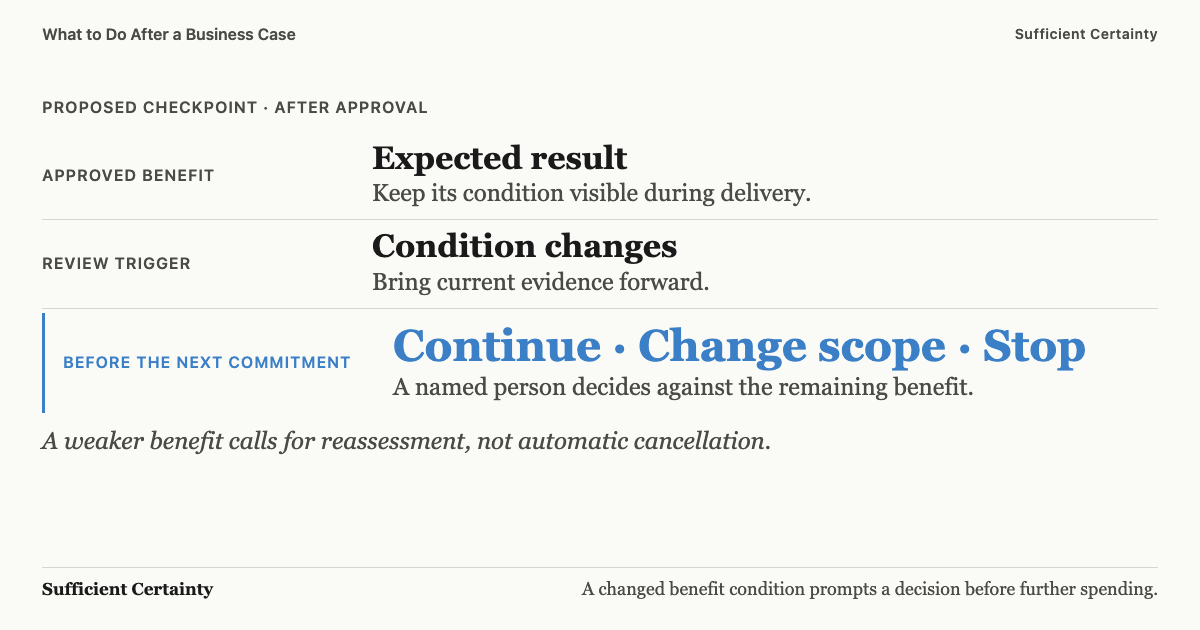
Such a checkpoint would require fresh evidence about completion and changed scope, alongside the consequences of stopping. The report does not show that this proposed checkpoint would have saved money. A weaker benefit warrants reassessment, not automatic cancellation.
Assign the continuation decision before the next commitment
Return to the benefits record created after approval. Add the condition needed for the main benefit, the evidence used to check it, and the signal that requires review. Name the person who will decide whether to continue. Put the review before a commitment that would make changing course harder.
Use existing authority. The person monitoring a benefit may not have power to stop spending. State who receives the evidence and where a decision above delegated authority must go. A governance structure is useful here only if the route reaches someone able to act.
When the trigger occurs, compare the remaining choices against the purpose. Continuing unchanged may still be justified. A smaller scope may secure a worthwhile benefit. Stopping may avoid further expense but create exit costs or leave an essential need unmet. Assess those consequences using current evidence.
Name who decides when the benefit condition changes. Record the decision and the reason in the decision record. If work continues, specify the evidence still needed and the next review signal. If responsibility transfers to operations, transfer the benefit check with it.
The Universal Decision-Making Method connects implementation to monitoring. In this setting, sufficient certainty concerns whether the remaining commitment still serves the purpose under current conditions. The broader decision-making frameworks explain ways to prepare a choice. An approved business case also needs a continuing decision about the investment it supports.
Who will decide whether to keep investing when the benefit behind your approved business case changes?
Work through your decisionNo sign-up. Just pick your decision and start.
Grant Purdy is the co-author, with Roger Estall, of Deciding (2020), and the architect of the Universal Decision-Making Method.