
After a stress test, the step before the results reach the board is to list what the scenario held constant and check whether the organisation survives those things moving. A comfortable pass is the result most likely to hurt, because it closes the discussion about everything the test left out.
In July 2011 Dexia cleared the European Banking Authority's EU-wide test with billions to spare. Within three months, three governments were breaking it up.
A stress test projects a bank's capital under a severe but plausible adverse scenario and compares the result against a minimum threshold, usually a capital ratio.
From stressed ratio to capital plan
A supervisory stress test ends with a number: the lowest capital ratio the bank reaches under the adverse scenario, set against a threshold. Internal stress tests end the same way, with the bank's own scenarios and its own minimum. What follows is a well-worn sequence, and in most banks it is written into policy as part of the wider risk assessment cycle.
First, the capital plan. Treasury and finance compare the stressed low point with the threshold and with the supervisor's expectations, then decide whether the buffer is enough. If it is thin, the options are familiar: hold back dividends, issue new capital, convert weaker instruments, sell assets or shrink risk-weighted assets. The stressed ratio often feeds the bank's risk tolerance limits as well.
Second, remediation. The exercise throws up data gaps, model weaknesses and queries from the supervisor, and each becomes a tracked action with an owner and a date. Third, the results feed the internal capital adequacy assessment process (ICAAP) and, where liquidity was stressed, its liquidity counterpart, the ILAAP.
Fourth, board sign-off. The results, the capital plan and the remediation list go to the risk committee and then the board, which approves them as part of its governance duties. The Basel Committee's stress testing principles (2018) expect those board reports to include "the main modelling and scenario assumptions as well as any significant limitations."
Fifth, disclosure. For supervisory exercises, results are published bank by bank and each bank issues its own release. By the time the market reads it, the pass mark has become the headline, and the limitations sit in an appendix.
A common scenario puts every bank on one yardstick
Stress testing does real work. A single adverse scenario applied across many banks makes results comparable in a way internal models never are. In the 2011 EU-wide exercise, 90 banks in 21 countries ran the same macroeconomic shock against end-2010 balance sheets, and the EBA published about 3,200 data points, against 149 the year before, according to the EBA chair's statement at publication.
It also moves capital. Banks knew the threshold in advance, and many acted before the cut-off. Applied to raw end-2010 balance sheets, the test left 20 banks below the 5% Core Tier 1 benchmark. After capital raised or committed by the end of April 2011, the count was eight. Core Tier 1 across the sample rose by about €50 billion in the first four months of the year.
For a board, the exercise turns a vague fear into a number with a date on it. Directors can see how far capital falls, which portfolios drive the fall and what it would take to restore the buffer. Compared with a scenario pack built by one team on one model, a supervisory test arrives with external scrutiny and peer benchmarks.
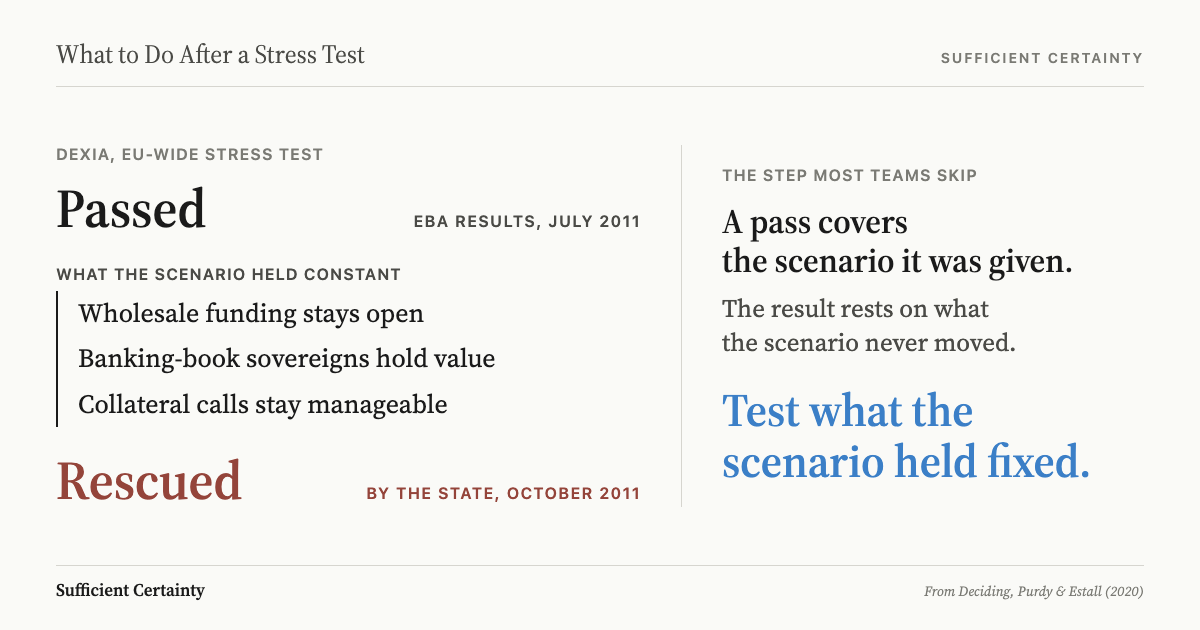
The EBA was candid about the limits. Its chair called the test a "what if" analysis that "is not a forecast" and "not a guarantee of the safety of individual institutions." Like a colour on a risk matrix, the ratio travels further than those caveats. A pass certifies the answer to the question asked, and nothing wider.
Take the stressed ratio your capital plan rests on and write down what the scenario held still to produce it, starting with funding. Start the Walk →
Dexia's pass mark and the empty till
Dexia was a Franco-Belgian lender to local governments, already rescued once by Belgium, France and Luxembourg in 2008. On 15 July 2011 its result looked comfortable. Under the adverse scenario, its Core Tier 1 ratio would fall from 12.1% at end-2010 to 10.4% at end-2012, €7.9 billion above the 5% benchmark. Its own release described the test's assumptions as very prudent, particularly on sovereign debt.
Two design choices sat underneath that number. Sovereign bonds in the trading book took market haircuts, while those in the banking book were "treated as other credit risk", with provisions rather than price falls. The EBA's aggregate report said this matched "the commitment of the European Union to prevent one of its Member States from defaulting." And the test measured solvency only. Liquidity was outside its scope.
Both choices landed on Dexia's weak points. The Belgian parliamentary inquiry (2012) noted that most of the group's sovereign risk sat in the banking book, so for Dexia the scenario was not really stressed. The inquiry also recorded that management saw its main danger as a drying-up of liquidity, not a large solvency loss.
The mechanism was the hedge book. Dexia had covered fixed-rate assets with interest-rate swaps, and when long-term rates fell it had to post collateral: about €132 million for each basis point, according to the inquiry. The National Bank of Belgium had already told Dexia that its internal liquidity stress scenario leaned too heavily on internal deterioration, such as a Dexia downgrade, and gave too little weight to adverse rate moves on the swaps.
Rates fell. Between June and September 2011 Dexia posted €15 billion in cash collateral while unsecured short-term funding drained away, according to Acharya and Steffen (2015). On 3 October Moody's put the group's ratings under review, citing its liquidity position and the collateral needs of its derivatives. The interbank market closed to Dexia, and it turned to emergency central bank liquidity.
On 10 October the board accepted the Belgian state's offer to buy Dexia Bank Belgium for €4 billion and joined a funding guarantee of up to €90 billion from Belgium, France and Luxembourg. The group also took a €3.4 billion loss on Greek sovereign bonds that year. The 10.4% answered the question it was set. The question left out the risk that broke the bank.
What did the scenario hold still?
Before the capital plan goes to the board, and before any result is published, ask for the scenario specification and the methodology note. From them, write one list: every variable the scenario held constant, every risk it excluded and every simplification applied, such as a static balance sheet or no management actions. The Basel principles already expect excluded material risks to be "explained and documented." That list is the real result.
Then read the list against the bank's own business model, not the average bank's. A scope choice that is harmless for one balance sheet can be decisive for another. Dexia's list would have shown banking-book sovereigns without market haircuts, no liquidity test and no path from falling rates to swap collateral. Each line matched a place where the group was concentrated.
For each assumption that matters, ask what would move it and what happens to the bank if it moves. Some answers come from a sensitivity run: the collateral needed if long rates fall 100 basis points, or the loss if banking-book bonds were marked to market. Others need a conversation with treasury about which lenders would pull back first. The same discipline belongs earlier in the cycle too, at risk identification.
The aim is not a second, harsher stress test. It is to make the assumptions behind the pass visible to the people approving the capital plan, so they sign off knowing which risks the ratio never saw. Surfacing and testing assumptions is a distinct step in the Universal Decision-Making Method, taken before anyone settles on how much certainty is enough.
How confident are you that the funding your stress test held constant will still be there when the scenario arrives?
Work through your decisionNo sign-up. Just pick your decision and start.
Grant Purdy is the co-author, with Roger Estall, of Deciding (2020), and the architect of the Universal Decision-Making Method.