
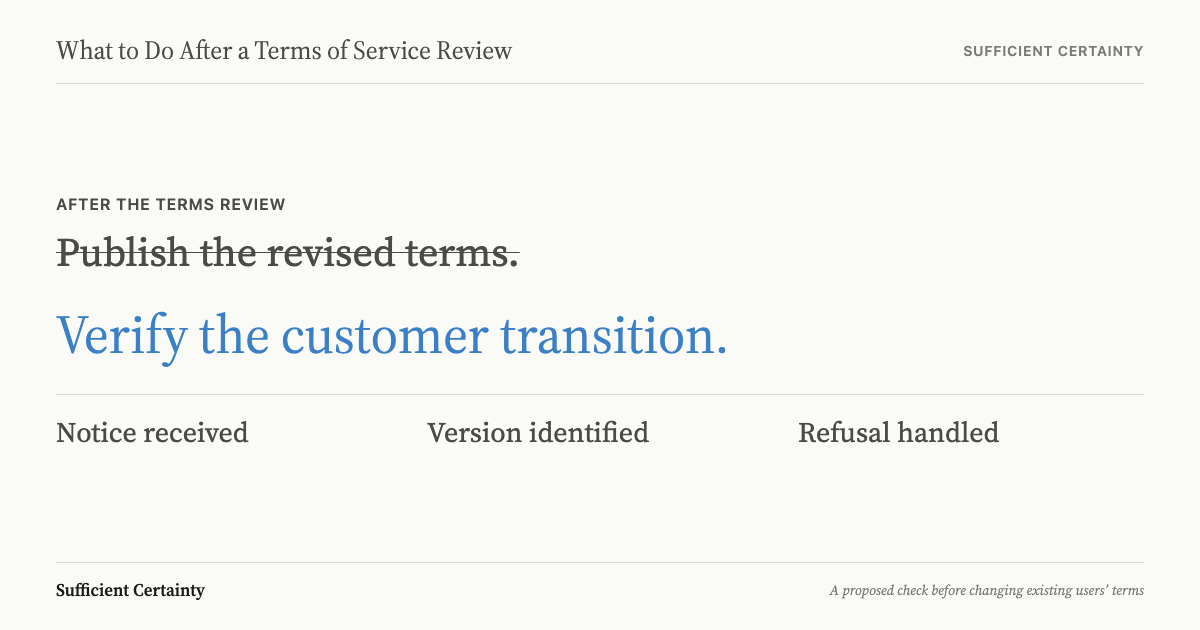
After a terms of service review, compare the revised terms with the notice an existing customer will actually receive. A carefully edited agreement can still leave the product team approving the wrong change. Before release, check how customers will learn about it and what happens when they decline.
A terms of service review examines the rules governing a service and the rights and responsibilities proposed for its users.
Reviewed terms define the proposed agreement
A completed review gives the product manager a version that counsel has examined. It can identify unclear wording and restrictions that need changing. It also records questions that remain unresolved. The next task is to connect that version to the proposed customer transition. Publishing a document is one part of that transition, rather than proof that the whole change is ready.
Start with the exact version intended for release. Record its identifier beside the existing version and the proposed effective date. Keep counsel's comments attached. Check which customers the review covered. New users accepting an agreement during registration may face a different process from existing users whose service continues under earlier terms.
Separate the wording change from the service change. A revised description may explain an existing feature more clearly. Another clause may introduce a new restriction or alter how customers leave. The product manager needs to know which kind of change is proposed. Otherwise, a release labelled as a legal update can include a material change that nobody has assessed as a product decision.
The ACCC's current guidance on contracts explains that written terms set out rights and responsibilities. It also identifies concerns with terms allowing one party alone to change an agreement. Those Australian rules require a jurisdiction-specific reading. A clause that permits updates is not sufficient evidence that every proposed update can proceed in every customer market.
The review also helps define ownership. Counsel assesses legal questions. The product team controls the release and customer experience. Support must apply the resulting rights. Treat those responsibilities as connected parts of organisational governance. A legal comment marked resolved should point to the wording or operating change that resolved it.
Preserve the difference between legal approval and release approval. The former can be limited to a draft and stated facts. The latter commits the business to a customer transition. This differs from the operating obligations examined after a contract review: the immediate question here concerns the people moving onto revised service terms.
Use the reviewed terms to decide whether the existing-customer transition is ready to proceed. Start the Walk →
How will existing users experience the change?
Open the proposed notice in the product environment where it will appear. Read it as someone who already has an account. Identify what changes and when it takes effect. Check whether the notice points to the reviewed version. A link to a general terms page may later show another version, making the original notice hard to reconstruct.
Follow one existing account through the proposed transition. Start before the notice arrives and continue until the account uses the changed service. Ask counsel what notice and acceptance are required for that customer group. Then ask the product team to show how the planned process meets those requirements. Do not infer acceptance from continued use without that legal assessment.
Where the process requires a recorded acceptance, inspect the record it creates. Check which version is identified and which account event is stored. A successful interface action must correspond to the intended evidence. A button can display a confirmation while failing to save the relevant version. This is a proposed verification step, rather than a claim that any particular service has that defect.
Use the contradiction above as a question to test against the actual package. The example is hypothetical. A rights statement in the terms can conflict with the transition described elsewhere in the same package. If that happens, send both passages to the responsible reviewer. Rewording one sentence without changing the customer process can leave the practical conflict unresolved.
Now examine refusal and non-response. What does the customer retain, lose or need to do? Check that the answer is consistent across the notice and support instructions. A change affecting stored information also needs an appropriate exit process. Related questions about a completed DPIA belong with the privacy owner; accepting service terms does not settle them.
Frame the decision around the customer transition. Ask whether the business should move this customer group onto this version through this process. That question exposes gaps a document-only approval can miss. It can also reveal a simpler option, such as limiting the first release to new accounts while counsel resolves the treatment of existing users.
Valve’s refund terms conflicted with Australian law
In March 2016, the Australian Federal Court found that Valve made misleading representations to Australian customers through Steam. The ACCC's account of the findings identifies three versions of the Steam Subscriber Agreement and two refund policies. The representations concerned refunds for downloaded games and the exclusion or restriction of statutory quality guarantees.
The court found that Valve engaged in conduct in Australia and carried on business there, despite its overseas base. The March release reported findings before a later hearing on relief. It does not describe present Steam terms. It also does not establish that Valve had completed a formal terms review before the conduct occurred.
The practical application concerns the scope of a present approval. A reader cannot use the case to conclude that all terms are invalid or that every refund request must succeed. The case shows why customer-facing statements need to be assessed against the law applying to the sale. The proposed check is to compare the agreement with what the customer is actually told.
Include the remedy process in the release review. Ask support to show how a request under the revised terms will be handled. Compare the response with counsel's requirements for the relevant market. If the response relies on a blanket refusal, return that refusal for review. The product manager should identify the mismatch rather than make an unsupported legal ruling.
Current ACCC consumer guarantee guidance states that businesses cannot remove covered consumer rights through terms. The applicable remedy depends on the circumstances. Keep that current guidance distinct from the historical Valve findings. A release decision today needs today's requirements for the actual service and customer group.
A revised refund clause may also require changes outside the document. Check the help page and the support response used for the affected accounts. Record who must update each item before launch. This connects the transition with action after a compliance assessment without treating a completed assessment as evidence that the customer process already works.
Review the customer transition before approval
Prepare one approval note joining the reviewed version to the transition evidence. Identify the customer group and effective date. Name the unresolved legal question most likely to change the release. Ask its owner for an answer before approving the affected part. If the answer is unavailable, compare delaying that change with a narrower release that counsel has assessed.
Document approval
- Approve the revised agreement.
- Set its publication date.
- Leave existing-user treatment unresolved.
Transition approval
- Identify the affected account group.
- Check notice and required acceptance.
- Confirm refusal and exit arrangements.
Use the five method steps on the release decision itself. The Universal Decision-Making Method provides a way to organise that work. The terms review remains a specialist input. The person approving the transition must judge whether that input and the operating evidence justify the proposed action.
- Frame: state which customers would move to which terms.
- Tentative Elements: compare the proposed transition with a delayed or narrower change.
- Assumptions: identify the notice or acceptance condition each option relies on.
- Sufficient Certainty: obtain the evidence needed to authorise the chosen transition.
- Implement+Monitor: assign the release work and watch for failures in that process.
Keep the final note specific. Approval can identify a version and require a named process to be ready before release. It should not rely on a general statement that legal has approved everything. Record any customer group excluded from the change. This keeps the person operating the release from extending a limited approval without noticing.
Reopen the decision when the customer process changes. A new notice channel or a changed refusal process can alter the facts counsel reviewed. Preserve the earlier record and document the new assessment. The same discipline supports a useful decision record: a later reader can see which transition was approved and the evidence that supported it.
How confident are you that existing customers can follow the transition your revised terms require?
Work through your decisionNo sign-up. Just pick your decision and start.
Grant Purdy is the co-author, with Roger Estall, of Deciding (2020), and the architect of the Universal Decision-Making Method.