
After a trade secret audit, choose one valuable information item and check its approved recipients before the next disclosure. In 2017, former Lutonix executive Christopher Barry was sentenced for stealing trade-secret files that he later transferred to a work computer at Urotronic. An inventory needs a decision about how each intended disclosure will preserve secrecy.
A trade secret audit identifies valuable confidential information and examines the measures used to preserve its secrecy.
An inventory locates information worth protecting
The audit gives a business unit manager a starting point for decisions about information use. It can identify a technical process, a commercial dataset, or a development record that requires protection. It can also show where copies sit and who has access. That work is useful when the next commercial step requires sharing.
An inventory becomes more usable when each entry identifies the actual information, rather than a broad department or folder. “Research” leaves the recipient guessing. A named process document, with its version and custodian, permits a specific access decision. Keep enough detail to distinguish the confidential item without exposing its contents in the audit report.
The WIPO explanation of trade secrets identifies secrecy, commercial value arising from secrecy, and reasonable protective steps as central conditions. An audit label alone does not establish all those conditions. Ask the responsible legal adviser how the relevant law applies, especially when information will cross borders or enter a joint project.
The manager’s next task is to connect the inventory to a real commitment. A supplier demonstration, a potential licence, or a new employee’s project access can each require a different response. State which disclosure is being considered. Do not ask whether the entire business is “protected” when the immediate choice concerns one information item.
Keep the scope distinct from an ownership review. Ownership and licence rights affect whether the business can use information, but this decision concerns how an intended sharing route preserves confidentiality. Likewise, the IT audit checkpoint addresses technical remediation authority. It does not decide what a commercial recipient is permitted to learn.
Use the audit to find the people who can answer the sharing question. The custodian can identify the version. The business sponsor can explain the recipient’s need. Legal and information-security staff can examine the proposed safeguards. The manager should collect these answers before granting access, rather than leave each team to infer the commercial purpose.
If the item no longer needs secrecy, record why. An outdated version might still reveal a current process, while a published result may no longer be confidential. Do not remove protection merely because a filename looks old. The audit should support a documented classification decision tied to the information actually being shared.
The audit inventory needs a permitted sharing route before the next commercial disclosure. Start the Walk →
Who can receive the listed trade secrets?
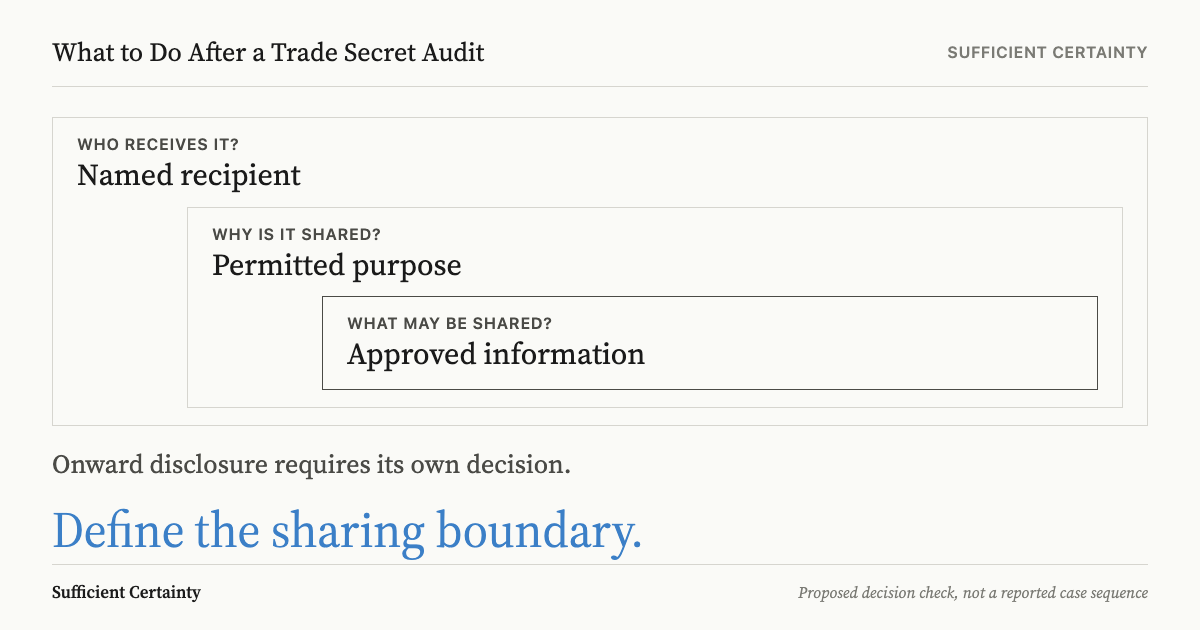
A completed list can encourage the wrong question: which protection action should be assigned to each row? Begin with the intended use instead. Ask who needs the information, for what purpose, and in what form. The answer may permit a limited extract, a supervised demonstration, or no disclosure until a particular condition is met.
Write down the proposed route from the current custodian to the final recipient. Include any adviser or subcontractor expected to see the material. A named company is not a complete access boundary if its staff can forward files to a wider group. The permitted use must be clear enough for people handling the information to follow.
The WIPO protection guidance describes measures including access limits, confidentiality agreements, and periodic consideration of who needs access. Which measures are reasonable depends on circumstances. A manager should therefore ask how the chosen measures fit this disclosure, rather than treat a signed agreement as proof that any channel or recipient is acceptable.
Challenge the proposed disclosure before choosing a control. If a partner needs performance evidence, must it receive the underlying process? If a contractor needs one module, must it receive the complete repository? These are proposed business questions. They can reduce unnecessary disclosure without requiring another audit or an unsupported claim that every secret has equal value.
An access list also needs a duration. State what happens when the commercial discussion ends or the project changes. Identify who can remove access and how retained copies will be handled under the agreement. The ISO 27001 follow-through offers a related way to connect a control action with evidence of its operation.
The Lutonix theft crossed an employment boundary
According to the US Department of Justice sentencing release, Christopher Barry left Lutonix in May 2015 to become Urotronic’s chief executive. As he prepared to leave, he stole trade-secret files for use in his next job. He later transferred those files from a portable hard drive to his Urotronic work computer and shared procedural documents with employees there.
Barry pleaded guilty in May 2017 and received a sentence of twelve months and one day that August. The source establishes his theft and subsequent handling of the files. It does not establish that Lutonix had completed a trade secret audit. It also does not establish a conviction of Urotronic or corporate knowledge that the files were stolen.
The relevant application is the boundary between legitimate expertise and another organisation’s confidential records. A business may employ someone for experience while lacking permission to accept specific files. The audit inventory should help managers ask about the origin and permitted use of material entering a project, as well as information leaving the business.
A new employee’s experience does not give the business permission to receive confidential files from a former employer. Ask about the origin of material before accepting it into a project.
For an intended disclosure, apply the same specificity in the other direction. Identify what will move, who will receive it, and what that recipient may do with it. Do not infer permission from a person’s seniority or familiarity with the technology. A commercial deadline can explain urgency, but it does not establish an authorised route.
The WIPO guide to trade secret management discusses confidentiality during licensing negotiations and the risk of receiving other parties’ secrets. This gives the manager two practical checks: protect the information being offered, and verify that the business has an acceptable basis for receiving information offered by someone else.
The broader organisational governance question concerns authority for that decision. Someone must be able to approve the defined disclosure and its conditions. The governance audit checkpoint can help identify who owns that approval when several functions hold different parts of the answer.
Define the permitted sharing route
Use the Universal Decision-Making Method to turn the inventory into one sharing decision. The five steps provide a sequence for examining the commitment. They do not certify that the information qualifies as a trade secret or replace advice on the applicable legal requirements.
- Frame: name the commercial purpose and the information the recipient needs.
- Tentative Elements: compare the proposed disclosure with a smaller extract or a different way to demonstrate value.
- Assumptions: identify the claimed permission and the expected recipient behaviour.
- Sufficient Certainty: decide what evidence must support those claims before sharing.
- Implement and Monitor: assign access, record its limits, and check the conditions that require a new decision.
Record the result beside the inventory entry. Include the item version, permitted recipient, approved purpose, sharing channel and person who can change access. Reference the relevant agreement and approval. Describe any unresolved point plainly, especially if it prevents disclosure. The record must tell the person sending the file what is permitted now.
Before the first transfer, ask the sender to compare the intended recipient and attachment with that record. This is a proposed management check, not a claim that a universal procedure prevents theft. It gives the decision owner an opportunity to identify a mismatch before information leaves the controlled route.
Set a reopening condition tied to the commercial arrangement. A new subcontractor, a wider requested use, or a change in the material supplied can require another approval. Refer a suspected breach through the established legal and incident process promptly. The compliance assessment checkpoint can support the response without blurring the specific disclosure decision.
Close the audit action only when its intended result is evidenced. An assigned agreement task or an installed access setting may be necessary, but neither explains the whole sharing route. The manager should be able to name the item that can be shared, the person who can receive it, and the conditions attached to that decision.
Who can receive the listed information, and what are they permitted to do with it?
Work through your decisionNo sign-up. Just pick your decision and start.
Grant Purdy is the co-author, with Roger Estall, of Deciding (2020), and the architect of the Universal Decision-Making Method.