
After an IT audit, take one recommendation and list every system owner needed to implement it. A remediation meeting can end with a named owner who cannot change the affected application. Before accepting that assignment, check which part of the work the owner can actually control.
The useful next step is a recommendation-to-system map. Keep it beside the audit action register, so a closed ticket can be compared with the condition the recommendation requires. Where the recommendation concerns service performance, the ITIL service review follow-up compares reported targets with incidents experienced by the users.
An IT audit examines information systems and their controls against defined criteria, using evidence to identify weaknesses and support conclusions.
An IT audit assigns actions to specific systems
A useful report identifies the control being examined and explains why the evidence falls short. Its recommendations give management a basis for assigning work. The response can then state what will change, who will make the change and when it will be checked. That makes follow-up possible without asking the auditor to operate the system.
Start with the report’s exact scope. Record which application the finding concerns and which access route was examined. Keep the original wording available beside the response. A shortened ticket description can omit a condition that matters when the owner decides whether the work is complete. Where access covers valuable confidential information, the follow-up to a trade secret audit connects approved recipients to the next intended disclosure.
NIST’s security and privacy control catalog separates control functionality from assurance about that capability. This distinction helps with remediation: changing a setting and establishing confidence that the control works require different evidence. The audit recommendation should guide what the owner must demonstrate.
The assigned owner needs authority over the required change. Naming the business-system owner can establish accountability, but it does not give that person administrative permissions. Record who will perform the technical work separately from who will accept the result. Authority over shared business definitions needs the same care; the follow-up to a data governance maturity assessment connects that authority to the decision that uses the data.
Illustrative process: a directory administrator closes the assigned task, while nobody checks whether the affected application has separate accounts. The recommendation is marked complete without evidence from that application.
Proposed change: the owner records whether application access depends on the directory and obtains evidence from each affected system. Closure waits until the agreed access condition has been checked.
The comparison above describes an illustrative process and a proposed improvement. It does not describe a reported event at the agency discussed below. Its purpose is to make the acceptance gap visible before work starts.
An internal audit response also needs evidence behind a completed action. An IT recommendation adds a practical question about where the control operates. Preserve the affected system’s name when the finding becomes a task. This belongs within governance audit follow-up when management is deciding who may approve closure.
An IT audit action needs an owner who can change every affected system. Start the Walk →
Who can change the control behind each finding?
An action register can contain a correct recommendation and an incomplete assignment. The hidden assumption is that the assigned team controls every place where the change must take effect. Before relying on that assumption, ask the team to show where access is granted and where it is removed.
For an account-control finding, begin with the affected application. Ask its administrator whether it uses directory authentication, maintains local accounts or supports both. These are questions for the actual environment, not claims about every system. The answer determines whose evidence the reviewer needs before accepting the action. For payment systems, the follow-up to a PCI DSS assessment adds a trace of the live payment route against the assessed diagram.
Put that answer beside the recommendation. Name the administrator of each relevant account store and record what must change there. If the application is managed by a supplier, identify the person who can request the change and the supplier contact who can confirm it. An internal owner still needs a usable route to that confirmation.
A directory change needs application evidence when access can survive elsewhere. The reviewer should agree what evidence will resolve that question before the ticket is closed. A screenshot of one account store may be useful, but its scope must match the finding. Record the application and date with any extract used for acceptance.
Do not start by asking each team for every document it holds. Ask for the evidence needed to answer the specific dependency question. If the application cannot be checked safely during normal operation, agree a controlled check with its owner. Record the remaining uncertainty rather than allowing an unavailable test to disappear from the action register.
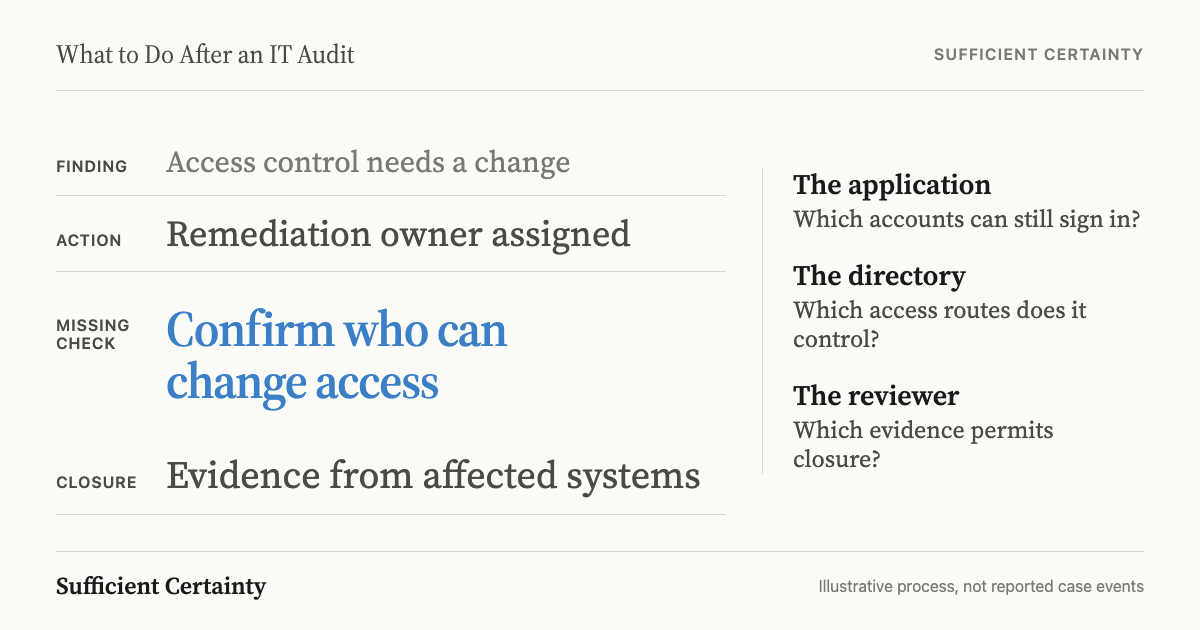
A cybersecurity assessment profile can inform investment priorities. This map answers a narrower operational question: whether the people assigned a recommendation can deliver its required change. Check the control dependency before accepting the promised completion date. A date has little practical value if the necessary administrator has not agreed to the work.
The DEP audit covered account controls across several applications
The New York City Comptroller published audit SI19-061A on 26 June 2019. It examined security and access controls at the Department of Environmental Protection’s Bureau of Water and Sewer Operations. The bureau used five mission-critical applications.
The Comptroller found that user access had not been disabled for inactive users and former City employees. Two applications did not enforce the city technology department’s password expiration and complexity rules. The report made sixteen recommendations, including disabling former and inactive employee accounts across the network and applications.
The published agency response summary records DEP’s concerns about some findings. According to the Comptroller, DEP supplied no documentation supporting its assertions on those disputed findings. The Comptroller therefore retained them. These findings do not establish a breach or a water outage. They do not describe the agency’s current systems.
The proposed map applies that distinction to a reader’s own remediation decision. It is not a process documented as used by DEP. Evidence from the network should identify which application conditions it actually covers. Where that coverage is uncertain, the reviewer needs confirmation from the application owner before relying on the result.
Those readings describe proposed responsibilities, not the agency’s recorded assignments. Make the differences explicit in the reader’s action register. The system owner can then request the relevant administrator’s work without leaving the reviewer to infer that all access routes were checked.
An external assurance report raises a related scope question, covered in SOC 2 follow-up. Here, the immediate issue is the owner’s ability to implement a recommendation across internal systems. Keep a disputed assertion separate from evidence that resolves it. Agreement in a meeting is not a substitute for the check the finding requires.
Check the dependency before accepting the remediation plan
Choose one recommendation whose completion depends on another team. Copy it into the map beside the affected application. Record which owner can approve the work and which administrator can perform it. Ask both to confirm the assignment before accepting a deadline or presenting the action as ready.
Write the required access condition in plain terms. It must be specific enough for the reviewer to judge the result. Keep any difference between the report’s recommendation and management’s proposed response visible. If management proposes another remedy, record why it addresses the finding and who may accept that reasoning.
NIST’s control assessment guidance provides procedures that can be tailored to the systems under review. That supports a deliberate choice of assessment evidence. It does not remove the need to identify which system the evidence describes or to explain what the check establishes.
Agree the closure evidence before the change is made. Ask the reviewer to identify the required record and the person who will assess it. Keep the original finding linked to that record. This reduces the chance that an administrator completes the assigned work but cannot supply what the reviewer needs.
If the dependency remains unresolved, leave the recommendation open and identify the reason. The owner can then decide whether to seek another administrator, change the proposed remedy or accept a temporary operating condition through the proper authority. Record that decision separately from technical completion. A delay deserves an explicit response when the affected service must continue operating.
This is an application of the Universal Decision-Making Method: identify the assumption behind the proposed action and obtain the evidence needed to act. Within organisational governance, the useful record connects that evidence to the person who can accept it. Close the recommendation when its required condition is supported across the affected systems.
Which application dependency still needs evidence before the audit recommendation can close?
Work through your decisionNo sign-up. Just pick your decision and start.
Grant Purdy is the co-author, with Roger Estall, of Deciding (2020), and the architect of the Universal Decision-Making Method.