
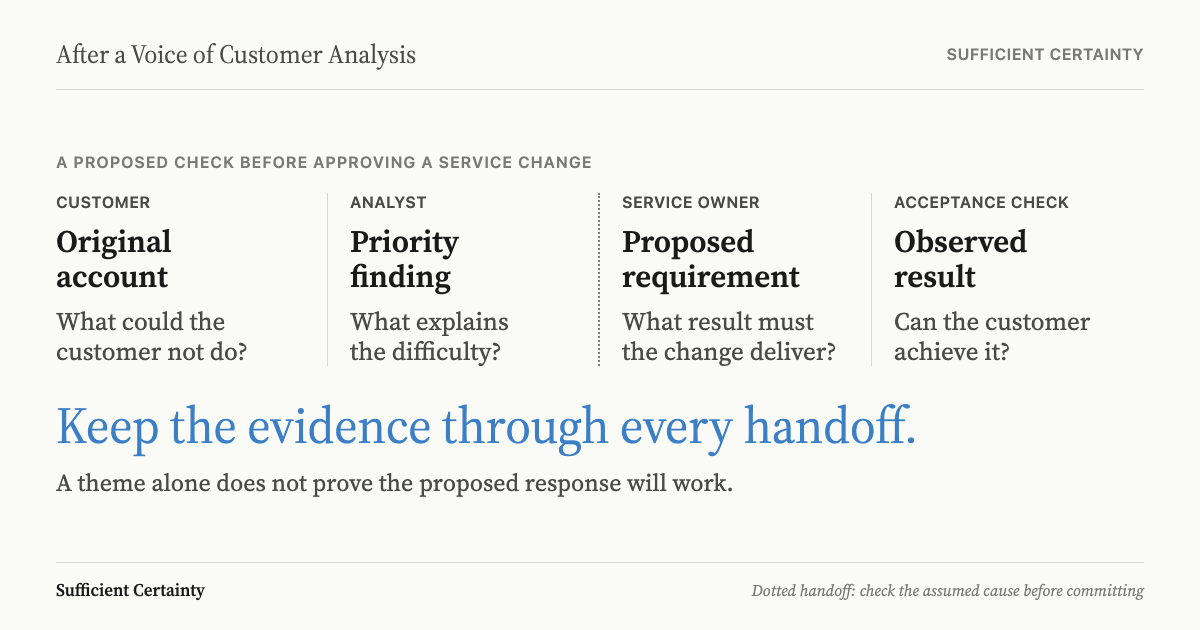
After a Voice of Customer analysis, trace one priority finding to the original customer comments. A service owner can receive a polished summary headed “improve communication” and still have no requirement that anyone can test. Before approving a change request, establish what customers could not do and what evidence would show that the proposed change helps.
The immediate task is to check the translation from findings into requirements. Keep the original evidence beside the proposed requirement, so an interpretation cannot become an agreed fact simply by moving into the delivery plan.
Voice of Customer analysis interprets customer feedback to identify needs and guide improvements to products or services.
Translate the findings into proposed service requirements
The completed analysis may contain coded comments, themes and recommended priorities. The next practical step is to give the responsible team a proposed requirement. That requirement should describe a result for the customer and the conditions under which it must hold. When that requirement becomes a service blueprint, ask the receiving team to demonstrate the customer request crossing the backstage handoff.
ASQ describes quality function deployment as a way to prioritize customer expectations and assign the resulting work to responsible functions. The handoff matters. A service owner needs enough detail to choose work without silently changing the customer need.
A proposed requirement should retain the evidence that explains why the customer needs it. Include the original comment or observation, where the difficulty occurred, and the analysis reference. Use controlled access when that material contains personal information. The change request needs a traceable reference, rather than unrestricted copies of customer records.
As a proposed illustration, suppose customers say they cannot tell whether a service request was received. A requirement to send more emails assumes that missing messages caused the uncertainty. First check whether customers received a message they could not understand, or whether the service recorded nothing at all.
Write the required customer result before choosing the implementation. In that illustration, customers need to confirm receipt and find the request's current status. The implementation could involve a clearer message or a correction to the recording process. The findings alone do not choose between them.
This is a stakeholder alignment task with a specific object: the requirement that will receive approval. Name who can approve it and who will verify the result.
A customer theme identifies work needing attention
A synthesis makes scattered experiences available to people who were absent from the original conversations. It can reveal that apparently separate complaints concern the same obstacle. It also gives a service owner somewhere specific to begin investigating.
The theme is useful because it identifies a customer difficulty worth examining. Preserve that value while checking the explanation. Reopening every interview is unnecessary when the question concerns a particular recommendation. Start with the comments supporting the requirement about to become a commitment.
ASQ's guidance on translating customer voice into needs distinguishes requested features from the benefits customers seek. It recommends recording the situation in which a statement was made. That context helps an owner judge whether a proposed service change addresses the difficulty described.
The same summary can nevertheless produce different instructions for different teams. The following proposed readings illustrate why the requirement needs an explicit check.
Agreement on a theme does not establish agreement on the change it requires. Check the proposed requirement with the people who must deliver and use it. The questions in what to do after stakeholder analysis help identify whose participation matters.
Which customer evidence supports the requirement you are about to approve? Start the Walk →
Whose account supports the priority?
Read the original evidence for the selected finding. Establish whether the summary describes a direct customer account, an employee interpretation, or an analyst's explanation. All can be useful, but they support different claims.
The assumption to test is that the proposed requirement addresses the difficulty shown in the customer evidence. A comment about poor communication does not itself establish whether the cause lies in equipment, wording or staff behavior. State the suspected cause as an assumption until something observable supports it.
Check who could be missing from the finding. A survey delivered through an online account cannot directly explain the experience of someone unable to enter that account. A theme from people who completed a transaction may omit those who abandoned it. These are checks to make against the actual collection method, not claims that every study has those gaps.
Where accounts disagree, keep the disagreement visible. Check whether the people described different moments in the service, rather than combining their comments into a single instruction. Ask the analyst to show which accounts support the selected finding and which challenge it. That check may narrow the requirement to the situation where the difficulty actually occurs.
The process for surfacing assumptions starts with the belief a particular choice needs to be true. Here, write that belief beside the requirement. Record what evidence would contradict it and who can obtain that evidence before approval.
Frequency can justify attention without proving that a particular remedy will work. If the requirement needs scarce delivery time, explain the consequence of leaving the customer difficulty unresolved. The approach to prioritizing competing urgent requests makes that consequence explicit.
JetBlue traced gate feedback to a speaker fault
The Qualtrics customer account of JetBlue describes negative comments and a lower Net Promoter Score at gate A18. JetBlue investigated and found a broken terminal speaker. Passengers could not hear the gate agent.
According to the supplier, JetBlue sent an automated alert to airport maintenance. The speaker was repaired that day, and scores subsequently rose. The page includes a testimonial from Danny Cox, JetBlue's Director of Customer Support and Insights.
This is a supplier account, rather than an independent investigation. It does not identify the airport or date for gate A18. It provides no figures that establish how much of the score change the repair caused. It also does not document completion of a formal Voice of Customer analysis.
The useful lesson is the investigation between the complaint and the chosen response. The reported customer difficulty had a specific physical cause. A broad requirement for better announcements would have left that cause unconfirmed.
Applied to a reader's service change, a proposed check would observe whether the intended customer can receive the information under relevant operating conditions. That is a suggested acceptance test, not a test documented in the JetBlue account. Record the conditions before deciding what evidence is sufficient.
The distinction also matters after root cause analysis: naming a cause and verifying a corrective action are separate tasks. Preserve the link between them when the change request moves to another team.
Check the acceptance condition before approving change
Atlassian's acceptance criteria guidance calls for clear, testable conditions describing the desired outcome. For a customer finding, those conditions should show whether the customer can achieve the result that justified the work.
The following proposed comparison keeps the change request open until the evidence supports approval.
Theme becomes instruction
- A recommendation supplies the wording.
- The team chooses a solution immediately.
- Completion means the change was delivered.
Requirement retains evidence
- Original accounts explain the customer difficulty.
- The suspected cause receives a check.
- Acceptance shows the intended customer result.
Use the Universal Decision-Making Method on the requirement awaiting approval:
- Frame. State the customer result and the service commitment being considered.
- Tentative Elements. Identify a possible response without treating it as settled.
- Assumptions. Name the unverified explanation connecting the evidence to that response.
- Sufficient Certainty. Obtain evidence proportionate to the cost and consequences of choosing wrongly.
- Implement+Monitor. Assign the acceptance check and the condition that will reopen the requirement.
Approve the requirement only when the evidence supports both the customer need and the proposed response. If it does not, authorize a focused investigation or a limited test. Record the unresolved assumption rather than hiding it in delivery wording.
Record who will perform the acceptance check and where its evidence will be kept. A delivery team marking its task complete does not establish that the customer result was observed. The owner approving the requirement should know what will count as a failed check before work begins.
After implementation, keep observing the customer result. The guidance on monitoring decisions helps distinguish a failed implementation from an explanation that was wrong. Reopen the requirement if the original difficulty persists despite the change passing its delivery checks.
Trace the customer finding to the condition your proposed change must satisfy.
Work through your decisionNo sign-up. Just pick your decision and start.
Grant Purdy is the co-author, with Roger Estall, of Deciding (2020), and the architect of the Universal Decision-Making Method.