
When the crisis plan no longer fits, the damage comes from following it, not from the original shock. The assumption the plan depended on broke days earlier. Nobody checked because the plan was still running and the team confused activity with response. Three questions catch the break before the damage compounds.
I have worked in decision-making for nearly fifty years. When the crisis plan no longer fits, the damage comes from a specific gap: the time between the moment an assumption broke and the moment someone noticed.
In December 2022, Southwest Airlines dispatchers ran SkySolver, a legacy crew-scheduling tool that had reassigned crews to aircraft during disruptions for years without incident. They called the crew desk, received an assignment, passed it along, exactly as their irregular-operations plan required.
They followed this sequence on December 22, and again on the 23rd, and again on Christmas Day, by which point 16,900 flights had been cancelled and more than two million passengers were stranded across the United States. The $140 million settlement the Department of Transportation imposed in 2023 was the largest civil penalty in US airline history, but the settlement had nothing to do with the quality of the plan.
SkySolver's central assumption, that it could re-solve crew assignments faster than disruptions accumulated, had stopped being true on the first day, and nobody in the building had the authority to say so.
A crisis plan no longer fits when the conditions it assumed at the time of writing have changed, but the organisation has not yet recognised the change or reopened the decision.
The Assumption Breaks Before the Plan Does
Southwest had used SkySolver successfully for years. The irregular-operations plan built around it was well tested. What changed in December 2022 was the scale: a winter storm created disruptions that compounded faster than the software could re-solve. The assumption, that SkySolver's capacity would always exceed the volume of disruptions, was not written down anywhere in the plan because nobody thought it needed to be.
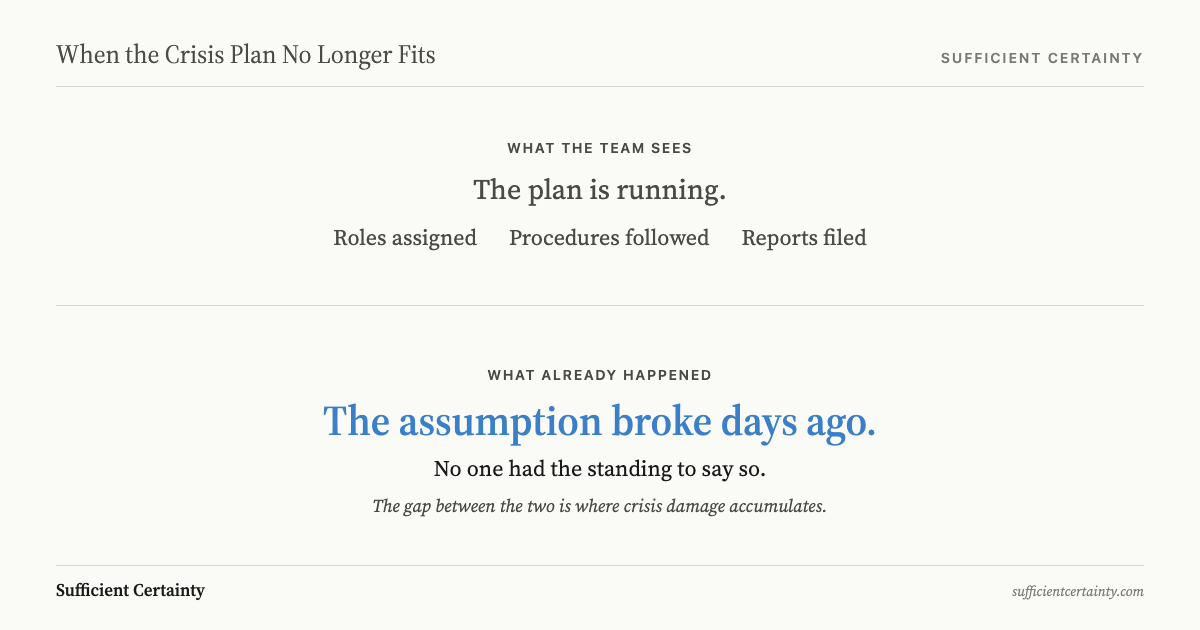
This is a pattern I see repeatedly in crisis management strategies: the plan carries neither a list of the assumptions it depends on nor any trigger for recognising when one has broken. At Southwest, that recognition gap ran for roughly four days, during which the dispatchers were doing exactly what the plan told them to do.
When the Crisis Plan No Longer Fits and Nobody Knows
The most dangerous version of this pattern is when the broken assumption was one nobody considered an assumption at all.
In February 2021, Texas's grid-reliability plan treated natural gas as firm, dispatchable on demand and the backbone of the system, while wind was classified as the variable, less reliable input requiring backup. When Winter Storm Uri arrived, wind performed close to or above forecast for most of the event, and natural gas, the supposedly reliable fuel, was what actually failed. Wellheads froze, pipelines froze, uninsulated plants shut down, and gas accounted for 87% of the fuel-related generation outages according to the subsequent FERC and NERC joint inquiry. The Texas Department of State Health Services recorded 246 deaths, and economic damage has been estimated between $195 billion and $295 billion.
The winterisation failures were not new: after a similar cold weather event in February 2011, FERC and NERC had recommended winterisation measures for Texas generators, but the recommendations were treated as optional and the state's deregulated market provided no mechanism to compel compliance. An assumption that survives one near-miss, with no visible consequence, becomes harder to question the second time; the survival itself is taken as evidence that the assumption is sound.
I have sat in rooms where "gas is firm" was treated as a physical law rather than an assumption someone should have been checking. ERCOT operators, working from a plan built on that assumption, had to improvise load-shedding decisions in real time with no procedure for a scenario where the reliable fuel was the one failing. They came within four minutes and 37 seconds of a complete, uncontrolled statewide blackout that could have taken months to restore.
What made this lethal was that the assumption did not break from a single, identifiable cause. Frozen pipelines and an unprecedented cold snap were individually manageable; in the same week they interacted, the facts were changing faster than anyone could track, and the combined effect invalidated the foundation the entire grid plan depended on.
Name the assumptions your crisis plan depends on and set the signal that tells the team when one has broken. Start the Walk →
How to Know When the Crisis Plan No Longer Fits
The Harvard Kennedy School crisis case library, one of the largest in the world, trains leaders by putting them through documented past crises and asking what they would decide. The skill it builds is recall: have you seen something like this before? The skill that mattered at Southwest and ERCOT was different: recognising, inside a live event, that the scenario you prepared for has stopped matching what is happening.
I have no quarrel with scenario rehearsal. Tabletop exercises, case libraries, certification programmes: they build recall, and recall has value. The dangerous assumption is that the next crisis will resemble one the library already contains. At Southwest and ERCOT, what broke the plan was a condition nobody had considered an assumption at all. No amount of rehearsal catches what nobody thought to name. The debrief after a crisis management exercise is the cheapest place to start naming them.
In hospital operating theatres and airline cockpits, professionals do not wait for a formal review to check whether the situation still matches the procedure. They cross-check continuously, because the cost of an unnoticed assumption in those environments is catastrophic, and consequently the checking is built into the work itself. An anaesthetist who sees a number drift does not wait for the surgeon to call a review. The standing to interrupt is built into the role.
Most crisis plans carry roles and escalation paths but do not name the assumptions they depend on or the signal that would tell the team when the crisis plan no longer fits the situation. Three questions close the gap before the crisis arrives: what assumptions does this plan depend on? How fast can each one change? What observable signal would tell the team it has broken?
The monitoring interval has to match the volatility of the assumption. At Southwest, the relevant interval was days, not the quarterly review cycle the organisation was using. In the Universal Decision-Making Method, monitoring is designed at the decision stage by the person with the greatest awareness of the assumptions, because that person is best placed to specify what checking is needed.
Who Has the Standing to Stop the Plan
When the crisis plan no longer fits and someone finally recognises it, the next question is who has the standing to act. In the organisations I have worked with, the crisis plan assigns roles for execution: who manages communications, who reports to the board. It almost never assigns the one role that matters most: who has the standing to declare that the plan itself has stopped fitting the situation.
At Southwest, dispatchers knew by December 23 that SkySolver was producing nonsense, and they said so to their supervisors, who escalated. Nobody in the chain had the explicit authority to override the plan and switch to manual scheduling, because the plan had no clause that said "if these conditions no longer hold, stop." Everybody waited for somebody else to make the call, and leadership finally acted on December 26, four days and 16,900 cancelled flights after the assumption had failed.
The call to stop following the plan is harder than any decision the plan contains, because it requires admitting that the basis of the original decision has changed. The sunk cost of the plan and the comfort of having a procedure to follow both weigh against the person trying to declare it obsolete. That resistance is why the standing to make the call has to be assigned in advance, not negotiated during the crisis.
I have reviewed crisis plans across every industry I have worked in. Every one of them tells people what to do. Almost none tells them when to stop. A crisis management plan that works needs a clause its authors almost never write: if these conditions no longer hold, stop following this plan. Each prepared action needs an exit condition and a break trigger — four fields that turn the document from script to tool.
The person running the plan has every incentive to keep executing. Assign the standing to someone whose job it is to check whether the plan still fits. When that person makes the call, record it: the assumptions that changed, the evidence that triggered the stop, the decision that followed. When the board, the regulator, or the coroner asks, the record is what defends the call.
Leadership under pressure is the discipline of building this into the plan before the crisis arrives, and having the standing to act on it when it does.
You could follow the crisis plan to the letter and never learn the assumption broke.
Work through your decisionNo sign-up. Just pick your decision and start.
Grant Purdy is the co-author, with Roger Estall, of Deciding (2020), and the architect of the Universal Decision-Making Method.