
Lead when the facts change fast by testing assumptions, not reacting to headlines. A leadership group that reverses last week's commitment every Monday is not adapting. It has no stable claim to test. Record the five assumptions behind the strategy and change course only when one breaks.
When to change strategy is the question a leadership group should answer before the next market update arrives. One group I watched reversed the previous week's commitment every Monday, each time citing different data and producing the same two hours of debate. By the fourth reversal the team had stopped executing because they expected the next meeting to undo whatever this one decided. The test is not whether the update is alarming. Change strategy only when it breaks an assumption the current plan depends on. Otherwise, stay the course.
I have watched this pattern in manufacturing firms and government departments across four decades of investigating decisions that produced other than the intended outcomes. It is the same problem any person in authority faces when new information arrives faster than the organisation can absorb it.
The instinct was always to blame the leader for indecision or to praise them for being flexible enough to pivot, and neither explanation reached the actual cause. The team had never written down which assumptions the original decision rested on, so every new data point looked equally urgent and the response to each one was indistinguishable from the response to all the others.
The team stops committing to execution because commitment has no value when the direction will change before the work is finished. Suppliers receive conflicting instructions. External partners question whether any commitment the organisation makes can be relied on. What begins as a decision problem becomes a credibility problem, and the root cause is always the same: invisible assumptions.
Change strategy when new information invalidates an assumption the current strategy depends on; otherwise, hold the course and keep executing.
When to Change Strategy: Most Teams Overreact
A Harvard Business Review study tracking 89 organisations through repeated restructures found that those with high change-fatigue scores experienced 43 per cent higher failure rates on subsequent initiatives and 31 per cent lower implementation success.
More than half the business leaders surveyed expected three or more major changes over the next two years, although most employees can absorb only one or two per year. The researchers compared the pattern to MIT's beer-distribution simulation, where a small temporary change in customer demand prompts an overcorrection that amplifies the original problem rather than dampening it.
The researchers named the pattern accurately: the "transformation treadmill." Their prescription, however, was empty. They recommended "brick by brick management" and "sensing emerging realities," phrases that sound like management but instruct nobody to do anything. That is the favourite move of the consulting industry: name the disease impressively, prescribe nothing.
The filter they were looking for does not require a new framework. Before executing, the Decider records the assumptions the current plan depends on. Not every assumption: the five or six that would actually change the outcome if they turned out to be wrong. That count is what separates a routine decision from high stakes decision making. When new information arrives, the team has something concrete to test it against.
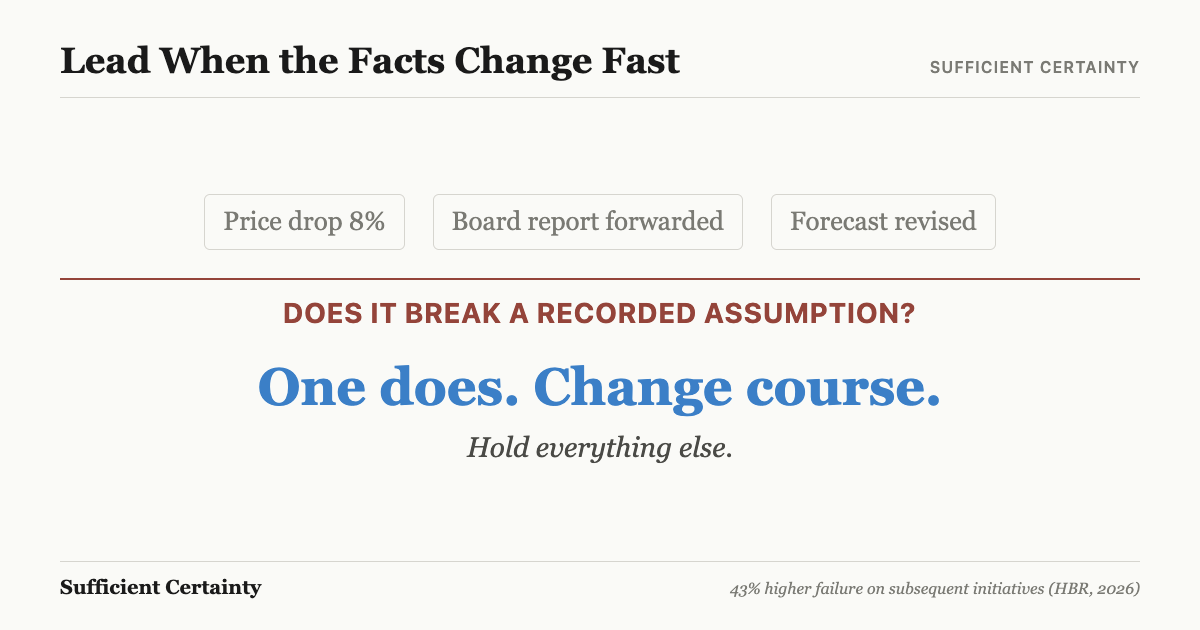
If a new fact invalidates one of those recorded assumptions, the leader changes course and explains which one broke. If it does not, the leader holds the line and tells the team why the plan still holds. That single question is the filter the 89 organisations were missing. It is also what separates a crisis management plan that survives its first real test from one that sits on a shelf.
Changing Course Without Saying Why Costs Trust
In February 2020, the United States Centers for Disease Control and Prevention recommended against mask-wearing for the general public. Six weeks later, after evidence of asymptomatic transmission mounted, the CDC reversed its position and recommended universal mask use. A study published in the Journal of Public Economics measured the cost: participants who saw the reversal became significantly less likely to trust subsequent government recommendations than participants who received only the final guidance.
Trust fell because the reasoning behind the original position had never been made visible. The CDC did not say in February: "We believe asymptomatic transmission is rare, and if evidence changes we will reverse this recommendation." It silently converted an assumption into public guidance, issued that guidance as though it rested on settled fact, and then wondered why nobody believed the correction.
When the reversal came, the public could not tell whether it reflected genuine new evidence or institutional confusion, and compliance dropped at the moment compliance mattered most.
The lesson for any leader whose team faces fast-changing facts is direct. If you do not state your assumptions before acting, a later change of course will cost credibility regardless of how well-founded it is.
This is why the Universal Decision-Making Method requires recording assumptions as a step, not as an afterthought. A Decider who changes direction can then say: "We assumed X. The new data shows X no longer holds. Therefore we are changing Y." That sentence preserves trust because it connects the reversal to a named reason. Without it, the team hears only the change and fills in the reason themselves.
Write down the five assumptions your current plan depends on and test the next update against them before the meeting reverses course again. Start the Walk →
A Recorded Assumption Is the Filter
In a finely balanced competition, as Roger Estall and I describe in Deciding, the same decisive play is reasonable or reckless depending on whether a specific condition has changed enough to move the threshold for action. The competitor who knows which condition matters can hold steady under noise; the one who has not named the condition reacts to everything.
That principle transfers directly to organisational decisions under pressure. The leader who has recorded assumptions knows which new fact moves the threshold and which is background movement that does not affect the current decision. The leader who has not recorded them cannot tell whether the situation has materially changed or whether the information is simply arriving faster, and that inability is the defining failure of every attempt to lead when the facts change fast.
In practice, this means recording the five or six assumptions that actually matter to the decision before execution begins. Each assumption should state what must remain true for the current plan to hold.
When a new fact arrives, the team asks one question: does this invalidate a recorded assumption? If yes, the leader reopens the decision and explains which assumption broke. If no, the team continues executing without convening another meeting to revisit a decision that was already made.
That question is the operational difference between decision-making under pressure that produces defensible outcomes and the whipsaw that exhausts the team. A visible record of what must remain true, protected by a leader willing to hold the line against noise, is the only filter that reliably makes that distinction.
When the Facts Change Fast, Match Monitoring to Their Speed
An INSEAD working paper on crisis management synthesised the literature into a phased scheme covering everything from who gets consulted to what the organisation says afterwards. The scheme's execution phase advises choosing "the right metric that authentically reflects results and generates trust."
That advice does not tell the leader which metric signals a genuine need to change direction and which reflects normal variation. It assumes the leader will know. Most do not, because nothing in the scheme requires writing down the conditions under which the current plan would no longer hold. Synthesising the literature is the academic equivalent of clearing the throat before someone else does the talking.
The missing step is designing monitoring into the decision before the pressure arrives. When I record the assumptions behind a decision, I also record what variance in each assumption would trigger a re-evaluation and how frequently each assumption should be checked.
An assumption that depends on a stable regulatory environment might hold for a year. An assumption that depends on a competitor's pricing might need weekly verification. The monitoring interval must match the volatility of the assumption, not the anxiety of the meeting room.
In nearly every decision I have been asked to investigate after the fact, the monitoring arrangement was set on a single interval, typically quarterly or whenever the board next happened to meet.
Everything was checked on the same schedule regardless of whether the underlying assumption could change overnight or would remain stable for years. That uniform interval is the reason organisations discover a broken assumption months after it broke, which is to say months after the decision should have been revisited.
This is what distinguishes leadership under pressure from mere responsiveness.
The leader who designs monitoring before executing, following the method's fifth step, can tell the team: "We check this assumption weekly. It still holds. Keep going."
The leader who has not designed monitoring convenes a meeting every time someone forwards an article, spends two hours debating information that nobody can connect to a stated assumption, and reaches a conclusion the team will discard on the walk back to their desks.
You could react to the next data point and still leave the assumption that holds the plan untested.
Work through your decisionNo sign-up. Just pick your decision and start.
Grant Purdy is the co-author, with Roger Estall, of Deciding (2020), and the architect of the Universal Decision-Making Method.