
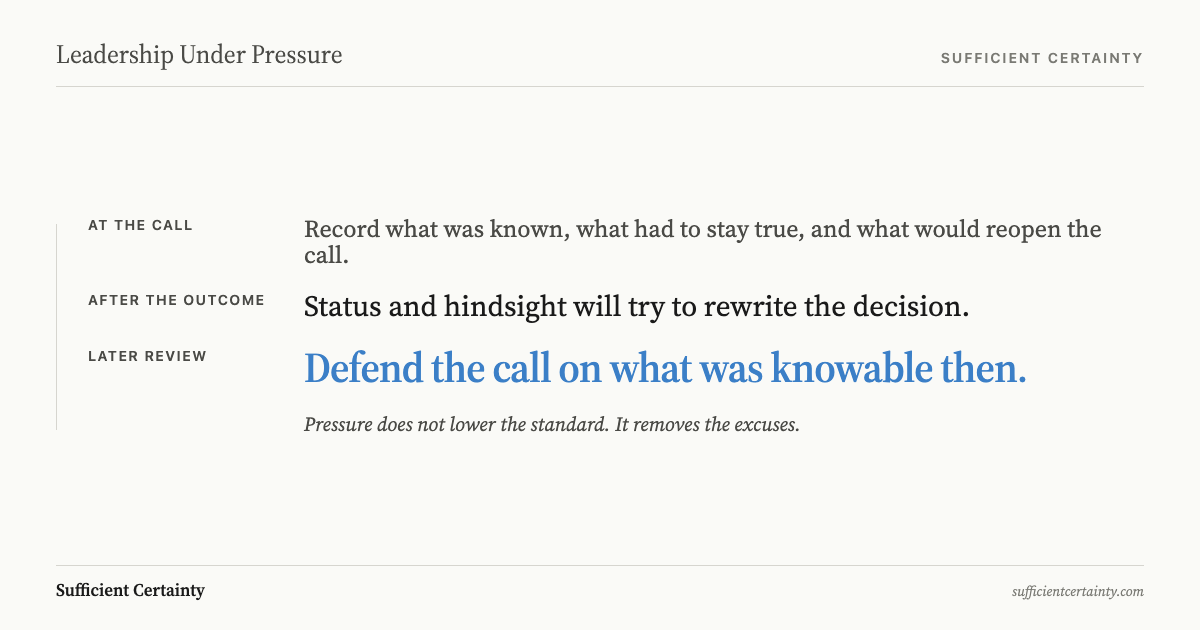
Leadership under pressure is not about composure. It is about making a call that can survive later review because the reasoning was visible before the outcome started doing public relations for it. A lucky result flatters a bad process. A bad result can follow a sound one. Only the reasoning at the time settles it.
When a plant is down and the board wants a restart note by four o'clock, leadership under pressure is not about looking composed. It is about making a call that can survive later review because the reasoning was clear at the time, not reconstructed once the noise dies down. By the time legal or governance people see the file, the pressure has gone and hindsight has moved in. That is exactly why the reasoning has to be visible before the outcome starts doing public relations for it.
Roger and I wrote Deciding because too many consequential decisions were being buried under ceremony and hindsight. A lucky outcome can flatter a bad call. A bad outcome can follow a sound one.
This reaches further than a formal crisis. It covers the shutdown or the restart that has to be defended in writing once tempers cool, with a regulator's question still waiting in the background. The pressure may last ten minutes or three months. The test is the same. I deal with the narrower operating version in decision making under pressure.
Leadership under pressure is deciding when time and evidence run short. The test is what was knowable then, not how it turned out.
What Leadership Under Pressure Actually Means
Most advice on this subject turns pressure into a character exam. Stay calm. Project confidence. I am not interested in that theatre.
The real question is whether the decision can be defended on what was knowable then, because that is what later review will eventually examine. The review is always retrospective. By then confidence is cheap and language gets polished. People start pretending the weak assumption was obvious all along.
Enron did not collapse for want of confident executives. Its stock slid from about $100 to a few cents while Andersen's audit work still certified financial statements the Senate report described as apparently fraudulent. Worse, clean audit opinions were still being issued while Andersen internally gave Enron its maximum risk rating. That was not a failure of posture. It was a failure of deciding that had been dressed for years in the language of control.
So when I talk about this discipline, I mean a stricter standard, not a softer one. The person making the call has to say what the call is. Then they have to say what had to stay true for it to work and why that was enough at the time. That written account is not decorative. It is the only serious defence against a later meeting in which status outruns evidence. Without it, later scrutiny becomes a fight between memory and status, and memory nearly always starts lying first.
Why Crisis Decisions Fail Before the Crisis Is Named
A crisis usually begins long before anyone uses the word. The visible disruption is often just the first moment when the gap between assumption and reality is too large to ignore. By then, what was assumed is no longer what is happening. The deciding error is often already old. The event looks sudden mainly to people who were not watching the condition that mattered.
Take a manufacturer considering a new product line. The call can look sensible on the day it is approved, then turn sour because a government changes tax settings to stimulate growth or because some other external condition shifts over the life of the decision. The world did not betray the decision. The decision depended on conditions that were never kept properly in view.
That is why I treat crisis management here as one operating context inside this discipline, not as a separate doctrine. The leader's job is to decide whether the original call failed or whether the Context changed enough to require a new one. That includes asking whether execution drifted away from the original basis, and how quickly any change would show up and become detectable. If those questions are blurred, the organisation starts explaining the disturbance instead of deciding when the operational failure became a business crisis.
Crisis Management Is a Decision Problem, Not Logistics
The category error is simple. Organisations treat a crisis as though it were mainly an operations and logistics problem, when the first real failure is usually that nobody has clear standing to make the live call. People speak as if the event itself does the deciding. It does not. The real question is who may reverse yesterday's decision or spend money fast when the underlying assumption starts to fail. In leadership under pressure, that is the whole game.
The First World War message story is funny until you remember what it means. "Send reinforcements, going to advance at midnight" moved verbally down the line and arrived as "send refreshments, going to a dance at midnight." If nobody with standing confirms what is being decided and on what assumption, confident repetition only spreads the error.
If authority has not been settled before the pressure arrives, the room starts bargaining with titles. One manager waits for permission that no one can clearly grant. Another protects the previous decision because reversing it feels like confession. The assumption carrying the call stays half-spoken because naming it would expose how little certainty the room actually has. Operational convenience then starts outranking decision quality. That is a decision failure before a single operational task has begun. Any crisis management plan built on that foundation is a shelf document, not a decision tool. A crisis playbook that pairs each prepared action with the condition that would make it unreliable turns a shelf document into a decision instrument.
Write down the reasoning behind a call you need to make today, before the outcome starts editing it. Start the Walk →
Leadership Under Pressure Still Needs Sufficient Certainty
Urgency is not evidence. Some leaders move too soon because action feels cleaner than doubt. Others keep asking for more material long after the decision has narrowed to one uncertain condition that will not become fully knowable in time. Both habits dodge the real question, which is whether there is enough certainty for this call given the context and consequences. That is why leadership under pressure still turns on sufficient certainty, not tempo.
The clock does not suspend the method. It makes the Universal Decision-Making Method more exacting, because under pressure you still have to Frame the decision cleanly and Recognise assumptions before the room confuses confidence with sufficient certainty. No decision ever provides total certainty. Under pressure the discipline has to work without ornament and without pretending a formula will save the person making the call from judgement. What separates a routine call from high stakes decision making is not the contract size or the rank in the room; it is the number of untested assumptions the outcome depends on.
A finely balanced sports match makes the point cleanly. A player can attempt the same ambitious move now, when one mistake may decide the result, or later, when failure will matter less because the state of the match has changed. The action is identical. Its reasonableness is not, because timing changes the significance of the assumption beneath it.
That is why assumptions have to be judged by influence and confidence, not by how strongly the room wants closure. Some assumptions are so influential that low confidence in them should slow the decision or change it. Others can be tolerated because the downside is smaller or the signal will return quickly. Greater certainty always has a price, usually delay or the loss of the opportunity itself. If you want the wider argument about uncertainty rather than pressure, I deal with that in decision making under uncertainty.
The Record That Defends the Call
The record that matters is not the tidy story written after the dust settles. It is the contemporaneous account of the call and the assumptions beneath it, including what would reopen the decision. It pins the decision to the prevailing Context before hindsight starts smuggling in knowledge that did not exist at the time. That is the difference between a defensible decision and a flattering reconstruction.
Civil aviation gives the cleanest example. Aviation record-keeping rules require maintenance records to identify the work and the responsible sign-off, including when the work was completed and under whose certificate it was released, so later buyers and regulators can see what was checked and how reliability was sustained after the original people and circumstances changed. The record survives the people because the question survives the people.
The same standard belongs on consequential business decisions. If the call may later need justification to a regulator or a board, write the call and the assumptions under it while they are still visible to the person making it.
Keep the prevailing Context in the record. Keep who was involved. Those anchors let a later reader separate what was reasonably knowable then from what only became obvious later.
Without that record, leadership under pressure becomes a contest between memory and self-protection. The organisation discovers too late that it kept records of motion rather than records of deciding. The crisis management examples that changed how I work all share that pattern. The crisis management plan examples that hold up are the ones that recorded what was assumed and who was watching.
Crisis Plans Are Secondary Elements, Not the Decision
A crisis plan is a subordinate aid, not a saviour. It helps only if the assumption it was written for still holds. A plan written for specified conditions cannot adjudicate conditions it did not foresee. Once reality moves, when the crisis plan no longer fits, the shelfware starts protecting everyone except the person left to make the call. That is why I have so little patience for crisis-plan theatre dressed up as discipline.
It survives because crisis-plan theatre protects the people who profit from it. Insurers get conditions to impose. Regulators get something auditable. Consultants with an internal sponsor get a trade to sell and administer. Boards commission the thing because it looks prudent in a file. Executives are comforted by it because it suggests the hard judgement has been done already.
It also gives the organisation a sacrificial prop. Once outcomes sour, the conversation can be dragged back to whether the ritual was completed instead of whether the decision was any good. When it fails, the custodians point to the standard or the last exercise, and the live decision still lands on somebody who was never protected by any of it.
COVID-19 exposed that fraud in public. Even the preparedness review found that pandemic plans and business continuity plans covered only some of the responses required. During that disruption, none of the organisations I dealt with reached first for a risk register or a business continuity plan. They were deciding how to cut vulnerability now and whether to stay shut or reopen in a changed market. The plans had been written for specified conditions, while the decision had to deal with conditions that had already moved.
By secondary elements I mean the pre-arranged actions and resources that may help once the live decision has been made. Backup power is one. An evacuation procedure is another. Useful, sometimes essential. Still secondary. They can support the decision or catch variance after it starts, but they never answer the central question of whether the present facts still justify the call, or what the executive should decide once escalation is triggered.
Monitoring Has to Match the Speed of Change
Monitoring is useless if it moves slower than the assumption it is supposed to watch. Ask how quickly the relevant change would show up, then set the signal to return on that scale. False precision wastes time.
Speed of change matters as much as the chance of change. Slow drift with poor detectability can be more dangerous than an obvious shock. If the assumption can rot this afternoon, then in leadership under pressure an annual assurance cycle is not monitoring. It is decoration.
The auditors case is blunt for a reason. Even well-designed monitoring assumes the instrument and the monitoring system are working as intended, so a clean report proves only that the previous check did not catch a variance. That matters when the decision may fail faster than the assurance cycle moves.
Good monitoring needs a signal fast enough to matter and a competent person with standing to act on it. That is why I prefer the ugly operational question to the polished assurance one. Do we need to know fast enough to act, and who will do something when the answer turns? If nobody can answer that, the organisation has not designed monitoring. It has designed delay, and delay is usually what turns a manageable variance into a public crisis. That is the missing discipline in crisis management strategies, and it persists until someone specifies what risk management should hand off before the pressure arrives.
How to Build Pressure Readiness Before the Clock Starts
You do not invent decision discipline in the first ugly ten minutes. By then you are stuck with whatever habits the organisation rehearsed when the stakes were ordinary. If the everyday habit is to hide assumptions or defer ownership, pressure will not correct that. It will expose it. And when those facts shift again after the first response, the habit of recording assumptions is the only thing that tells the room which change actually matters.
The same is true when motion is mistaken for a decision. Quiet decisions are where the room learns whether someone may surface a bad assumption without being punished for slowing things down. That is why the real rehearsal happens in unglamorous operating decisions, not only in theatrical exercises once a year. When one does run, the useful question after a crisis management exercise is what the scenario was never allowed to test.
The Accounts Payable example is ordinary on purpose. Hiring someone to clear an invoice backlog can look like an obvious operational fix, yet in the wrong control environment the same move can open the door to massive fraud. Pressure to get invoices moving does not excuse a narrow frame when the intended gain is speed and the hidden exposure sits in control weakness.
That is why I keep returning to the five-step method. It is plain because the problem is already hard enough without professional fog. Readiness is not a workshop badge or a rehearsed line about resilience. It is whether the room can still say who owns the call and what would make that call wrong once patience has gone. The quiet Tuesday habits are the ones that survive the ugly Friday.
You could face a board call tomorrow with only hindsight where your reasoning should be.
Work through your decisionNo sign-up. Just pick your decision and start.
Grant Purdy is the co-author, with Roger Estall, of Deciding (2020), and the architect of the Universal Decision-Making Method.