
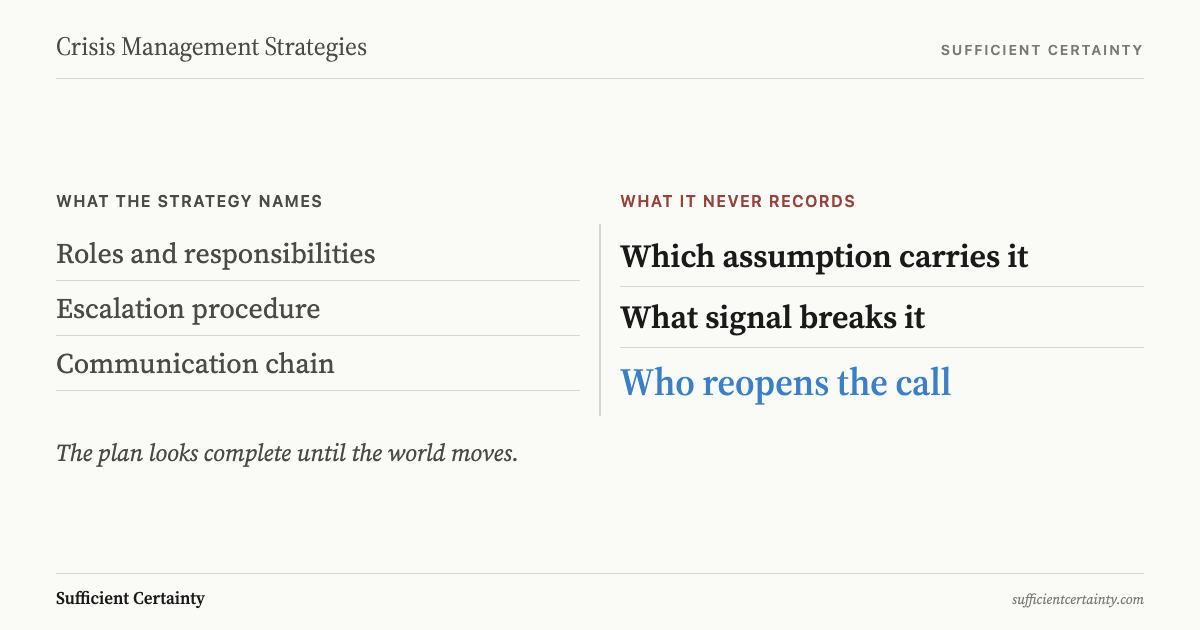
Crisis management strategies worth using name the assumptions each action depends on and say what would break them. Most crisis packs assign roles and skip the harder question: which assumption, if it fails, means the prepared response is now the wrong response? That question needs an answer before the pressure arrives.
I sat with a VP of Operations who had a 26-page crisis pack, a 14-name call tree, and eight days before the board meeting. Her team had run the tabletop exercise twice. Nobody could tell me which assumption would make the whole thing wrong. That is where leadership under pressure starts, and where most crisis management strategies stop being useful.
The plan existed. The roles were assigned. The rehearsal had run. But none of it answered the only question that matters in a live crisis: what fact, if it changed tonight, would make all of this wrong? Without that answer, the pack was a comfort object with a binding.
Crisis management strategies are the decisions, triggers, and monitoring rules that tell an organisation what to do when a crisis changes faster than its plan.
Why Crisis Management Strategies Rot Before the Crisis Arrives
I have watched it happen the same way every time. The team writes the plan when things are calm, assigns the roles, schedules a drill, files the document. Nobody records what the plan depends on. So when the world shifts, nobody in the room can say whether the strategy still holds or whether they are following a dead document out of loyalty.
That is exactly what the New Zealand inquiry into the 2023 severe weather events exposed. Fifteen people died across the Auckland Anniversary floods and Cyclone Gabrielle. Physical damage ran between NZD 9 billion and NZD 14.5 billion. The inquiry did not blame the people in the rooms. It blamed the strategies that had never been turned into operational decisions. Readiness, situational awareness, and decision-making were all judged inadequate. Plans existed. The judgement to act on them, change them, or abandon them did not.
The OECD confirmed the scale of the problem: 18 of 25 member countries had experienced a major non-COVID crisis since 2017 that they were not prepared to manage. That is not a shortage of templates. Every one of those countries had crisis documentation. What they lacked was the discipline to record which assumption could break the strategy and the authority for someone to say so before the damage was done.
That is the rot. The plan looks complete on the day it is written. It decays the moment the world moves and nobody updates the assumption register. Most rooms are full of capable people who still miss the one assumption that matters because nobody owns the job of watching it. That gap is what turns a routine call into high stakes decision making, and most organisations cannot tell the difference until after it goes wrong.
Name the assumption your crisis strategy depends on and the signal that would force the room to reopen the call. Start the Walk →
Which Signal Should Change a Crisis Strategy
Whichever signal breaks an assumption the strategy depends on. If the strategy assumes a supplier can deliver within 48 hours, the signal is that supplier's lead time crossing the line. A procurement team that tracks the metric weekly will catch the drift before it matters; one that waits for the quarterly review will learn about it from a customer. If it assumes the backup site is live, the signal is the backup going dark. The Universal Decision-Making Method starts here: record which assumption the strategy depends on and who reopens the call when the signal breaks it.
Most organisations flatten this into a calendar. Quarterly reviews, annual drills, scheduled updates. That works when the assumption can only break slowly. When it can break in a day, and many can, the quarterly review is a quarter too late. The monitoring cadence has to match the speed at which the assumption can fail, not the speed at which the organisation likes to hold meetings.
The person who sees the signal also has to be able to act on it. If the alert must climb through three layers of approval before it reaches the room, it arrives as history. By that point the room is not deciding; it is constructing a narrative about what went wrong.
The UK government resilience framework spent GBP 22 million backing local resilience forums with principles and delivery themes. That is a lot of apparatus around the question and very little time on the question itself: who sees the signal that breaks the assumption, and can they stop the room before the old plan does more harm than no plan at all? That is where decision making under pressure either works or collapses into performance.
What Crisis Management Strategies Must Record Before the Room Commits
Before anyone acts, I want two things written down: what the strategy assumes, and what would force the room to reopen the call. Not a general risk register. Not a list of everything that could go wrong. The specific facts the team believed were true when it committed, and the specific change that would make those facts wrong. That is the work the method does before pressure strips away the slack, and it is what risk management should hand off before the crisis team starts cold.
The GAO counted 254 US weather and climate disasters above USD 1 billion each since 1980, totalling more than USD 1.7 trillion. Those numbers are large enough to have produced better crisis strategies by now. They have not, because recording damage after the fact teaches you nothing about the decision failure that let the damage happen. Information only helps when someone ties it to the assumption that could break the call before the call is made.
I want the decision record to say what was true when the call was made, what was assumed, and who brings the issue back if the assumption fails. I have never seen a board punish a team for writing that down. I have seen plenty punish the opposite: a team that followed a plan without ever asking whether the plan still fit. The board wants evidence that someone owned the question, not proof that the answer was comfortable.
Roger Estall and I wrote in Deciding that secondary elements are prepared in advance and support the decision without replacing it. Crisis management strategies work the same way. The monitoring, the escalation paths, and the communication templates all support the live call. The moment any of them substitutes for the call itself, the strategy has stopped working and the organisation is running on habit.
The Board Needs a Defensible Call
The board does not need a binder. It needs to know the team recorded what was assumed, watched for the signal that could break it, and reopened the call when the signal fired. That is the point of leadership under pressure: defend the quality of the call, not the comfort of the outcome.
When the facts change, the board question is whether the team knew the change mattered. If the team did not know, the fault is not indecision. The fault is that nobody owned the monitoring. A good crisis strategy makes that ownership visible before anyone has to improvise under fire: which assumption each person watches, what threshold triggers the call, and who has the authority to reopen it without waiting for permission.
I have seen too many teams keep a plan alive long after the facts had killed it. They were not weak. They were loyal to a script that no longer fit the situation in front of them. The right move was to say so, reopen the decision, and decide again with what they actually knew. A crisis management plan only earns its keep when it tells you when to stop following it.
If the plan can only be defended by saying it existed, it was never a strategy. It was paperwork with an approval date, and the next crisis will treat it accordingly.
You could rehearse the crisis strategy and still leave no one watching the assumption that would break it.
Work through your decisionNo sign-up. Just pick your decision and start.
Grant Purdy is the co-author, with Roger Estall, of Deciding (2020), and the architect of the Universal Decision-Making Method.