
Accountability examples in the workplace get treated as motivation stories. They are not. Every useful case follows the same pattern: a decision hardened without a visible owner, a warning sat in someone's inbox, and the person who should have dragged the call back into the room stayed quiet. That is the failure worth studying.
One workplace let a wheel bearing run 103 degrees Fahrenheit above ambient before a train derailed. Another had a patch rule that said 48 hours and still left an internet-facing portal exposed. People call these accountability examples in the workplace.
I care about these examples because they show decisions hardening without a visible owner. The values posters can stay on the wall. The apology can come later. The evidence that should have dragged the decision back into the room is where accountability either exists or becomes theatre.
Accountability examples in the workplace are cases that tie a work decision to its owner and to the evidence that should have reopened it.
What accountability examples in the workplace usually miss
Most page-one articles on this phrase give you behaviours, usually some version of owning mistakes and following through. Those things matter, but they arrive after the interesting part. The real question is who made the commitment that everyone else is now being judged against.
Roger Estall and I wrote Deciding because we kept seeing the same dodge in different organisations. A target would be blessed. A control would be treated as adequate. Then somebody lower in the chain would be asked why accountability had slipped. This is the dodge I am attacking in the guide to accountability in leadership: the senior person blesses the commitment, then the junior person inherits the blame. A tidy arrangement, especially for the person who blessed it. In the Universal Decision-Making Method, accountability starts when the Decider is named and the decision is framed, not when the post-mortem begins.
That is why I ask who had the authority to commit the organisation. Then I ask what made the commitment look safe at the time. If an example cannot answer that, it is probably only a story about manners.
| Case | Decision owner problem | Warning sign | Question to ask |
|---|---|---|---|
| East Palestine | Alert thresholds and emergency authority were not owned tightly enough. | Wheel bearing heat reached 103 degrees Fahrenheit above ambient. | Who could stop the train? |
| Equifax | The patch order had no proof owner. | An exposed portal stayed unpatched after the 48-hour rule. | Who verified closure? |
| Nottingham | Governance absorbed concerns without forcing a decision back up. | Families and staff kept surfacing safety concerns. | Who owned escalation? |
| Southwest | The response rules had owners only after passengers were stranded. | More than 1 million passengers lacked prompt notifications or refunds. | Who owned the response? |
East Palestine turned a warning into a decision test
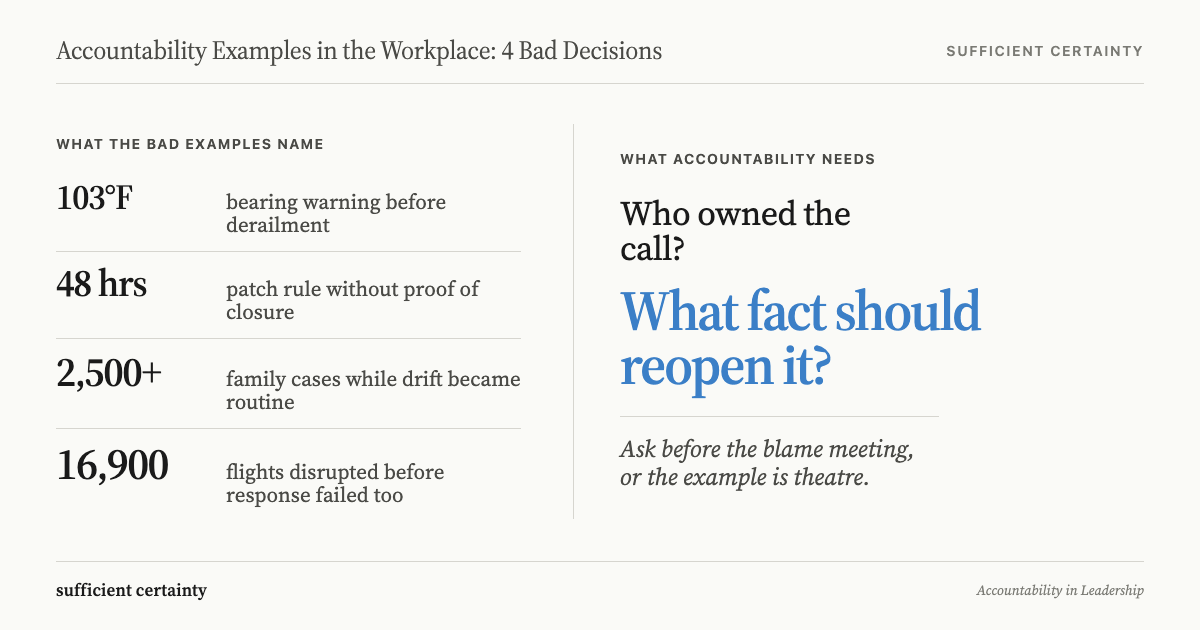
The NTSB report into the February 3, 2023 East Palestine derailment is brutal because the warning signs were not hidden. Investigators said the wheel bearing that failed had reached 103 degrees Fahrenheit above ambient before the derailment. That matters because the organisation had to decide what threshold meant stop and who had the authority to act on the alert. Those are workplace decisions, not acts of fate.
The second decision was just as revealing. After the derailment, the incident commander was told he had 13 minutes to approve a vent-and-burn of five tank cars. The NTSB later concluded that the vent-and-burn was unnecessary. I want you to pause on that. In the middle of a crisis, the decision-maker was put under false time pressure and given a basis for action that did not stand up later. Accountability failed when a live decision had to be owned and challenged.
This is where the accountability vs responsibility muddle earns its keep. If responsibility is all we discuss, attention stays on the people doing the work. Conveniently, it stays away from the people who approved the threshold logic while leaving nobody with standing to stop the thing once the facts started to wobble.
Trace one warning in your team back to its owner and decide who is accountable for acting before it drifts. Start the Walk →
Equifax was a patch order without proof
The House oversight report on the Equifax breach gives you a cleaner office example. On March 8, 2017, Homeland Security alerted Equifax to the Apache Struts vulnerability. Internal policy required patching within 48 hours. The consumer-dispute portal still went unpatched, and the breach later affected about 148 million people. No factory, no derailment, no dramatic smoke plume. Just an instruction that everyone could admire while the exposed system stayed exposed.
What usually gets said is that Equifax told people to patch and the handoff failed. That is responsibility language. It tells me work was assigned. It does not tell me who owned verification, who was meant to confirm that the exposed system had actually been fixed, or what assumption senior leaders were relying on when they accepted that the exposure was closed. A patch order without proof is only an instruction floating through the building.
That is why most accountability frameworks leave me cold. They can tell you who is consulted or informed. They rarely record the assumption the organisation is betting on. In this case the hidden assumption was that notification plus policy meant closure. An accountable workplace would have treated closure as a decision requiring evidence, not as a cheerful email sent into the void. The beneficiary is the manager whose dashboard says "policy complied with" while the exposed system waits patiently for the thieves.
Nottingham was drift with no owner
The final review of maternity services at Nottingham University Hospitals NHS Trust, published on June 24, 2026, covered the period from 2012 to 2025 and examined more than 2,500 family cases. The warning sign was not hidden in a spreadsheet: the review was established after significant concerns from local families, then met more than 500 families and heard from more than 830 current and former staff. Years of governance failure and weak clinical monitoring gathered force because the organisation kept normalising what should have been intolerable.
Slow drift is popular because it gives everyone an alibi. Nothing dramatic happened today, so nobody has to admit that yesterday's unacceptable signal has become today's operating condition. A team gets used to a delay in escalation. Managers tell themselves the last review dealt with it well enough. After a while the live assumption becomes: this is still broadly acceptable. If nobody owns that assumption, decline becomes routine.
I have seen this pattern outside healthcare, too. People imagine accountability means a named person at the top and a stern review at the bottom. That is too crude. Real accountability needs somebody attached to the signal that says the decision basis is eroding. If the signal belongs to nobody, the institution drifts. A short decision record helps because it preserves what the service was relying on in the first place, including the signal that should force the decision back onto the table.
Southwest failed again when the response needed an owner
The US Department of Transportation order against Southwest shows something managers often miss. The December 2022 collapse involved more than 16,900 disrupted flights and more than 2 million affected passengers. The order also said Southwest failed to provide prompt flight-status notifications and prompt refunds to more than 1 million passengers, leading to a $140 million civil penalty announced on December 18, 2023.
That is one failure, followed by a second one wearing an administrative badge. First the system broke. Then came the decision about what stranded passengers would be told and how fast money would move. Many organisations treat the response as mere administration, as though the only accountable decision was the one that created the breakdown. I do not buy that. Once the collapse begins, the response rules still have owners.
Useful accountability examples in the workplace do not stop at the breach; they name the proof that should have closed the loop. The second failure is usually designed in advance, inside refund rules and escalation thresholds that nobody has quite owned. When those rules are ownerless, the organisation gets to fail twice, first in the event, then in the response.
Ask who made the commitment and what fact should have dragged the matter back into the room. If a leadership team will not answer that, the rest is theatre with better stationery.
You could teach the case and still never ask who owned the warning.
Work through your decisionNo sign-up. Just pick your decision and start.
Grant Purdy is the co-author, with Roger Estall, of Deciding (2020), and the architect of the Universal Decision-Making Method.