
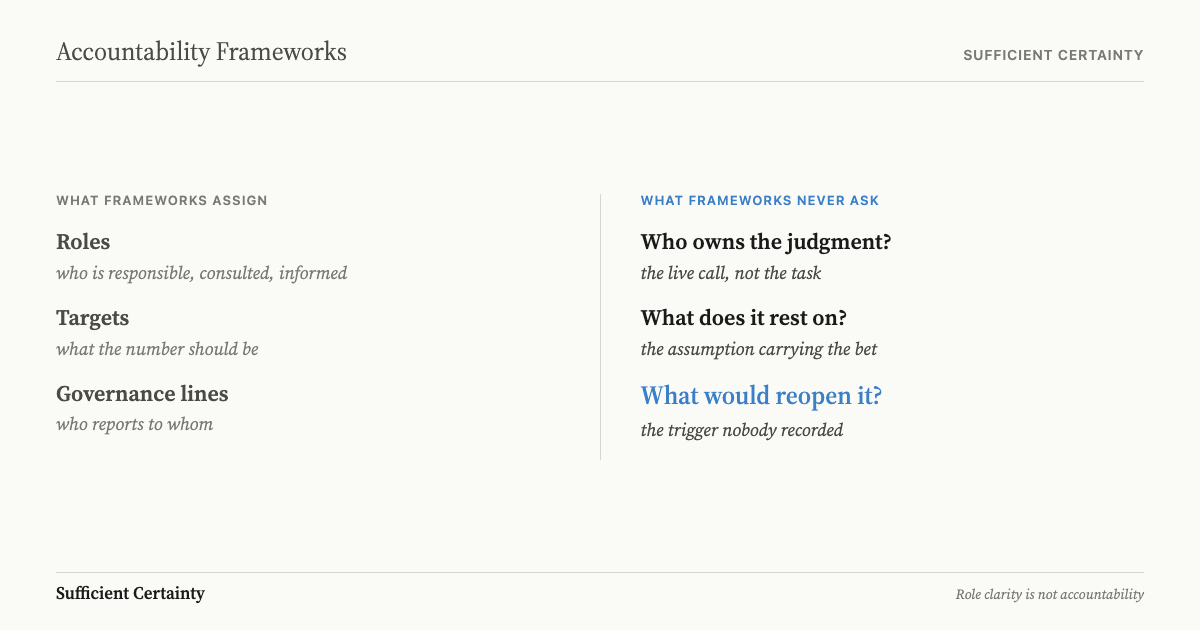
Accountability frameworks assign roles and targets. They do not record why the call was made or what would reopen it. A RACI chart stops turf fights. It does not test whether the judgement behind the decision was sound. Until the reasoning is written down, the framework is theatre with initials.
I have sat in meetings where a RACI matrix was stapled to the pack and the deck was streaked with red and amber targets. The room still could not answer the only question that mattered: who is actually deciding? That is why accountability frameworks look busy and fail the minute the judgement call turns difficult.
I am not against role clarity. I object when role clarity is sold as accountability. In my experience, charts stop turf fights; they do not tell a board or a hospital executive what the bet rests on when the future is uncertain.
Accountability frameworks are systems that make decision ownership clear and make follow-through visible.
Why accountability frameworks disappoint
Most of them disappoint because they sort the boxes and ignore the decision. In Harvard Business Review, Paul Rogers and Marcia Blenko looked across 350 companies and found only 15% of executives thought their organisations made decisions consistently better than competitors. Their John Lewis example is enough for my purpose: head office cut kitchen lines, stores were barely involved, sales fell, then recovered after the decision rights were clarified.
RAPID helped John Lewis stop tripping over itself, but it still did not answer the harder question: once the numbers went soft, who owned the judgement? Naming the Decider is only the front gate. After that, somebody has to frame the decision properly and expose the assumption doing the heavy lifting. Somebody also has to say what would tell us we were wrong while there is still time to change course. A role chart says nothing about that, which is useful if your main goal is to look organised.
John Lewis recovered because the stores were not decorative stakeholders. They knew what customers were actually buying, and when head office handed them a role in the decision, the sales data that had been sitting in the wrong inbox finally reached the right conversation. RAPID helped the company hear that voice. It still took a human being to weigh the evidence and own the call.
RACI still leaves the live judgement call exposed
RACI still leaves the live judgement call exposed because responsibility maps do not create authority or challenge. The Defra project initiation lessons report reviewed six major projects, up to GBP 23.8 billion. It says a RACI or RAM can clarify responsibilities. It also says the obvious thing: delivery depends on strong leadership and people being able to tell the accountable person that the premise is going soft. In several of those projects, the roles were clear on paper. The difficulty was that nobody had permission to say the original cost estimate was drifting, or that the technical assumption behind the timeline had already failed.
If the person in the accountable box cannot be challenged, the chart is wallpaper. People later say, "It was her call," as if the sentence carries its own logic. Nobody asks what the call rested on or whether anyone in the room was authorised to say it looked wrong. The chart assigns accountability and responsibility to different people but rarely tells you who owns the judgement itself.
When I hear that a program failed because the RACI was unclear, I usually suspect a kinder fiction is being protected. The room did not want to test its assumptions while the decision was still alive. Somebody knew the premise was soft, but the governance structure rewarded silence over challenge. Redrawing the boxes afterwards is cheaper than reopening the call while it can still be changed, especially for people who want to sound diligent on Monday.
That is why I keep coming back to the Universal Decision-Making Method. It starts with the live decision, not the reporting line. Before the room debates options, it asks what the decision actually rests on and what would tell us the call has gone wrong. If the assumption underneath cannot be stated in plain English, the structure around it is already doing theatre.
Layer the judgement call onto your role chart and expose the decision the framework still leaves unowned. Start the Walk →
When accountability frameworks become alibis
In my experience, accountability frameworks become alibis the moment targets or governance bodies start outranking purpose. The Francis inquiry follow-up on NHS culture describes a Trust that treated national targets and financial balance as the main game while quality of care and patient welfare slipped behind them. The machinery looked serious. The judgement inside it was rotten. The same inversion starts after OKR setting, once a key result carries pay before anyone has asked how much certainty it needs.
I have watched the same pattern in private companies. The board approves a risk appetite statement, the executive team translates it into KPIs, and the KPIs become the accountability framework. Within a year the KPIs are the point. The original purpose they were meant to serve sits in a strategy document nobody reopens. When the call goes wrong, every manager can show they hit their number. That is the alibi.
Targets are excellent hiding places for bad trade-offs. Once a number is crowned, managers defend the number and stop revisiting the choice that crowned it. That is why accountability in management often feels like burden without authority. It is also why so much talk about accountability culture collapses into posters and dashboards, even in accountability examples in the workplace where the warning sign was already visible.
Big infrastructure tells the same story with heavier consequences. The Crossrail lessons-learned report shows the trick in formal clothing. Sponsor boards existed and intervention points existed, yet authority still drifted back into parent bodies when the pressure rose. With about 70% of the funding outside central government, the line of authority blurred just when it needed to sharpen. The usual bargain applied: the centre kept the authority, the people nearer the risk kept the schedule grief. That arrangement flatters the parent bodies (and leaves everyone else holding the explanation). Authority to intervene existed on paper, but it did not exist in the room where the schedule was bleeding.
The framework I trust starts with the decision
The framework I trust starts with the decision itself. Most accountability frameworks start at the wrong end. They sort roles first and ask what the decision rests on later, if they ask at all. After decades of watching organisations accumulate governance machinery, I do not confuse neat board paper with a sound call. Roger Estall and I wrote Deciding because we had seen too many cases where structure stood in for thought.
If you want real accountability, name the Decider before the discussion starts. Then write down why the call seems sensible, in words an ordinary manager can test six months later. Also write the fact that would make you reopen it. If nobody can name that trigger, the room is borrowing confidence from the future.
I also want a short decision record, not a consultant report or a register full of stale entries. One page that states what we decided and why we thought it was sound, with the fact that would make us reopen it written in plain English. That record is the real test of accountability in leadership, because it survives the people who made the call and still lets a successor challenge it.
Most accountability frameworks never name the assumption carrying the decision or set a trigger that would reopen the call, which is why accountability without blame collapses when the review has no record to inspect. The reasoning goes unrecorded, and when the decision ages badly, the framework becomes the blame machine organisations claim they want to escape. RACI and RAPID produce tidy governance, but tidy governance is what people build when they would rather sort the boxes than make the actual judgement.
You could redraw the RACI and still leave the live judgement call unowned.
Work through your decisionNo sign-up. Just pick your decision and start.
Grant Purdy is the co-author, with Roger Estall, of Deciding (2020), and the architect of the Universal Decision-Making Method.