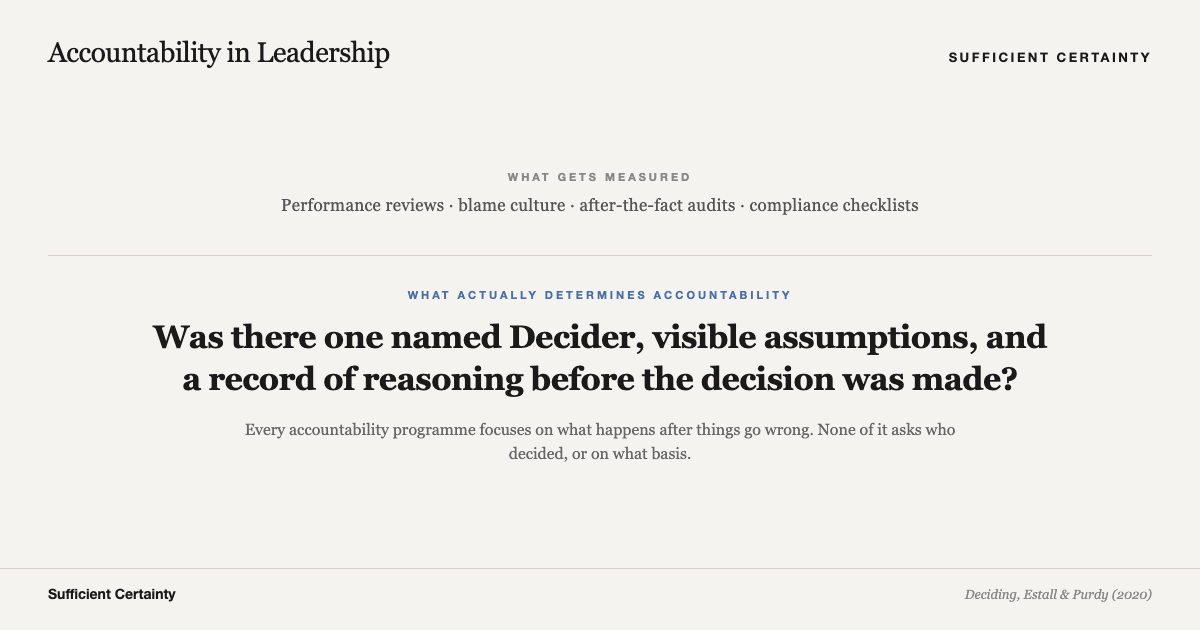
Accountability in leadership fails after the decision, not before it. Organisations call for more accountability once the damage is visible. By then the real failure has already happened: nobody named the Decider, nobody surfaced the assumptions, and nobody recorded why the call looked sound at the time.
After Challenger, after Enron, after every boardroom embarrassment, the call goes out for more accountability in leadership. What usually follows is a repair job on the optics: a review, a new role chart, a values statement about ownership. The sequence is backwards. By the time the post-mortem starts, the real accountability failure has already happened. It happened when nobody named the Decider, nobody surfaced the assumptions, and nobody wrote down why the call was thought sound.
Accountability in leadership is the practice of naming one person to own each decision before it is made, surfacing the assumptions it rests on, and recording the reasoning.
What accountability in leadership actually means
That is what I call decision accountability. In the Universal Decision-Making Method, accountability begins at the moment a decision is framed, not after the outcome is known.
Data does not change that obligation. Leaders avoid owning decisions when a dashboard becomes cover, rather than a way to test the call they have made.
That is the plain answer. It is not mainly about "owning the result" after the fact. It is about owning the decision before the commitment is made. Who decides? What is the decision for? What assumptions does it rest on? What was judged sufficient to proceed? If those questions cannot be answered while the choice is still live, the organisation does not have accountability. It has a ceremony for distributing blame later.
This matters because outcomes are noisy. Good decisions can end badly when conditions change. Bad decisions can look wise when luck intervenes. Leadership accountability that begins with the outcome will always punish some sound calls and protect some foolish ones. The serious work starts earlier, when the Decider is named and the reasoning is made visible enough for challenge.
That also means accountability is not a personality trait. It is a structure. A leader can be brave, eloquent, and admired, yet still leave a decision homeless. Another can be quiet, awkward, and decisive in the only sense that matters: the decision was clearly framed, the live assumptions were exposed, and the basis of the call was recorded before the room moved on.
When people ask me what decision accountability looks like in practice, I give the same answer every time. One person owns the call. Others contribute knowledge and challenge. The assumptions are named. The reasoning is written down. That is what accountability in leadership actually means when the jargon is stripped away.
Why most accountability programs fail
Most accountability programs fail because they begin too late. They are built for review, remediation, and ritual apology. They are not built for the living moment when a leader must decide under uncertainty and make their judgement legible to others.
Gallup has reported that fewer than half of leaders rate themselves as accountable. I do not hear that as a moral confession. I hear a design failure. Most organisations tell leaders to be accountable, then surround them with systems that reward delay, diffusion, and polished ambiguity. A bad quarter produces a values workshop. A failed project produces a new approval gate. Nobody goes back to the actual decision and asks what it rested on at the time. The same happens after a quarterly business review that closes the forecast gap without asking where the closing revenue came from.
I have sat through too many of those reviews. The room talks about ownership as if it were a missing virtue. Then someone produces a RACI. The chart assigns an "A" and everybody relaxes. Yet the decisive question is still untouched: what assumptions is that A sitting on? Most decision-making frameworks map authority after the fact or by role. They do not test whether the person with authority has exposed the reasoning well enough to deserve confidence.
The deeper problem with most accountability frameworks is that they assign roles without ever recording the reasoning those roles are supposed to protect.
Blame moves into that gap. Accountability without blame only holds when the record was written before anyone knew how the decision turned out.
OKRs fail in the same way. So does the balanced scorecard. They measure outcomes, milestones, and activity. That is useful, but it is not sufficient for accountability. An OKR can tell you sales missed the target. It cannot tell you whether the original decision relied on a fantasy about demand, a lazy assumption about capacity, or a timetable nobody believed. Values posters are weaker still. They tell people to be responsible, courageous and transparent, without ever asking who decided, on what basis, and where that is recorded.
Roger and I used to ask clients a rude question: "If 'risk management' is the answer, what was your question?" The same impatience applies here. If an accountability program begins with punishment, reporting, and behavioural slogans, it has already missed the question. The real question is how the organisation makes decisions that people can later defend without fiction. Anything else is retroactive theatre. That is why so much leadership accountability becomes a slogan.
Accountability in leadership vs responsibility: the distinction that matters
The distinction matters because responsibility and accountability are not the same thing. Responsibility is about the work to be done. Accountability is about who made the decision and what reasoning authorised that work.
An operations team can be responsible for implementing a plant closure. That does not make them accountable for deciding to close the plant. A finance team can be responsible for producing the numbers. That does not make them accountable for the bet the board placed on those numbers. Responsibility is execution. Accountability is decision ownership.
This is a structural distinction rather than a matter of HR vocabulary. RACI gives you Responsible, Accountable, Consulted, Informed, then stops just before the useful part. It never asks what assumptions underpin the decision the A is approving. So the work gets assigned while the reasoning stays foggy. Later, when the outcome disappoints, the organisation starts arguing about who "owned" what. Ownership, in most companies, amounts to little more than enthusiasm.
If you want the practical test, it is simple. Can you point to one person who made the call? Can you point to the assumptions that carried it? Can you point to the moment they judged the basis sufficient? If not, you may have responsibility spread across ten desks, but you do not have accountability. You have administrative motion and a future quarrel.
This distinction is why so many middle managers feel trapped. They are told they are accountable for results when they never held decision authority and never got to challenge the assumptions. That is not accountability. It is exposure without control, which is one reason the language has become so distrusted. The full argument about accountability vs responsibility starts with the decision, not the org chart. Before approving pay or development action, the follow-up to a performance review separates documented performance from missing opportunity or resources.
The same timing problem sits under the usual ownership language: accountability versus ownership only helps when it shows who decided, what they assumed, and who is watching.
Take a live decision and record who is deciding, what assumptions carry it, and what would reopen the call. Start the Walk →
The Decider: one person, one decision
Real accountability becomes structural at the first step of the Universal Decision-Making Method: establish "the authority of the Decider to make the decision". That line does more work than a shelf of governance manuals. It says the decision will not emerge by drift, committee mood, or seniority theatre. One person decides. Others contribute. That is also what keeps collaborative decision making honest. Groups are there to improve the thinking, not dissolve the ownership.
If you prefer organisational jargon, call it a decision rights framework. I prefer plainer language. Name the Deciders, the decision and the authority under which it is made. Once that is clear, the conversation can do useful work.
Challenger is the case that still shames the modern organisation. On 28 January 1986 the shuttle broke apart after launch and killed all seven crew. Engineers had warned that the O-ring seals were not certified for the launch temperature. Management overrode them. The method forces the question that the system avoided: who was the Decider? Was it the engineers with the technical knowledge? The managers who overrode them? The NASA officials applying the schedule pressure? Accountability was so diffused that the decision had no clear owner and no visible set of owned assumptions. When that happens, the decision gets made by default, by hierarchy, by timetable, by whoever is willing to stop asking questions first.
Roger Estall and I used an ordinary workplace example in Deciding because good structure is easier to see in a small room than in a national tragedy. The Decider says: "We are having to make a decision about whether to outsource our IT helpdesk with the aim of improving productivity by reducing IT-related downtime. Today, as a first step, we need to all agree on the nature and frequency of help desk delays. I am looking to you to provide an overview of recent experience in your departments and get your analysis of causes but without seeking to attribute blame to any person."
Before anyone speaks, accountability is clear. The decision is named. The Purpose is named. Today's objective is named. The input sought is named. The no-blame boundary is named. Nobody has to infer what game is being played. Nobody can later pretend the conversation was about something else. That is what structural accountability looks like when a competent Decider opens their mouth.
Most organisations never get there. They hand a manager the title "accountable" and a target, then withhold authority over the decision that shapes the result. I wrote about that structural gap in accountability in management because it is the commonest version of the problem. Before choosing a development action from 360-degree feedback, compare observer groups and the work situations each group saw.
If you want concrete cases of warnings nobody really owned, see these accountability examples in the workplace.
Assumptions are where accountability breaks
Assumptions are where accountability breaks because they are the load-bearing elements of a decision. Budgets, demand forecasts, safety margins, supplier promises, timetables: the call stands or falls on these things. If the Decider does not surface them, they cannot own them. They can only act surprised later.
This is where people start begging for a formula. There isn't one. "What is sufficient for one Decider might not be sufficient for another." That is not an invitation to whim. It is a statement about judgment. Sufficiency depends on the Decider's authority, the significance of the assumptions, and the cost of being wrong. One person may need tighter evidence before proceeding. Another may accept more residual uncertainty because delay is more dangerous than movement. The point is not to standardise the appetite. The point is to make the judgment visible.
The water-testing drift case shows what happens when that visibility never turns into ownership. A food manufacturer had precautionary biological-count testing on its water supply. The instruments drifted out of calibration and nobody noticed because nobody owned the monitoring. Contaminated water reached the product. Both the product and the reputation were damaged. This looks like a monitoring failure, and it is. It is also an accountability failure that began much earlier. If nobody owns the assumptions in Recognise assumptions, nobody will truly own the checks in Design monitoring. Controls without named ownership decay silently.
That is what separates structural accountability from the poster version. When an organisation builds accountability culture around a decision method rather than a behavioural programme, the room no longer needs blame as its only enforcement mechanism.
The decision record: accountability you can point to
The decision record is the part most organisations skip because it feels like paperwork. It is not paperwork. It is the thing that makes accountability real. A proper record preserves who was involved, what was decided, which assumptions carried the decision, why the reasoning was judged sufficient, and what will be watched next.
Without that record, monitoring is blind. You cannot hold anyone accountable for a decision nobody wrote down clearly enough to inspect. Memory will be edited by status, self-protection, and hindsight. The eventual post-mortem analysis has nothing to compare reality against. A year later the meeting minutes will say that concerns were considered, without recording which concerns they were, which assumption mattered, or who accepted it.
I call this a decision quality issue because low-quality decisions almost always hide inside vague records. The Decider has the best view of the live assumptions at the point of deciding, which is exactly why the monitoring requirements should be specified then, not invented after something drifts. Records are not bureaucratic overhead. They are accountability you can point to.
The same logic applies at every level. Accountability in the workplace fails when the person carrying the deadline never owned the call that created it. The record fixes that by making the commitment visible before work starts.
Building accountability into how decisions are made
If you want more accountability, change how decisions are made. Do not start with the posters. Do not start with another behavioural program. Start with structure. I have long put it this way: governance is "how the organisation is controlled". Risk management, stripped of its industry theatre, is how decisions are made and people are held accountable.
That is why I prefer a method for making decisions to another sermon about culture. One client's maturity score moved from 13.3 to 31.8 after adopting the method. The lift did not come from charisma training or better slogans. It came from naming Deciders, exposing assumptions, and recording reasoning before action. The organisation had not discovered a nobler class of leader. It had stopped asking character to do a job that belongs to process.
I have watched the mood change when people realise accountability can be fair. Once one person is clearly authorised to decide, once the assumptions are visible, once the reasoning is written down, the room no longer needs blame as its only enforcement mechanism. Challenge becomes easier because the target is the logic, not the person's worth. That is the foundation of an accountability culture worth having.
This is the shift that matters. This kind of accountability is not a trait you hire for, and it is not a speech you give after the numbers go bad. It is a repeatable method. One person decides. The assumptions are exposed. The reasoning is recorded. Then, and only then, the organisation has some right to say that its leaders are accountable.
You could leave the room with nods, then spend weeks chasing unclear ownership.
Work through your decisionNo sign-up. Just pick your decision and start.
Grant Purdy is the co-author, with Roger Estall, of Deciding (2020), and the architect of the Universal Decision-Making Method.