
Accountability without blame needs evidence from before the outcome was known. Almost nobody writes that down while the decision can still be argued with. Blame is not the root problem. It is what rushes into the evidence vacuum once the result is visible and the reasoning was never recorded.
I have sat in plenty of reviews that opened with a promise nobody would be blamed and closed with a name. The promise is not dishonest. It fails because accountability without blame needs evidence from before the outcome was known, and almost nobody writes that down while the decision can still be argued with.
In my experience, blame is rarely the root problem. It is what rushes into an evidence vacuum. Once the outcome is known, the room can no longer see the uncertainty that existed at the time, so the person becomes the evidence. A good decision can still end badly, a weak one can get lucky, and if nothing was recorded before the work started the review cannot tell the difference.
Accountability without blame is the practice of tying a decision to its owner and to the reasoning available when the decision was made.
What accountability without blame actually requires
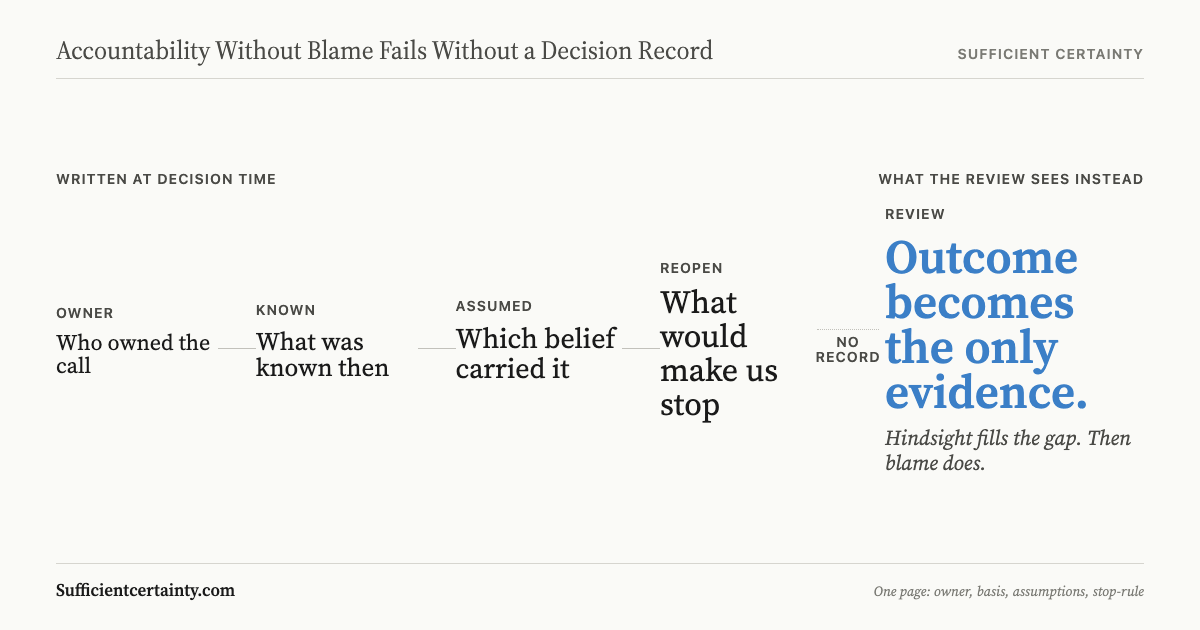
It requires something sterner than nice language. Somebody has to own the decision, and the basis for the call has to be written down while the call can still be challenged. The trigger for reopening it belongs on the same page. Without that record, "no blame" quickly turns into amnesty dressed up as maturity, which is why senior leaders do not trust the phrase.
Roger Estall and I wrote Deciding after watching organisations demand ownership from people while refusing to leave a clean record of the judgment that put them there. In the Universal Decision-Making Method, I start by asking who the Decider is and how the decision is being framed. If nobody can answer that plainly, the rest of the apparatus is just noise (and some people make a good living from that noise).
The only part of accountability vs responsibility worth arguing about is this: responsibility can spread, the judgment that committed the organisation cannot. That is the part leaders usually smudge over, because vague ownership is useful to anyone who approved the work and anyone who later wants to deny it. That evasion sits at the centre of accountability in leadership, because leaders cannot demand ownership while keeping the judgment itself conveniently vague.
Why blameless reviews still become blame sessions
They become blame sessions because the review is often the first time anyone tries to reconstruct the decision. That is absurdly late. The U.S. Department of Health and Human Services Office of Inspector General reported in July 2025 that hospitals did not capture half of patient harm events among hospitalised Medicare patients, and few of the captured events were investigated or turned into improvement. A review built on that sort of record is built on memory and whatever story survives the room.
Once the record is thin, the loudest participant becomes the official historian. Somebody recalls having raised the issue. Somebody else recalls having dealt with it. Nobody can prove much, which suits the people who prefer prestige to evidence. That is why so much talk about accountability culture leaves me cold. I would rather have a blunt meeting with a proper record than a gentle one built on guesswork.
I have sat through enough of these reconstructions to know who benefits from them. The people who never forced a clean record get to talk about tone, and the people who sold the organisation a thick process manual get to say the team failed to follow it. The machinery stays innocent, conveniently.
If the trigger for reopening the call was never written down, the room can only judge the ending. That is how blame sneaks in wearing the badge of accountability.
Put your next review decision into a record that shows who decided, what evidence counted, and what reopens the call. Start the Walk →
Macondo and Grenfell were record failures before they became blame stories
The Chemical Safety Board's Macondo materials tie the Deepwater Horizon disaster to 11 deaths, 17 injuries, and an oil spill that lasted 87 days. The investigation also pointed to weak pre-job risk assessment during temporary abandonment and poor criteria for reading the negative-pressure test. Macondo needed a decision record that made clear who could accept that test and what sign would have forced the work to stop.
I have little patience for most accountability frameworks here. Frameworks love a box because a box cannot argue back. The live judgment stays foggy, which is convenient if you are selling diagrams or hiding behind them. At Macondo, the belief behind the call should have been plain enough for another person to challenge before mud was displaced.
The UK Government's response to the Grenfell Tower Inquiry Phase 2 report carries the same lesson in a different building. Seventy-two people died, and the final report, published on 4 September 2024, made 58 recommendations. Official material also points to missing or incomplete safety artefacts, including the absence of a completed fire safety strategy. By inquiry time everybody wanted a responsible person. Much earlier, plenty of people had benefited from not pinning one down.
Polite leadership advice usually stops there, because once you say that out loud you have to admit who the vagueness protected. It protected the people who were meant to approve the work and the people who were meant to challenge it.
How to run accountability without blame next week
If you want this in place next week, start earlier than the review. Put one page on the table before the work begins. It should say who owns the decision and why the call is being made. It should also say what would make the organisation stop and look again. Now the review has something better to inspect than a bruised human being.
If the reasoning was sound at the time and events still turned against you, say so plainly. If the reasoning was weak, say that plainly too. People usually cope better with a hard judgment than with the usual fog, because fog is where scapegoats and freeloaders both flourish.
Consequences do not disappear under this approach. If somebody hid facts or ignored the agreed trigger, the issue is conduct, and the record will show it without the usual moral theatre. The real fear behind "no blame" is simpler: most organisations never built a proper record, so they have nothing precise to enforce.
This is also why the Universal Decision-Making Method ends with Design monitoring. The stop-rule is part of the decision, not a clerical note to be discovered later by whoever inherits the mess.
The Abu Dhabi paper, published on 25 September 2025, matters because staff got visible reporting tools and a feedback loop. The hospital recorded 2,848 incidents and drew 650 lessons from them. Near-miss reporting rose from 14% to 23% of all reports, and good-catch reports rose from 3.0% to 6.9%. People learn faster when they can see the record will be used, not filed. They also report more when they stop assuming the paperwork exists to find a culprit after lunch.
Before the meeting starts, put that page in front of the room. If it cannot tell an outsider who owned the call and what would have made you stop and reconsider, the review is already in trouble. Then blame will swagger in and pretend to be accountability.
You could open the review promising no blame and still have nothing written from before.
Work through your decisionNo sign-up. Just pick your decision and start.
Grant Purdy is the co-author, with Roger Estall, of Deciding (2020), and the architect of the Universal Decision-Making Method.