
Accountability culture programmes fail because they install values posters instead of decision records. Nobody tracks who decided, what they assumed, or who is watching. Culture does not cause accountability. Documented ownership of real choices causes accountability. The poster is decoration. The record is the work.
Your office probably has a poster somewhere. Accountability culture, in a serif font, maybe over a stock photo of a mountain. I have seen hundreds of them. I have yet to see one hanging next to a document that shows who decided what last Tuesday, what they assumed, and who is checking whether those assumptions still hold.
That is the entire problem with most accountability culture programs. They treat accountability as something you install through conversation: set clearer expectations, hold people to account for results. The advice sounds reasonable until you ask a blunt question. Accountable for what, exactly? If nobody recorded the decision, the reasoning behind it, or the assumptions it rested on, there is nothing to hold anyone to. You have slogans, and slogans have never stopped a board from making the same mistake twice.
Accountability culture is the organisational habit of naming one person to own a decision, recording the assumptions it rests on, and monitoring whether those assumptions hold.
What most organisations mean when they say accountability culture
The search results for this phrase are remarkably uniform. Step-based guides for leaders who want their teams to own their work: set expectations and follow through. This is performance management with a rebrand. It focuses entirely on what happens after decisions have already been made, usually by someone who has quietly left the room.
I have sat in boardrooms where the entire accountability conversation consisted of who owned the project plan. Nobody asked who owned the decision behind the plan, or what that decision rested on. Nobody asked whether the assumptions in the business case had been tested or simply inherited from the previous slide deck. The numbers are always there. The reasoning rarely is. The moment someone raises that question, the room goes quiet, because the honest answer is that nobody owns the decision at all.
APRA’s 2018 prudential inquiry into the Commonwealth Bank of Australia found this pattern at industrial scale. CBA had committees, values language, and governance structures. It also had six major incidents spread across a decade, a widespread sense of complacency, and what the panel called an unquestioning confidence in management. The panel’s 35 recommendations pointed to one missing question: not “can we?” but “should we?” That question belongs inside the decision, before action starts. What nobody built was a method for asking that question before the money moved.
Start with one recent call and record who decided, what they assumed, and who watches for drift. Start the Walk →
When accountability runs in reverse
The Post Office Horizon scandal is the clearest case I know of accountability culture working backwards. For more than a decade, the Post Office treated shortfalls in its Horizon IT system as proof that sub-postmasters were stealing. When evidence accumulated that the system itself produced phantom discrepancies, senior people maintained the fiction that Horizon data was always accurate. By the time the inquiry reported, 111 convictions had been quashed by the courts, and the Post Office (Horizon System) Offences Act 2024 had overturned hundreds more.
The organisation pushed accountability downward onto the people least able to challenge the system, while protecting the assumption at the heart of every prosecution. Nobody asked who decided that Horizon outputs were sufficiently certain to support criminal charges, on what basis, and with what ongoing scrutiny. The people who owned that assumption kept their positions. The sub-postmasters who questioned it lost their livelihoods.
NASA found a version of the same failure in its 2026 Starliner investigation. A crewed mission planned for eight to fourteen days lasted ninety-three. The investigation found that schedule and program goals had shaped engineering decisions that should have stayed anchored to safety margins. The schedule won. It usually does, when nobody is named as responsible for saying the assumptions behind it are no longer safe.
What makes accountability culture structural
One study shows the fix in practice. When two Singapore hospitals reimplemented the WHO Surgical Safety Checklist with stronger briefing design, team training, and measured follow-through, NOTECHS team-performance scores rose from 37.1 to 42.4 across 252 observed cases. Device-related interruptions fell by 86.5 per cent, and nine of twelve safety-culture composites improved.
The surgeons became accountable because the reimplemented checklist forced a pause where anyone in the room could say stop. No poster required. What changed was not the people. It was whether the room had a method that forced each person to own a specific moment in the procedure.
Most accountability programs skip straight to monitoring outcomes. That is like checking the oil after the engine has seized. The Universal Decision-Making Method that Roger Estall and I set out in Deciding builds accountability in at four points.
A named Decider owns the call before it scales. Assumptions are surfaced before anyone acts: what are we assuming here, and how confident are we? The decision is recorded: who decided, the prevailing context, and the main assumptions to be monitored. That record means something.
When the board reviews a decision that went wrong, they can examine the reasoning instead of hunting for a scapegoat. Monitoring watches those assumptions, not just the outcome. If the assumptions were wrong, reopen the decision. If they held and the outcome still went sideways, that is uncertainty at work, not someone’s fault. That shift, from hunting blame to checking assumptions, is what separates structural accountability in the workplace from the poster on the wall. For concrete cases, see accountability examples in the workplace.
A quick test for your organisation
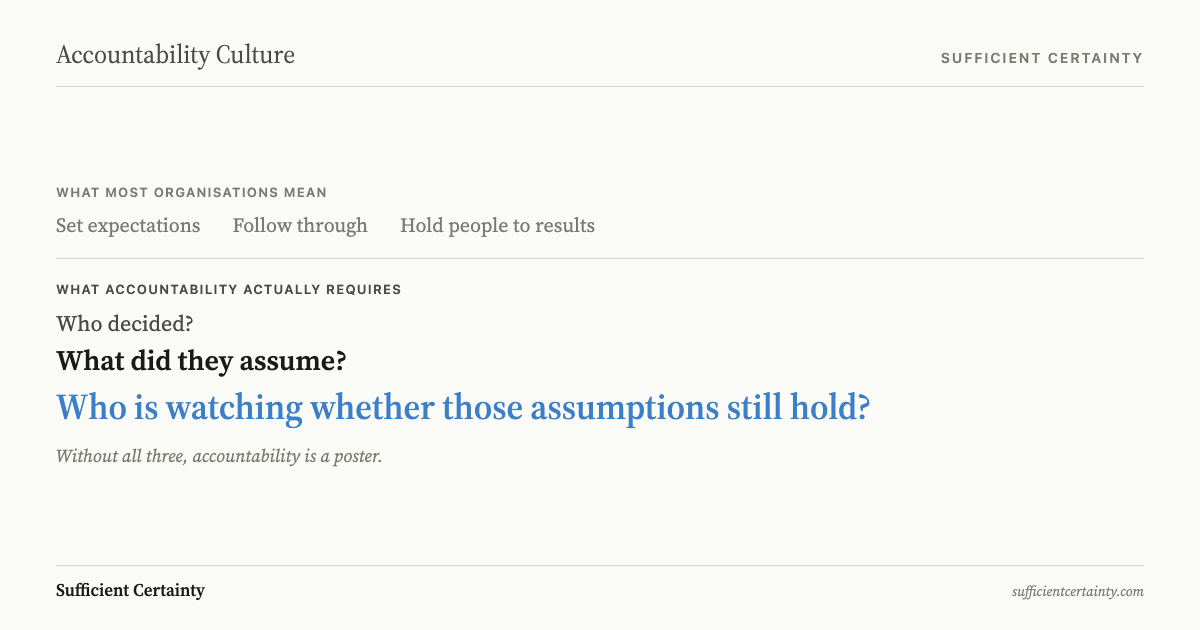
Pick your last three material decisions. Not the routine ones. The ones where money, safety, or reputation turned on someone’s judgment. For each one, answer three questions. Who decided? What did they assume? Who is watching whether those assumptions still hold?
If you cannot answer all three for even one of those decisions, your accountability culture is a poster. The fix is a repeatable decision method that names the owner, records the assumptions, and watches what the decision rests on. Until those three things exist, you are not holding people accountable. You are holding them responsible for decisions they may never have made. The same trap ruins accountability in management wherever a target is handed down without the decision behind it. And the same decisions, with the same blind spots, will be made again next quarter.
You could hang the poster and still never ask who decided.
Work through your decisionNo sign-up. Just pick your decision and start.
Grant Purdy is the co-author, with Roger Estall, of Deciding (2020), and the architect of the Universal Decision-Making Method.