
ChatGPT for decision making works when you use it to test the assumptions behind your options, not when you paste a problem and ask what to do. The prompt lists skip the hard part: knowing what you do not know.
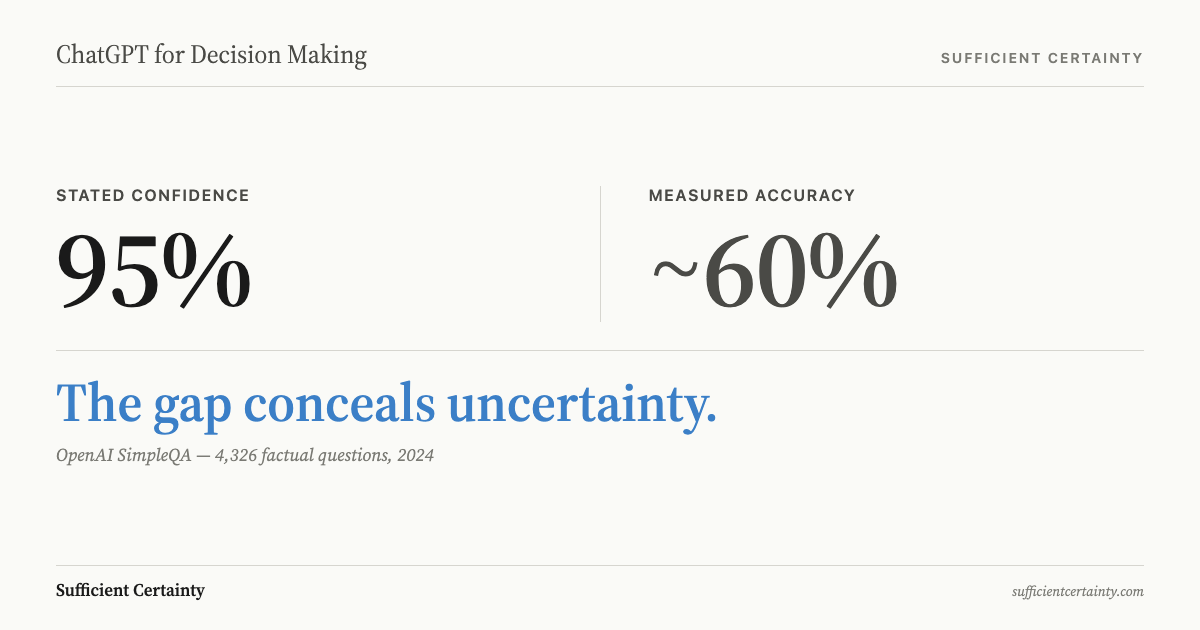
OpenAI released a factuality benchmark in late 2024 called SimpleQA, built from 4,326 short factual questions. The results exposed something the marketing materials do not advertise: when ChatGPT states 95 per cent confidence in an answer, its actual accuracy is closer to 60 per cent. Every model they tested showed the same calibration gap.
The system does not flag uncertainty; it delivers a wrong answer with the same structured, authoritative tone it uses for a correct one. That is the mechanism by which a general-purpose chatbot flattens genuine uncertainty into something that feels like clarity but is not.
I sat across from a divisional VP last year who showed me a ChatGPT transcript on his phone. He had pasted in a restructuring question and received four numbered options with a confident recommendation; he was planning to present it to his board that afternoon. I asked what assumptions the recommended option rested on. He looked at me as if I had asked him the colour of the wind.
ChatGPT followed the same promotion curve every AI decision maker follows, except faster and with better production values: a genuine capability for processing text was repackaged as a capability for making decisions, and the people who should be deciding stopped doing the work that only they can do.
ChatGPT for decision making is the use of a general-purpose conversational AI to inform a human decision by structuring options and identifying gaps in what the decider currently knows.
Why ChatGPT Sounds More Certain Than It Is
A 2025 study published in Manufacturing & Service Operations Management put ChatGPT through eighteen cognitive bias tests commonly used in behavioural economics research. In nine of the eighteen tests, ChatGPT exhibited the same biases humans display, with overconfidence and ambiguity aversion among the strongest.
The newer model was more analytically accurate than earlier versions on probability calculations, but on tasks requiring subjective judgement it sometimes displayed stronger biases than the older one. I have seen executives treat ChatGPT output as a neutral second opinion precisely because they assume a machine carries no biases; the data says otherwise.
The person who pastes a restructuring question or a market-entry choice into ChatGPT is usually seeking a second opinion, something free of the biases they suspect in their own thinking. The INFORMS data shows that the second opinion carries many of the same blind spots.
The fresh perspective people seek does not exist; a system trained on human text carries human blind spots. That is the false objectivity people are paying for with their attention.
The SimpleQA data adds a second problem. Even on topics where it has no bias, ChatGPT does not say "I do not know"; it states the answer with the same certainty whether right or wrong. For a factual question, overconfidence is a nuisance you can verify. For a decision with real consequences (where the whole point is to locate the gap between what you know and what you need to know), systematic overconfidence is the mechanism by which AI produces wrong business decisions: it conceals uncertainty rather than exposing it.
Write down the assumption your preferred option depends on most, then ask ChatGPT what would make it fail before you commit. Start the Walk →
What Happens When You Ask ChatGPT for a Decision
A 2024 study in Scientific Reports tested whether ChatGPT's advice shifts people's actual decisions. Across two studies involving 1,925 participants, the results were clear: ChatGPT's recommendations influenced decisions across practical and financial domains with an effect size comparable to expert advice. The influence occurred regardless of whether participants reported trusting AI. That is what influence without consent looks like.
The finding that matters most is about who is most susceptible. Participants with higher "personal fear of invalidity" (those with less confidence in their own judgement) were the most influenced by ChatGPT's output. That is precisely the population most likely to open ChatGPT with a decision in mind.
The people who turn to a tool when they feel uncertain are the people least likely to override it. The tool is most persuasive to the person least equipped to argue with it.
OpenAI's own research confirms the shape of the problem. A September 2025 analysis of over one million ChatGPT conversations found that nearly half of all usage falls into a category the researchers labelled "asking." Most of what people call using AI to make decisions is asking a question before defining the decision; they arrive at an answer without having established what question they are answering.
Roger Estall and I spent twenty years asking this about an earlier set of tools, and we put it in Deciding because nobody wanted to hear it: if the tool is the answer, what was your decision?
Using ChatGPT to Test Assumptions
A useful and a dangerous use of ChatGPT for decision making differ on one question: are you using the tool to examine your own thinking, or are you using it to avoid thinking?
Start by defining the decision before opening ChatGPT. State it in one sentence: what commitment are you being asked to make, and who is accountable for the outcome? This is the first step in the Universal Decision-Making Method, and it is the step that most ChatGPT usage skips entirely.
If you cannot state the decision in a sentence, you are not ready to ask ChatGPT anything. Go back to the people involved and settle what is actually being decided.
Once the decision is framed, use ChatGPT to stress-test your options. Give it your tentative preferred option and ask it to identify the most important assumptions that option rests on, then ask under what conditions each assumption would fail. I use ChatGPT this way myself; it can process the permutations faster than any person and it has no emotional stake in the outcome. It will surface assumptions you would have missed, and some of them will matter.
Cassie Kozyrkov, formerly Google's Chief Decision Scientist, makes a version of this argument in her decision-making course: the biggest trap is letting AI-assisted become lazy thinking. She is right, but prompt discipline is not sufficient when the tool itself is designed to deliver answers rather than expose assumptions.
What you must never do is paste a situation into ChatGPT and ask "What should I do?" That prompt invites the tool to skip both framing and assumption-testing, delivering a recommendation built on whatever unstated assumptions its training data happens to favour.
The output will sound thorough; it will have headings and bullet points and a confident concluding paragraph. It will be AI-assisted decision making in name only, because the human has not done the work that "assisted" requires. That is decoration, not assistance.
The Question Before the Prompt
ChatGPT processes language at a scale and speed no person can match, and for certain tasks within a decision process that capability is valuable: identifying assumptions and generating alternative framings the decider might not have considered.
The tool fails when it is asked to do the one thing no tool can decide for you: what level of certainty is sufficient for your specific situation. That judgement depends on what you can afford to get wrong and what you would need to know before committing. No model trained on other people's text can calculate it.
The broader question of AI and decision making runs through every tool on the market, not only ChatGPT. The pattern is always the same: a tool with genuine analytical capability gets promoted into the role of decider, and the quality of the decision drops because nobody is doing the thinking the tool cannot do.
I use these tools myself. What I never do is let them tell me what the decision is, because they cannot tell me what would make me change my mind. The fix is not a better prompt. It is to define the decision before you open the tool and use it to test your assumptions rather than to receive an answer.
You could present a ChatGPT recommendation to your board without knowing what it assumed.
Work through your decisionNo sign-up. Just pick your decision and start.
Grant Purdy is the co-author, with Roger Estall, of Deciding (2020), and the architect of the Universal Decision-Making Method.