
Confirmation bias in decision making turns a first answer into protected property. The room stops weighing evidence and starts collecting support for the conclusion it has already chosen. Awareness does not fix it. A process that forces the preferred answer to state what would kill it is the only reliable countermeasure.
In 2010, Theranos was courting Walgreens and promising a portable analyser that could run blood tests from a finger prick. Its board was stocked with famous names. Inside the company, scientists were rerunning samples and watching failed results disappear from the story. Confirmation bias in decision making had already picked its winner.
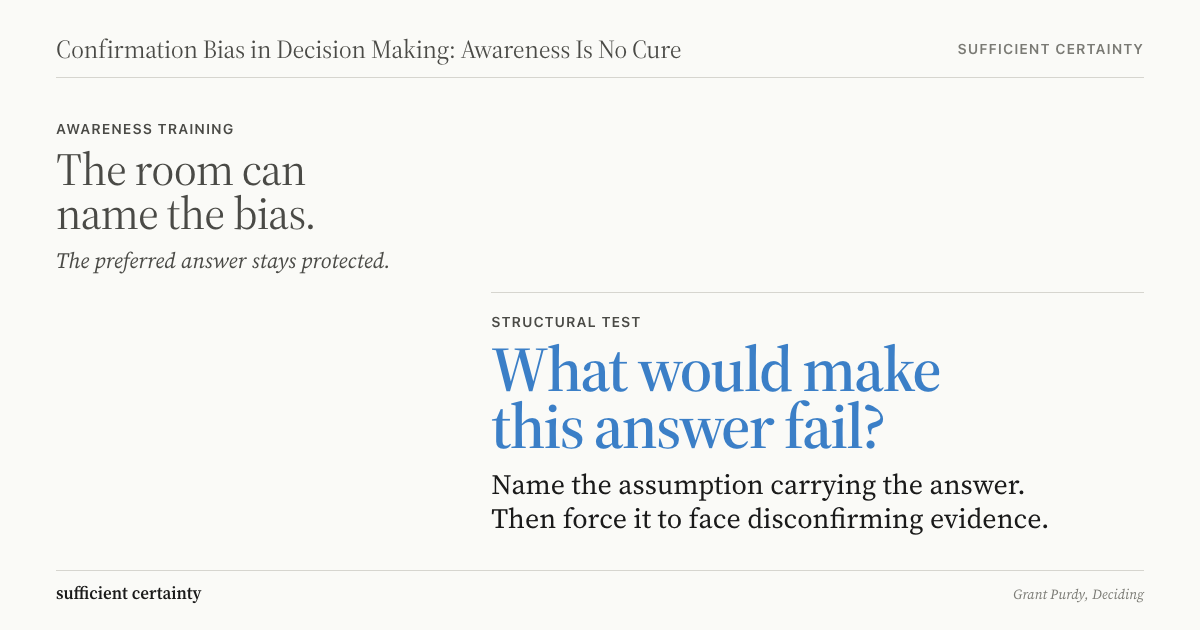
People talk about this bias as if the cure were self-awareness. I have listened to that sermon for years and it is cheap. Once a room has chosen its answer, facts stop being evidence and start working for the answer. Roger Estall and I wrote Deciding because I do not care whether a committee can define the bias. I care whether its process can wound the favoured answer before cash or credibility is tied to it.
In the longer piece on cognitive biases in decision making I deal with the wider pattern, but here the point is narrower: confirmation bias in decision making turns a first answer into protected property. In the Universal Decision-Making Method, Step 3, Recognise assumptions, drags that answer into daylight; Step 4, Sufficient certainty, asks the question sponsors and chairs usually hate: what would have to happen before we kill it?
Confirmation bias in decision making is the tendency to favour evidence that supports an early conclusion and to discount evidence that would unsettle it.
Why confirmation bias in decision making survives smart people
Smart people are not immune. Expertise often makes the bias harder to catch because expertise gives people better language for keeping a shaky answer alive. A board paper arrives with a recommendation and a polished tone that makes challenge feel late. The room mistakes polish for proof.
Awareness programs have done very well for the people selling awareness programs, naturally. In a confirmation-bias meeting, a tidy objection gets aired and the paper stays intact. The chair gets to look open-minded, which is helpful if appearances are the whole game. That is why pages on types of cognitive bias are only the first inch of the job. Staged dissent after the recommendation is already under guard does not count as challenge. That is what confirmation bias in decision making looks like in a respectable committee.
I have seen the same thing in ordinary capital decisions. A sponsor wants a plant expansion, so the paper is built around demand forecasts that favour it. Rival evidence arrives, but by then the meeting has already chosen its default verdict. Facts that help are called prudent; facts that hurt are called premature.
Take the answer you already favour through the five steps and force the disconfirming assumption onto the page. Start the Walk →
What confirmation bias in decision making looked like at Theranos
The SEC's Theranos action said Holmes and Balwani raised more than $700 million while telling investors the company's device could run a wide range of tests from finger drops of blood, even though it could do only a small number and most patient work was being done on modified commercial analysers. The Justice Department case adds something useful: the same fiction was strong enough to support fraud allegations tied to both investors and patients. Bad evidence existed inside the system. It was simply denied voting rights.
People often tell this story as one charismatic founder fooling gullible investors. That is true as far as it goes, and still too kind. Directors treated prestige as verification, and commercial partners wanted the story badly enough that challenge started to look disloyal. Once a room wants the narrative, disconfirming evidence gets treated like a nuisance employee. Sometimes that evidence arrives as a feeling, and the room calls it emotional decision making instead of recognising the assumption it carries.
I have seen smaller versions of that arrangement many times. The scandal is less glamorous, but the mechanics are identical. A preferred project arrives with borrowed authority, and once later facts are judged by whether they help it survive, analysis has already been replaced by protection work.
Iraq and Polaroid wore different uniforms
The U.S. Senate report on the Iraq intelligence assessment shows what happens when a formal process cleans up a favoured answer and sends it upstairs in respectable prose. Thin sourcing and accepted premises hardened into high-confidence claims about weapons that were not found. By the time the paperwork looked complete, the conclusion had already been dressed for Cabinet and challenge was too late.
Polaroid is the corporate version. As Yale's review of Polaroid notes, 42 per cent of the company's research spending was already going to digital imaging by 1989, yet senior management kept reading that evidence through the assumption that customers would always want hard-copy prints. The evidence was in the lab. The assumption was in the executive suite. When the market moved, management acted surprised by facts it had effectively been paying to ignore.
Iraq and Polaroid wore different uniforms, but the move was the same: the answer was chosen early, and the machinery was hired to defend it. Consultants and anyone paid to keep the paperwork moving do better when the paperwork decorates the favourite conclusion instead of threatening it. That arrangement is tidy for careers, and ruinous for decisions.
How confirmation bias in decision making gets broken
I do not ask people whether they think they are biased. That flatters the room and changes nothing. I ask them to write the sentence carrying the favoured answer. We are assuming this technology works at scale. We are assuming this source is reliable. This is where confirmation bias in decision making stops being a textbook phrase and starts costing real money. Once the sentence is visible, people can attack the sentence instead of performing loyalty dramas around the sponsor.
Then I ask the question this bias hates: what fact would force us to bury this recommendation? That is the move most advice on overcoming cognitive biases keeps oddly polite. Good intentions do not help. The room has to name the thing that would kill the answer while there is still time to kill it.
If the favourite answer survives that beating, the next dodge appears quickly. People start behaving as though the remaining uncertainty has evaporated. That is where overconfidence strolls in looking respectable. Step 4 matters because a recommendation can survive challenge and still claim more certainty than the evidence can carry.
A chair once introduced me as "Grant Purdy, the man who asks what would make us bin the recommendation." Fair enough. I want the favourite answer to survive a beating before it gets a budget or a board minute. If it cannot survive that, the machinery is there to bless a verdict you already bought, not to help you decide.
You could nod at the evidence and still protect the answer you chose first.
Work through your decisionNo sign-up. Just pick your decision and start.
Grant Purdy is the co-author, with Roger Estall, of Deciding (2020), and the architect of the Universal Decision-Making Method.