
AI decision making examples fill vendor slide decks by the thousand, and nearly all of them are calculations. Fraud scoring and dynamic pricing are useful, certainly, but they involve no uncertainty and no consequences that a formula cannot resolve. Those are not decisions. They are arithmetic with better marketing.
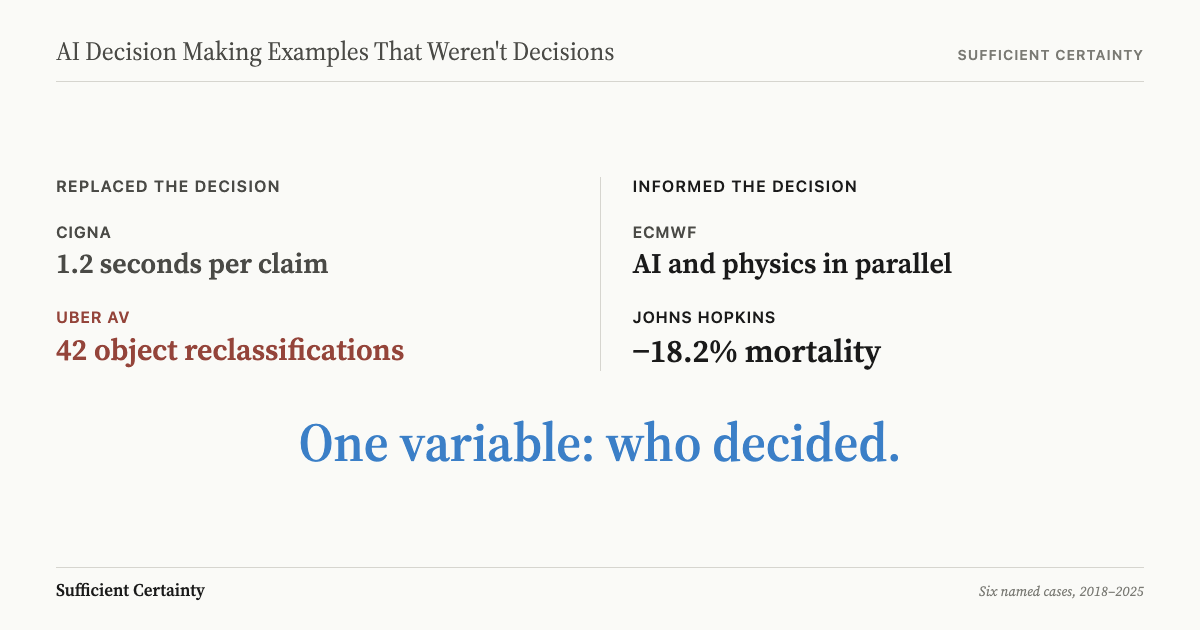
These six AI decision making examples divide on a single variable: whether the human retained the conditions to decide, or the system's output became the decision by default. In three, the AI informed a judgement. In three, it replaced one. The technology in both groups was comparable; the outcomes were not.
AI decision making examples are real cases in which AI played a material role in a consequential human choice, whether by informing the decider or replacing their judgement entirely.
Three AI Decision Making Failures
1. Uber — 42 Reclassifications, Zero Escalation
On 18 March 2018, an Uber autonomous test vehicle struck and killed Elaine Herzberg in Tempe, Arizona, at 39 miles per hour. The NTSB investigation found that the vehicle's perception system had detected her six seconds before impact but could not settle on what it was seeing: it cycled through 42 object reclassifications in those six seconds, switching between vehicle, bicycle, and unknown object, resetting its predicted path with each cycle.
The system had no mechanism to flag its own uncertainty. It could not escalate to a human with the message "I do not know what this is." Uber had disabled the Volvo's factory emergency braking to avoid what it termed "erratic vehicle behaviour," and the safety driver was watching a video on her phone.
That is what happens when a calculation is promoted to a decision. The system could classify objects at speed; it could not decide what to do about an object it could not classify, and nobody was positioned to make that call. The arrangement suited Uber's development timeline; it did not suit Elaine Herzberg.
2. Lavender — 37,000 Targets, Twenty Seconds Each
The same failure appeared at industrial scale during the Gaza operations of 2023 and 2024. The Israeli military deployed AI systems codenamed Lavender and Gospel to generate bombing targets, compiling a database of approximately 37,000 suspected militants. Officers reportedly spent approximately twenty seconds reviewing each AI-generated target before authorising strikes; sources within the military described the human review as a "rubber stamp."
The system was designed to handle a volume that would take human analysts weeks to process. In achieving that processing speed, it eliminated the conditions under which genuine judgement could operate. A twenty-second review of a targeting decision is not a review. It is a signature on someone else's work.
3. Cigna PxDx — 300,000 Denials, 1.2 Seconds Per Review
Cigna's PxDx algorithm completed the pattern in health insurance. The system matched diagnosis codes against procedure codes and denied claims automatically, without individual physician assessment. A former Cigna medical director testified that he reviewed claims in batches (a generous description of what he was doing), spending an average of 1.2 seconds per case.
Over a two-month period in 2022, the system denied more than 300,000 claims. The denial was the algorithm's output; the physician's "review" consisted of mass-clicking approval on recommendations he had no time or context to evaluate. The arrangement suited Cigna's quarterly numbers and the compliance department that could point to "physician review" in its filings; it did not suit the patients whose claims were denied without examination.
In all three cases, the organisation maintained that a human remained "in the loop." In all three, the loop was theatrical: the AI's output was the decision, and the human provided a procedural layer that satisfied compliance requirements without contributing to the quality of the judgement.
I recognise the pattern from governance reviews across my career: the organisations were not negligent in the conventional sense; they had followed the accepted practice of placing a human reviewer between the system and the consequence. That is what "human in the loop" has come to mean in these systems: a person with a title and a timestamp, but no capacity to think.
Name the AI recommendation your team is about to accept as the decision, and ask whether anyone retained the authority to override it. Start the Walk →
Three AI Decision Making Successes
4. Johns Hopkins TREWS — 18.2% Mortality Reduction
Johns Hopkins developed TREWS, the Targeted Real-Time Early Warning System, to flag patients showing early signs of sepsis. The system alerts clinicians but does not initiate treatment; the physician evaluates the alert against the patient's full clinical picture and decides whether to act.
In a study of more than 590,000 patients across five hospitals, patients whose clinicians confirmed TREWS alerts within three hours showed an 18.2% relative reduction in in-hospital mortality. The system has since received FDA authorisation, and the critical design choice that earned it was simple: TREWS does not treat patients; it asks doctors to look.
5. UC San Diego COMPOSER — 17% Mortality Reduction
UC San Diego's COMPOSER system, which provides sepsis risk scores to emergency department clinicians, produced a comparable result through independent research: a 17% reduction in sepsis-related mortality and a 1.9-hour reduction in time to antibiotics. The improvement came not because the AI made treatment decisions but because clinicians received relevant information faster. They retained full authority to override or ignore alerts based on each patient's history, current presentation, and clinical factors that no dataset captures. That is AI-assisted decision making in the literal sense: the AI assists, and the clinician decides.
6. ECMWF — AI and Physics in Parallel
The European Centre for Medium-Range Weather Forecasts took its AI Forecasting System into operations in February 2025, running it alongside the traditional physics-based Integrated Forecasting System rather than replacing it. The AI improved tropical cyclone track predictions by up to 20%; during Hurricane Francine in September 2024, it projected Louisiana landfall ten days before conventional models reached the same conclusion.
The institution's machine learning coordinator stated the position directly: "We're not looking at turning off the physical system." Running both systems in parallel means the meteorologist can check one against the other and apply their own judgement about which model's strengths suit the current conditions.
In each of these three AI decision making examples, the designers made the same structural choice I advocated in board presentations and risk reviews for decades: the AI's output enters the human's workflow as information, not as an instruction (which should not be remarkable, but evidently is). That is competent design; the fact that it is treated as innovation tells you how low the standard has fallen.
The Variable in These AI Decision Making Examples
The three failures and three successes span unrelated industries under different regulatory regimes. The algorithms were built by different teams for different purposes. Nevertheless, the outcomes divided on a single variable: whether the human retained the decision or whether the system's output became the decision by default. In every decision-making system I have assessed, neither the sophistication of the tool nor the scale of the investment has determined the result.
In the book I wrote with Roger Estall, Deciding, we stated a principle that predates the current generation of AI but explains every case above: "Deciders must be wary of treating calculations or mathematical models intended to assist with making decisions as if the results are the decision." I sat in risk committee meetings where this principle was stated as policy and violated as practice in the same quarter; the technology delivering the calculation changes, but the temptation to treat its output as the answer never fades. TREWS embodies the principle in its architecture.
Uber's self-driving system, Lavender, and Cigna's PxDx represent the inverse. Each treated the model's output as the decision while maintaining the appearance of human oversight (an appearance that protected the organisation, not the people affected). I saw the same pattern in risk management long before anyone was talking about artificial intelligence, and the ethical consequences compound with each iteration.
The Universal Decision-Making Method requires a thinking approach rather than a procedural one. That requirement becomes more urgent, not less, when the procedure is automated. A system that can generate 37,000 targeting recommendations or deny 300,000 insurance claims in weeks produces a volume of output that overwhelms any procedural review process. The only structural defence is to design the system so the human decides, not so the human approves what the system has already decided.
What AI Cannot Calculate
The vendor literature on AI decision making treats decisions as a data-processing problem: collect more data, build a better model, and the right answer emerges. This framing is accurate for calculations; it is catastrophically wrong for decisions. That is the category error: treating speed of output as quality of decision.
A decision involves uncertainty that processing speed cannot eliminate and consequences that will be borne by specific people who must weigh competing values. No algorithm resolves this, because the resolution requires a person who understands what is at stake to determine how much certainty is sufficient to act. That threshold is personal, which is precisely why no AI can make the decision for you: what counts as sufficient certainty for one decider will not be sufficient for another, because they are weighing consequences that differ in kind, not merely in quantity.
The three partner cases succeeded because their designers understood this distinction. In each case, the AI handled the calculation and the human handled the decision. I traced what happens when organisations adopt AI for business decisions without understanding this distinction, and the pattern in those failures is identical to what Uber, Lavender, and Cigna demonstrate here.
If your organisation is evaluating how to use AI in its decisions, these six cases provide the question that matters. It is not "how accurate is the algorithm?" or "which vendor has the best platform?" The question is whether the person who owns the outcome retains the conditions to think about the decision, or whether the system's speed and volume will make thinking impossible. Three steps for using AI to make decisions without crossing that line start with surfacing the assumptions the AI cannot test.
I have put that question to boards and executives across industries; the ones who take it seriously produce systems that work. Every credible AI decision making example I have examined lands on one side or the other of that line.
You could deploy the next AI system and still leave the decision it replaces unexamined.
Work through your decisionNo sign-up. Just pick your decision and start.
Grant Purdy is the co-author, with Roger Estall, of Deciding (2020), and the architect of the Universal Decision-Making Method.