
Most Porter's Five Forces examples stop at the finished grid and call it analysis. A useful example tests what each rating assumes, names the evidence that would change the rating, and shows the team where the grid is concealing a bet rather than describing a fact.
In February 2022, Peloton Interactive cancelled a $400 million manufacturing facility in Ohio before it opened, laid off 2,800 employees, and booked $611 million in restructuring charges. The stock, which had peaked at $167.42 in January 2021, fell 97 per cent to an all-time low of $2.70 by May 2024. CEO John Foley was replaced; his successor, Barry McCarthy, also resigned after failing to reverse the decline. What makes this collapse useful as a porter's five forces example is that the analysis preceding it was not wrong on any individual force.
Eighteen months before the collapse, a porter's five forces example built on Peloton would have rated every force in the company's favour. High entry barriers, low buyer power, no meaningful substitute threat: the business looked structurally unassailable. The analysis would have been correct on the day it was written, and it would have told the board nothing useful about what was about to happen.
A porter's five forces example is a worked case that rates a company's competitive forces to judge whether its industry structure favours profitability.
A porter's five forces example with five favourable ratings
The analysis behind Peloton was not carelessly done. Each force had real evidence behind it, and the picture it produced was exactly the kind of clean, supportable competitive reading that gives a board confidence to commit capital. The strategy team had a deliverable. The board had cover. The shareholders had a snapshot that would expire within a quarter.
The hardware lock-in was the centrepiece of the position. Customers paid between $1,500 and $2,500 for a connected bike or treadmill that worked only with Peloton's subscription content, and that investment created switching costs that simultaneously raised barriers to entry and suppressed buyer power. No competitor had assembled both the hardware platform and the live content library needed to challenge that position.
On the supply side, Peloton used standard components and commodity manufacturing, giving suppliers no pricing power, and had just acquired commercial fitness maker Precor for $420 million to bring more capacity in-house. The substitute threat was rated weak because gyms required commuting and commodity home equipment lacked the content integration that justified the premium price.
Connected fitness subscriptions reached nearly three million at their peak, and no incumbent gym chain had responded with a comparable digital offering. Revenue had hit $4.02 billion in fiscal 2021, growing 120 per cent year on year, and the company's 10-K filing supported every force rating the framework could produce.
I have reviewed dozens of competitive analyses built on exactly this structure, where every box was green and every rating was backed by evidence, but no line anywhere named the condition that would have to hold for the picture to remain true. Peloton committed over $800 million in capital on the strength of five ratings that were each supportable on the day they were written and each dependent on conditions nobody had agreed to watch.
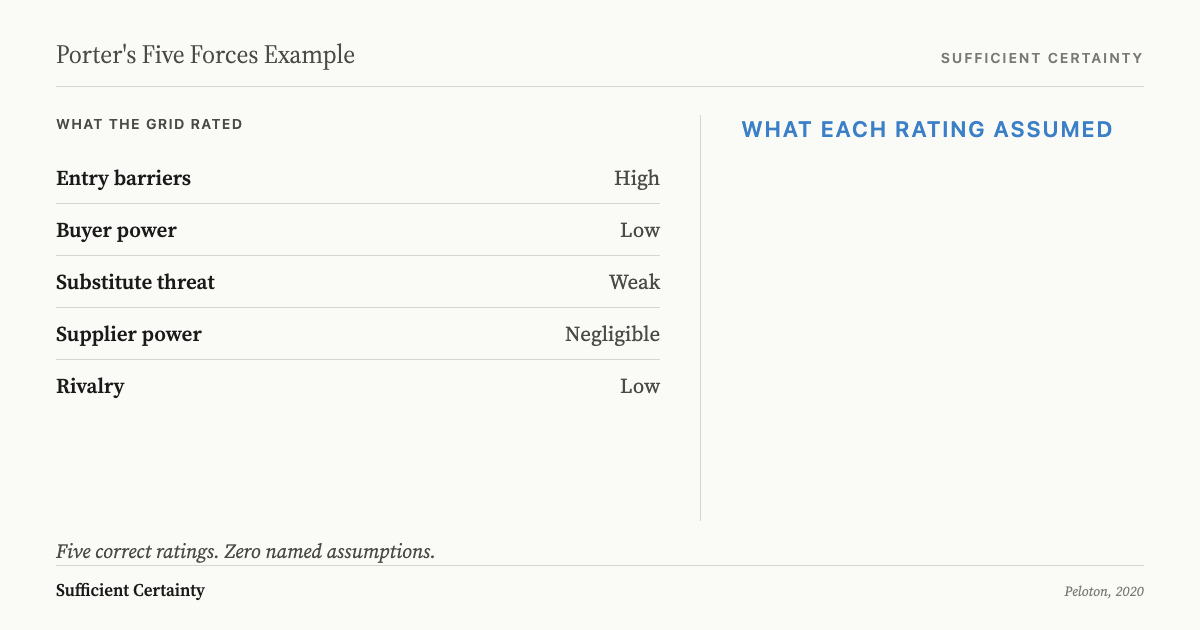
What each favourable rating was hiding
"Low buyer power" assumed that a customer who had paid $2,500 for hardware would not walk away from it when gyms reopened. "Low rivalry" assumed that Apple, Amazon, and Lululemon would not enter connected fitness at scale. Both assumptions turned on the same underlying condition: that pandemic-era demand patterns were structural and permanent rather than a temporary artefact of lockdowns.
"Weak substitutes" assumed gyms would remain unattractive indefinitely. "Negligible supplier power" assumed the new manufacturing capacity, hundreds of millions of dollars of it, would be absorbed by continued demand growth. The moment lockdowns ended, the substitute assumption and the buyer assumption failed together because they were never independent conditions; they were the same pandemic bet expressed in different boxes on the grid.
Tony Grundy identified this structural gap in a 2006 paper in Strategic Change, noting that Porter's model had become "largely an academic business school model" precisely because it treats forces as independent when in practice they interact and cascade. A framework that requires five separate answers discourages the one question that matters: are these answers independent? Consulting firms have never found that limitation commercially inconvenient.
Peloton's subscribers and gym competitors were close-in actors who could change behaviour deliberately. The pandemic ending was something else entirely: a wider shift in conditions that reset the terms everybody was operating under. The five-box grid placed both on the same plane, which is why the grid looked clean until a single contextual shift moved every rating at once. I keep returning to this distinction because the framework's neatest trick is making five correlated bets look like five independent findings.
Every rating in this porter's five forces example had been individually supportable; the entry barriers and the switching costs were both real. What was not real was the independence between them that the five-box layout implied. Once the assumptions behind each rating were separated from the grid, the strategic picture reduced to two questions: is the demand structural or pandemic-driven, and if it is pandemic-driven, how much of the capital commitment is recoverable when it reverses?
Porter's Five Forces was never designed to detect correlations between forces, and Peloton paid the price of that structural gap in a billion-dollar write-down.
Rewrite each force rating in your analysis as a dated claim and assign someone to watch the condition it depends on. Start the Walk →
The porter's five forces example that has been correct for forty-five years
If Peloton shows what happens when a Five Forces analysis is wrong about the future, the airline industry shows what happens when one is right indefinitely and still produces nothing actionable. I have watched this particular diagnosis reproduced in strategy decks for thirty years, and every version reaches the same conclusion.
Airlines are the canonical Five Forces textbook case. Rivalry is intense, suppliers hold genuine pricing power through the Boeing-Airbus duopoly and fuel dependence, and buyers are price-sensitive travellers with minimal switching costs. Every business school slide deck that works through the framework reaches the same conclusion: structurally unattractive industry.
The diagnosis is correct. IATA's 2024 outlook shows the industry's return on invested capital at 5.7 per cent against a weighted average cost of capital above 9 per cent, with an average annual shortfall of $11.7 billion between actual returns and what investors required. Net profit margin sits at roughly 3.6 per cent: a buffer of about $7 per passenger between profit and loss. The industry lost $186.6 billion between 2020 and 2022 alone, and more than a hundred airlines have launched globally since Porter published the framework in 1979. The diagnosis has been commercially successful for forty-five years. Airline margins have not.
Two McKinsey partners, Kevin Coyne and Somu Subramaniam, identified the structural reason for this futility as early as 1996 in McKinsey Quarterly. They named three assumptions the framework depends on but never states: that competitors and suppliers act independently, that structural advantage is the primary source of value, and that uncertainty is low enough for the snapshot to remain valid. The third is the most damaging for practitioners, because it implies the competitive picture captured this quarter will still hold when the capital committed on its basis is actually deployed.
The analysis has been correct for forty-five years and has not told a single airline what specific bet to make or avoid. I have seen five forces industry analysis of airlines done well and done badly, and the correct version and the careless version both end at the same point: a verdict with no instructions. Southwest Airlines built a profitable position inside the same "structurally unattractive" industry by identifying which specific assumptions about cost structure and route density it could act against. The five forces model rates the industry as unattractive and stops; an assumption-based reading of the same data identifies which structural condition was being bet against and what evidence would signal that the bet was failing.
Both Peloton and airlines end the same way: a completed analysis with no name on the bet.
What makes a porter's five forces example decision-ready
The distance between a textbook example and a useful one is a single translation step. Each force rating needs to be rewritten as a dated claim with a falsification condition and somebody assigned to watch it.
"Low buyer power" is a rating that nobody can argue with or test. "We assume that customers who have invested $2,500 in hardware will not switch to alternatives when gyms reopen within the next twelve months" is a claim with a falsification condition attached. The Peloton board had no mechanism to revisit this assumption because it was never stated in those terms, and the evidence of accelerating churn accumulated for months before anyone treated it as a strategic signal. Quarterly variance is a label that lets management postpone the conversation for another ninety days.
For the airline analyst, the same translation produces a different but equally useful result. Instead of concluding that the industry is unattractive and stopping, I would write the assumption being bet against in explicit terms: that fuel costs will remain below a particular share of operating revenue over the planning horizon, or that a hub-and-spoke network will maintain its yield premium over point-to-point competitors on the routes being committed to. Those are conditions that can be monitored; a generic five forces diagnosis cannot.
The same translation works when the subject is a competitor rather than a force. For the structured move from competitor profiles to testable claims, read what to do after a competitor analysis.
The two steps Peloton's board skipped were the ones that would have made the difference: naming what each rating was assuming, and designing monitoring that would detect the moment those assumptions failed. Without those two steps, the grid is a snapshot with no expiry date printed on it. They are the third and fifth steps in the Universal Decision-Making Method, and they are precisely the steps that a Five Forces grid neither requires nor accommodates, because the framework stops at diagnosis and the method picks up where diagnosis leaves off.
Roger Estall and I wrote Deciding in part because we had seen this pattern across industries over decades. The organisations that came to grief were rarely short of analysis. What they lacked was somebody who had stated what the analysis was assuming and agreed to watch for the moment those conditions shifted.
A porter's five forces example that includes that step tells the reader what to watch and who is watching it. Without it, the grid records what the world looked like on one particular day.
You could rate all five forces and still commit capital on assumptions nobody agreed to watch.
Work through your decisionNo sign-up. Just pick your decision and start.
Grant Purdy is the co-author, with Roger Estall, of Deciding (2020), and the architect of the Universal Decision-Making Method.