
Biases and heuristics are not opposites. One is a shortcut; the other is the damage the shortcut does when nobody checks the assumption it carried in. A good heuristic earns its keep. A bad one earns political protection and starts wearing borrowed authority the room is too polite to question.
I have sat with executives facing a plant closure. The board pack ran to 74 pages, the savings estimate on page six had already become holy writ, and the meeting was ten days away. Later, people call this a case of biases and heuristics. On the day, it was simply a room borrowing confidence from a number nobody wanted to reopen.
Heuristics do real work. Nobody has time to inspect every fact from first principles before lunch. Trouble starts when the shortcut stops being a working guess and starts wearing borrowed authority.
Biases and heuristics are related parts of judgment: heuristics are mental shortcuts, while biases are the recurring errors that appear when the wrong cues get too much weight.
Biases and heuristics are compressed bets
Heuristics are compressed bets about which cues matter. In their review of heuristic decision making, Gerd Gigerenzer and Wolfgang Gaissmaier pulled together cases where a simple rule beat a heavier model. At an apparel retailer, the hiatus heuristic predicted returning customers at 83 percent, while the more elaborate Pareto/NBD model reached 75 percent. A shortcut that earns better results has earned the right to stay.
The same review shows where the rot begins. In two London courts, fast-and-frugal bail heuristics predicted 92 percent and 85 percent of decisions largely by echoing cues from prosecutors and police. The courts saved time by borrowing somebody else's judgement. In my experience, that is how shortcuts go bad. They win one round, get promoted to authority, and soon nobody can remember why that cue was trusted in the first place. And because the shortcut has a track record, questioning it looks like dissent rather than diligence. The heuristic has earned political protection.
I have seen the same thing with prettier stationery. A board receives a traffic-light risk report before anyone has properly framed the decision, and the colours start doing the thinking. Red must be serious. Green must be safe. Nobody asks what assumptions turned a live judgement into three little boxes. The shortcut is no longer just mental, it has been given institutional costume.
Take the shortcut guiding your decision into the five steps and find the hidden assumption doing the real work. Start the Walk →
Knowing about biases and heuristics does not stop them
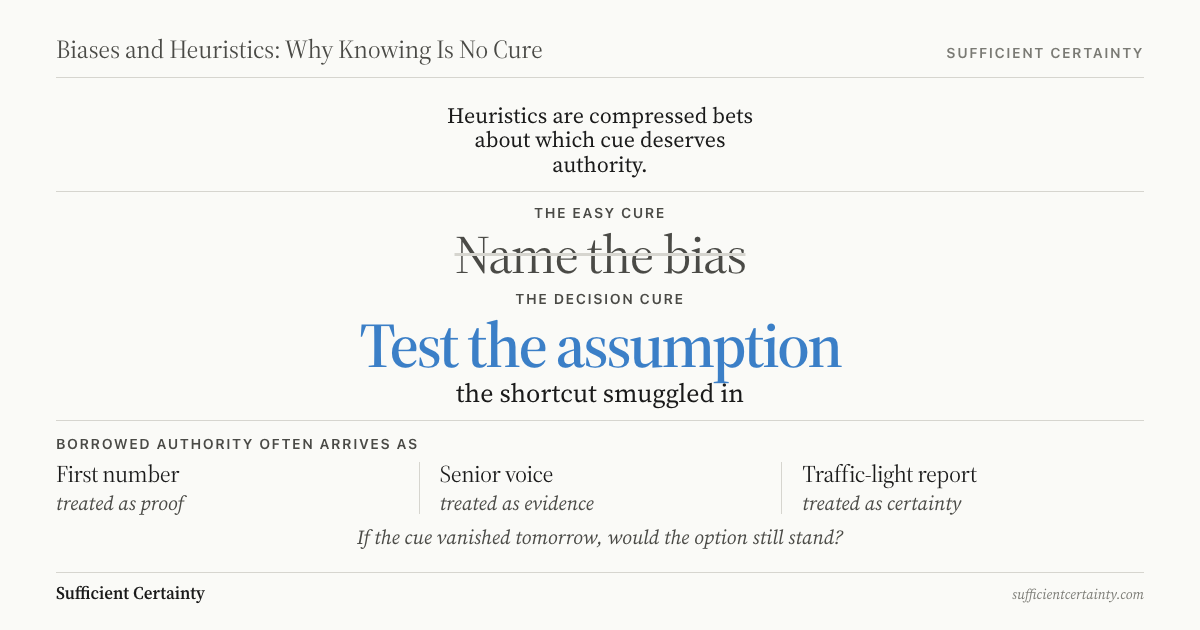
Awareness rarely interrupts a judgement already taking shape. In Scopelliti and colleagues' work on the bias blind spot, the tendency to see bias in others more readily than in yourself was independent of intelligence and general decision-making competence. People higher in that blind spot were also more likely to ignore useful advice. In the study's training test, once blind-spot scores rose past 2.55, the intervention stopped helping. The clever person in the room is not protected by vocabulary.
Ariella Kristal and Laurie Santos make the broader point: awareness alone usually fails because some errors sit inside perception or emotion, while others slip through when attention breaks at exactly the wrong moment. That is why bias workshops flourish. They let an organisation look active without changing the decision machinery, and they suit the consultant who would quite like another invoice for teaching people names they will not use when the real pressure arrives. I make the same argument about behavioral decision science: the field earns its keep only when it changes who can challenge the call.
I ask what the shortcut assumed
When biases and heuristics start running the room, I do not ask for a glossary. I ask what the shortcut imported. Sometimes it imported rank. Sometimes it imported habit. If the first number is steering the meeting, that is anchoring bias. If the favoured explanation survives because a senior person said it first, the shortcut has imported deference and disguised it as evidence.
When Roger Estall and I wrote Deciding, we built the Universal Decision-Making Method around that interruption. Step 3, Recognise assumptions, forces the room to say why this cue deserves the authority it has. That is also the thread running through the broader picture of cognitive biases in decision making. Trouble starts when a rough rule turns into doctrine and nobody can explain why it is still running the show.
My first question is usually, "If this cue vanished tomorrow, would the option still stand?" My second is less polite, but often more useful: "Who gets a free ride if we keep treating it as fact?" In my experience, those two questions do more for judgement than an hour spent naming categories. What typically surfaces is not a textbook bias with a Latin name. It is a preference that walked into the room wearing borrowed data.
Slow the shortcut when the consequence is high
In high-consequence calls, biases and heuristics need a brake, not a seminar. In a JAMA study by Mamede and colleagues, a structured reflection step improved diagnostic accuracy after availability traps. I cover that mechanism in more detail in the piece on availability bias. The useful part here is simpler: people improved when the process forced a re-check.
I do not want managers dragging every ordinary choice through a ceremony. If the cost of error is small, use the shortcut and move on. Most decisions are small enough to survive a wrong guess, and slowing them down costs more than it saves. If the cost is a plant closure or a safety call that will trap other people in the consequence, slow down long enough to test the assumptions and reach Sufficient certainty. In my experience, five honest minutes here beats another fortnight of respectable report-writing.
That is the practical point most writing on this subject avoids. You do not need exhaustive proof before acting. You need evidence that is good enough for the consequence you are about to impose. Those are different standards. One helps a Decider decide. The other helps an organisation collect paperwork and call it discipline.
Rooms that can state the assumption and test it are still deciding. Rooms that prefer vocabulary and respectable shortcuts are usually laundering a preference that arrived earlier. The machinery survives because it looks diligent, and because it keeps the sponsor comfortable and the adviser billable.
You could trust the next tidy number and borrow confidence you never checked.
Work through your decisionNo sign-up. Just pick your decision and start.
Grant Purdy is the co-author, with Roger Estall, of Deciding (2020), and the architect of the Universal Decision-Making Method.